Donate Newsletters

Race, Ethnicity, and Commuting

Following up on a recent post on race and driving, here’s data from the American Community Survey on Northwest commuting patterns by race and ethnicity—showing that both Hispanics and Blacks are more likely than the Northwest’s white residents to seek an alternative to solo driving for their daily commute. (Just to be clear, I’m using the census term “Hispanic” interchangeably with the word “Latino,” the census term “Black” interchangeably with “African American,” and the census term “White alone” interchangeably with “white.”)
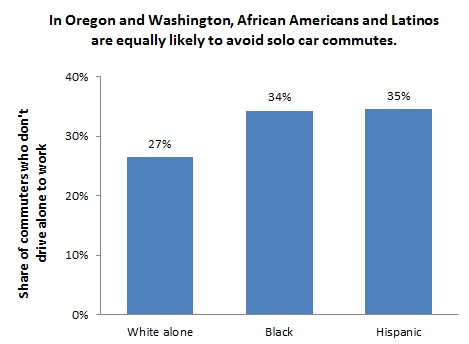
But despite the superficial similarities there are some major differences in Black and Hispanic commuting patterns.

Read more

Car Sharing Olympics Reconsidered

What a difference a few months make!

At the end of July, we gave Vancouver, BC the gold medal in our “Northwest Car Sharing Olympics.” Vancouver edged out Portland in our rankings, largely because Vancouver had three mature car sharing services with a variety of pricing and membership models. Portland also had three services; but its peer-to-peer car sharing service, Getaround, was just getting off the ground, with only about 70 cars available for short-term rental at the time we looked.

Fast forward just two and a half months, and Getaround’s car availability has nearly quintupled.  The service currently offers 328 cars in greater Portland, including both the city and the suburbs.

Who Farms?

In the Northwest, the average age of our farmers is 57 and climbing. And the chances are pretty overwhelming that a person running a farm will be white.

It’s certainly not that white people are the only ones who know how to farm. The region’s agricultural economy runs on Latino/Hispanic farmworkers who can weed a row in a matter of minutes, fix an irrigation system with whatever is handy, or nurse ailing tomato plants back to health. A diverse set of refugees from farming communities in eastern Africa or the highlands of Asia may never have seen a beet, but give them some seeds and a few months, and they’ll have sizeable ones.

There are a number of reasons why the region’s farms tend to be run by white people. For starters, those are the families who tend to own farmland, and it’s much easier to own a farm if you inherit one. Working in fields or orchards may teach you a lot about how to grow crops but not the business and marketing skills to turn a profit. Start-up farms require capital for everything from seeds to greenhouses to packing infrastructure, and people of color have not had equal access to credit that can grow a business. USDA programs designed to help farmers have not historically been geared towards reaching minorities. (And in some cases, federal farming programs have demonstrably discriminated against them.) All of that adds up to this crazy lopsided chart:

Read more

Six Tips for Selling Green Stormwater Solutions

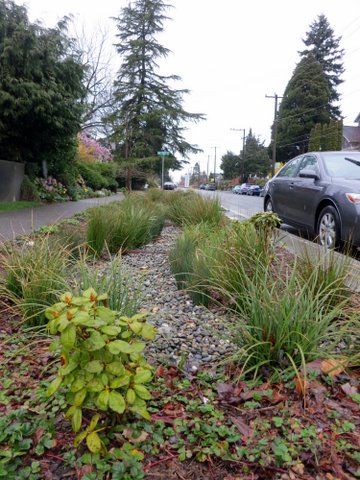
Seattle roadside rain garden

Congratulations! You’ve come up with a great idea for an affordable, attractive, environmentally sound solution for the polluted runoff that’s fouling Northwest rivers, lakes, and inland seas. But before you dig up that first shovel full of weedy grass to install your roadside rain garden, take heed: You must get the public (or in the case of a private development, your client) on board first!

Puget Sound area governments have been swimming against a small but vocal opposition to rain garden projects on public property that abuts private homes. The most effective way to resolve this backlash is through communication, education, transparency, and lots of dialogue well before a spade hits the soil.

Sightline recently convened a group of city and county representatives and some private individuals to talk about how best to earn support for rain gardens and other low-impact development projects built for treating polluted stormwater.

We distilled the conversation down to six tips for making the case for green stormwater solutions. Here they are:

Read more

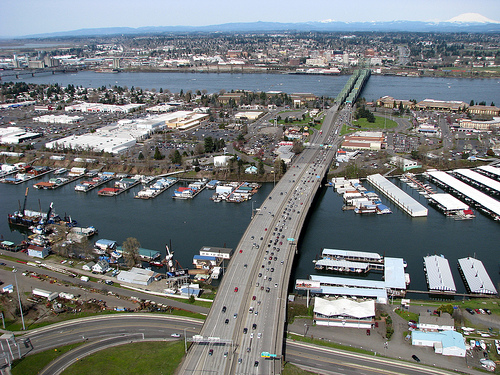
Columbia River Crossing: Cutting Ped/Bike Projects

And so it begins.

Faced with mounting costs and uncertain funding, the planners of the Columbia River Crossing are hoping to “save” money by postponing parts of the project. And unsurprisingly, biking and walking investments are among the first things on the chopping block. If you want the details, BikePortland has the goods.

Of course, it’s just a proposal at this point. But it’s a telling one. First, because of the doublespeak: as economist and CRC-watchdog Joe Cortright points out, the CRC planners claim that they’re simply delaying parts of the project by a few years, but they still want to count delayed spending as “savings.”  That’s having it both ways: either the project is cheaper because it’s smaller, or it’s the same size and just as costly. Pretending otherwise is gobbledygook.

But second, the CRC planners’ move may signal the trajectory for many of the highway megaprojects under construction in the Northwest.

Read more

Vehicle Efficiency Gains: Slower Than You Might Think

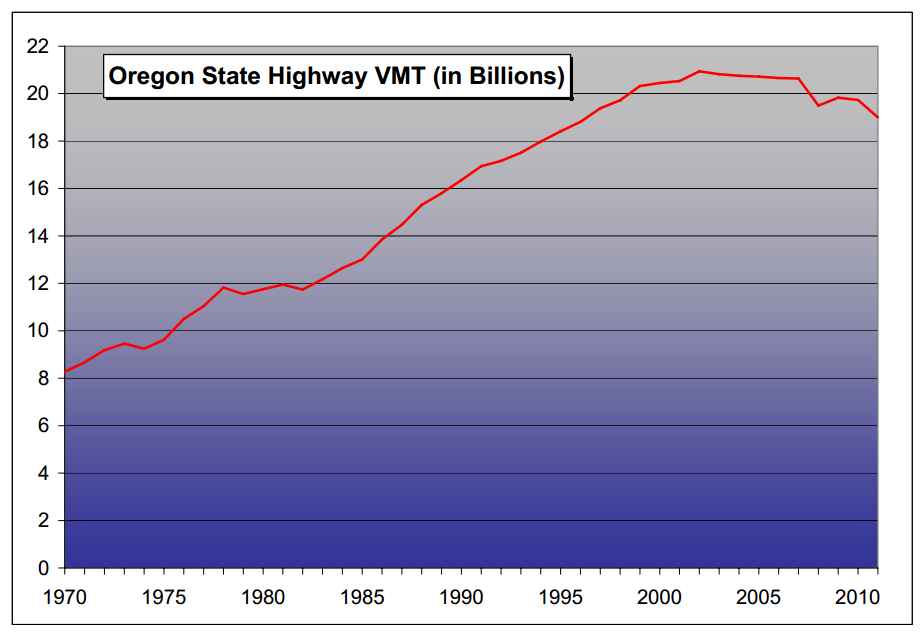
Our most recent report highlighted an encouraging trend: northwesterners are using less gasoline. In all, motor fuel consumption in Washington and Oregon declined by about 4.5 percent after cresting in 2002. With population growth, that translates into a 16 percent decline in per capita fuel consumption.

When many people hear this news, they immediately think of one thing: the Prius. Surely, the increased sales of hybrids, high-efficiency vehicles, and electric cars must be at the root of the decline in gas consumption over the past decade…right?

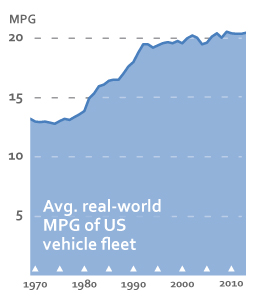
Unfortunately no. I, for one, certainly wish that sales of hybrids had yielded a significant boost in vehicle efficiency. Yet despite the rise of the hybrid car, real-world fuel efficiency has improved only a wee bit over the past two decades. 

Surprised? Here’s what’s going on.

Read more

Portland’s Ecodistricts Summit

Next month, the Portland Sustainability Institute will convene leaders from across the country to talk about achieving sustainability at the neighborhood level. There’s a seriously awesome lineup of speakers here. Ecodistricts are a unique, comprehensive model of looking at sustainability at the local level. They tie green building and infrastructure planning with individual action to … Read more

Gas Consumption Shifting Into Reverse?

Many Northwest drivers are preparing to top up their tanks for travel this Labor Day weekend—and will pay dearly for the privilege. But there’s new evidence that high fuel prices are curbing our appetite for gas.

We detail the evidence in our latest report: Shifting Into Reverse. According to state and federal data, total gasoline consumption in Oregon and Washington in 2011 was about 4 percent lower than it was in 2002—the year that overall motor fuel consumption in the two states peaked. And early data suggests that high prices in the first part of 2012 sent fuel consumption even lower this year.

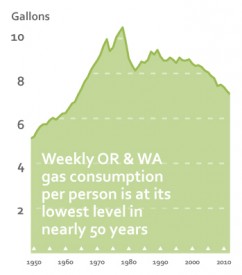
Meanwhile, the region’s population keeps growing—which means that fuel consumption per person keeps falling. In fact, per capita gasoline consumption is now at its lowest level in nearly 50 years.

The chart to the right shows the long-term trends. Gas consumption per capita skyrocketed during the post-war period, up until the oil crisis of 1979—a year when oil prices spiked. That was followed by years of volatility as the Northwest economy cratered and recovered, and federal fuel economy standards ushered rapid efficiency gains in the vehicle fleet. In the late 1980s, fuel consumption per capita hit a bumpy plateau. But once gas prices started to rise in 1999, the region’s drivers have been consuming less and less gas.

Read more

Event: Climate Change, Consumption and Reproductive Health

If America’s consumer habits contribute to climate change, how can we change our approach to consumerism as a climate solution?  What is the role women play as climate solvers? If women and girls bear the greatest burdens from floods, food scarcity and other climate extremes globally, can they also be empowered to strengthen their families … Read more

×