Donate Newsletters

The Instability of Coal Exports

When the Port of Vancouver, Washington rejected a recent coal export proposal the Port’s operations manager, Mike Schiller, explained that the economic fundamentals of coal are bad.

Coal is the most risky bulk mineral market,” is how Schiller put it.

To find out what he meant, I did a little digging into the US Department of Energy’s quarterly coal export figures, which are kept online for each customs district in the country as far back to 1995. Here’s what the last 15 years has looked like for the region that covers the whole of the West Coast:

:
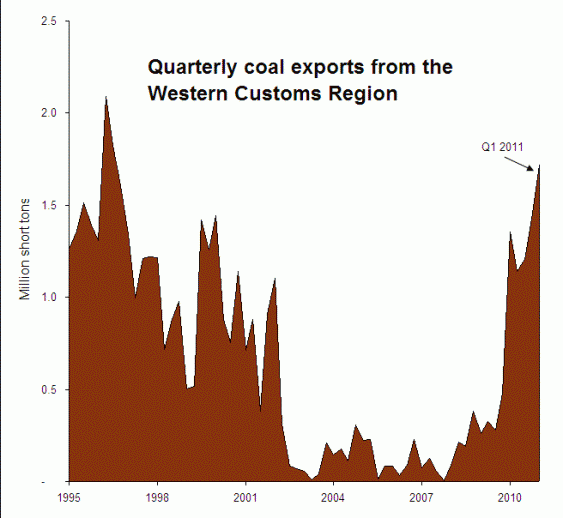
It’s not exactly the picture of stability. There’s a tremendous amount of volatility from quarter to quarter—suddenly doubling or tripling in volume, only to come crashing down just as quickly. The long-term trend is hardly more comforting.

Let’s take a closer look at the individual customs districts within the Western region:
Read more

Decriminalizing Graywater

“In most places there is a legal requirement to intentionally pollute drinking water with human excrement.” That’s how the Cascadia Green Building Council frames the problem with recycling water. By law and by practice, the region has historically made it illegal, or at least highly impractical, to reuse water, even for uses that obviously don’t require clean drinking water such as flushing the toilet or washing the car. There’s no good reason why we should fill our toilet bowls with clean drinking water rather than lightly used recycled “graywater.”

The Northwest’s water reuse policies are changing, and not a moment too soon. Even in the rainy west side of the region, population growth is pressuring water supplies, just as climate change begins to yield weather mayhem. Water supply problems can be even more intense in the region’s drier places, and in much of the world.

Long ago, health concerns motivated strict no-contact rules for used domestic water: Every ounce of it must leave the area and flow to a waste treatment plant. The laws have scarcely changed until recently. That policy may have made sense when building trades were not very sophisticated in the Northwest, when inspectors were scarce, and when water was bountiful. Now, plumbers and plumbing inspectors are highly professionalized, many builders are creative and green-minded. Plus water is increasingly scarce and expensive.

Fortunately, several jurisdictions in the Northwest are leading the way to legalizing sensible, low-cost water-recycling solutions.

Read more

Peak Gas Hits Oregon

We hate to say we told you so…wait, strike that, we actually kinda like it: “ODOT says road projects may need to be cut.”

Oregon transportation officials say they may have to scale back plans for highway work because revenue from road users is coming in more slowly than expected. Cash-strapped drivers are using less gasoline, so they’re also paying less in gas taxes—and that means Oregon stands to lose $150 million or more in federal funding, officials warn.

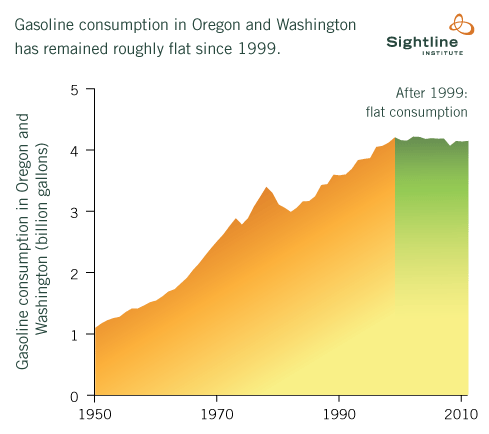
Just last week, we released a new report showing that gasoline consumption in Oregon and Washington has been pretty much flat since 1999, while vehicle travel flat-lined in 2002. In short, people are driving less; and it’s not just the recession. We warned that these trends could wreak havoc on highway financing. And in only one week, we’ve had 2 confirmations of those warnings. 

Read more

Who’ll Catch the Rain?

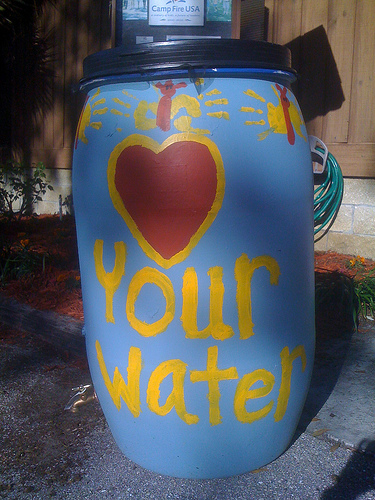
Love Your Water rain barrel

You hooked up a 55-gallon rain barrel to one of your roof downspouts. You were glad — maybe even a little smug — about tapping that free water to keep some of your plants happy this summer.

Are you ready to kick it up a notch?

There’s increasing interest around the Northwest in rainwater harvest on a bigger, bolder scale. Stretch that little rain barrel into a 550-gallon cistern installed above ground or below. Or don’t stop there — how about vessels holding 1,000 gallons, 10,000 gallons — to catch all that lovely rain. The bigger the better. After all, the uses are endless and our rain supply is generous during most seasons.

So far, Oregon has been a big step ahead of Washington in encouraging and permitting the capture and use of rainwater and next week, Portland is hosting the 2011 American Rainwater Catchment System Association (ARCSA) Conference.

Read more

Portland, the City of Sedums?

Sedums

The City of Roses is being transformed into the City of Sedums as nearly 300 Portland rooftops are now blanketed in the drought-tolerant succulents.

And as rooftops in Oregon are going green, some of the businesses that design, build, and landscape ecoroofs are having an economic mini boom.

News headlines cheer sales numbers that have tripled in the past year for one Portland company. Another is doing cutting-edge ecosystem research that could help businesses cut costs and benefit the environment. And two local businesses are merging their green products into an exciting new technology.

The enthusiasm for ecoroofs is spilling over into other Oregon cities and counties, including Bend, Salem, and Multnomah County. Libraries, schools and universities, even gas stations and a high school batting cage are sprouting green covers.

Portland is the state’s hothouse for green roof growth. If you include the number of buildings capped in smaller patches of plants and veggie gardens in the tally, there are 428 green roofs in Portland covering 30 acres, officials report.

There are lots of benefits to the roofs. They help soak up stormwater runoff, make roofs last longer, insulate buildings to cut energy costs, plus they look beautiful and can provide a home for bugs, birds, and other wildlife.

“They are becoming part of the fabric of what our city looks like,” said Matt Burlin, outreach coordinator for Sustainable Stormwater Management with the city of Portland’s Bureau of Environmental Services.

Read more

Should We Trust Toll Revenue Forecasts?

Hey gang!  We’ve got a new report out today: a literature review on the accuracy of tolling revenue forecasts. In a nutshell, both national and international experience shows that official tolling forecasts tend to overestimate real-world toll road revenue—particularly where drivers can choose alternative, toll-free routes. If the research holds true for our part of the world, there could be lots of implications for highway finance.  Read on for more…

It seems like everywhere I look, there’s another story in the news about road tolls.  Which shouldn’t be too surprising: every highway megaproject on the books in the states of Washington and Oregon—the Columbia River Crossing, Washington’s SR 520 floating bridge, Seattle’s deep bore tunnel—is counting on robust tolling revenue to help pay for the project costs.

The first up will be SR 520: the state plans to begin tolling the span in December, as part of a bid to raise $1 billion in revenue (about a quarter of the project’s costs) from the drivers who use the facility. To raise that much money, the state is planning to charge $3.50 for a rush-hour trip—or more, if you don’t pay electronically—and up to $2.20 each way on weekends. For a regular rush-hour commuter, the tolls will add about $1,750 to the cost of a year’s trips to and from work. It’s enough money to make many drivers look for other ways across the lake—other routes, other times of day, or even switching to transit. And it’s also enough to convince lots of occasional drivers that a trip on SR 520 across the lake just isn’t worth it.

Read more

Northwest Coal Exports II

Sightline is releasing a new and updated research backgrounder today: it’s a “frequently asked questions” about coal exports from the Northwest.

In the new version of “Northwest Coal Exports” we set out some basic facts about coal exports: how much North America currently exports, what the new proposals involve, and what the pollution consequences might be. We take a hard look at the scientific literature on the health impacts of coal dust, and we draw some lessons from coal export facilities elsewhere in North America. We also tackle some of the more vexing questions, like whether British Columbia ports have the capacity to handle the export proposals, and whether US coal exports add to global greenhouse gas emissions.

Moving Planet

Saturday September 24 will be a worldwide day of action calling for solutions to climate change: Moving Planet. Events will be happening across the globe, including here in Cascadia—from the big cities to smaller towns like La Grande and Ashland. Seattle will boast activities like electric bike riding, and a rally at Lake Union Park. … Read more

A Sneak Peak?

I’ve been tracking gasoline consumption in the Northwest for over a decade now. But for most of that time I’ve been focused on the year-to-year ticks: a mini-surge in 2002 and 2003, a dip in 2008 when oil prices spiked, a rebound the following year when prices fell.

But the year-to-year fluctuations concealed a much bigger and more interesting story: gasoline consumption in Washington and Oregon has remained essentially flat since 1999. I describe the trends in our brand-new report: Peak Gas?: Northwest gasoline consumption stalled out in 1999.

Take a look at the chart. Prior to 1999, gasoline consumption in the region grew steadily, roughly in step with the region’s growing population and burgeoning economy. The only substantial interruption in the meteoric rise in gas consumption was the economic downturn of the early 1980s.

But since 2000, Oregon and Washington have grown substantially—in population, in average income, and in overall economic output. Yet total fuel consumption has barely budged.

This is not—I repeat, NOT—merely a result of recent economic doldrums. It can’t be: you can’t explain a trend that began all the way back in 1999 by referring to what’s happened in the last few years. Gas consumption stalled out well before the economic crisis in 2008. It stalled before oil prices spiked to record highs; before the military actions in the Middle East in the last decade; and even before the turmoil following the 2001 terrorist attacks. Arguably, it coincides with the beginning of the previous recession, triggered by the dot.com bust of 2000.

The biggest single reason why gas consumption halted its seemingly inexorable rise is pretty obvious: gas prices.

Read more

An Alternative to Coal Jobs

If coal export terminals are too risky for many ports because of their checkered past on the West Coast, there is a alternative strategy for economic development: clean up and redevelopment of polluted port sites. It’s a strategy that is proving to create many more jobs than coal, and with far less pollution.

First, though, to understand how poorly coal export stacks up, let’s consider the facts at Longview. Millennium Bulk Logistics proposes to use a former mill site owned by Alcoa to export coal. The site, which occupies prime waterfront industrial land, is contaminated with pollution from the mill operation. Cowlitz County faces a choice for the site: approve Millennium’s proposed coal export terminal or force Alcoa to clean it up to attract other business. The choice should not be a hard one since Alcoa has already signed an Agreed Order with the Washington Department of Ecology, in 2007, requiring Alcoa to clean up the site’s pollution.

In fact, Alcoa has a good track record cleaning up aluminum mills and selling the land for more productive uses. In the last five years, Alcoa has successfully completed cleanup of former aluminum mills in Troutdale, Oregon and Vancouver, Washington. Alcoa even received a national award for its cleanup of the Troutdale site. Both sites are now active job-producing industrial areas.

Read more

×