Donate Newsletters

Coloring Inside the Lanes

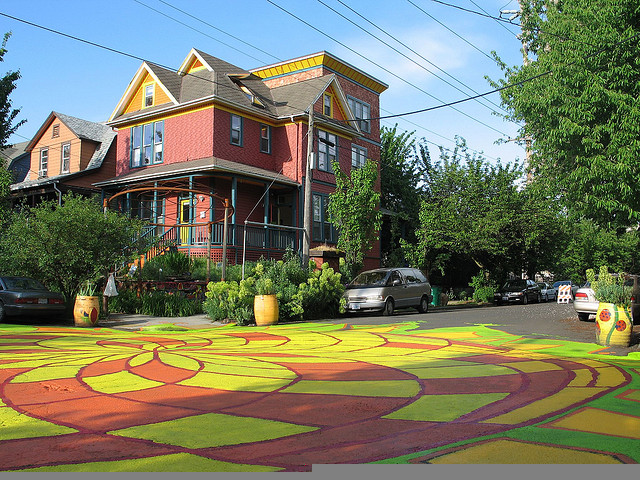
Sunnyside Piazza, by DanielEtra, flickr

What if all it took to build better neighborhoods was a little paint?

Walking in Southeast Portland, I once stumbled on a horizontal rendition of a sunflower, painted curb to curb on the intersection of Southeast 33rd and Yamhill (pictured above). Sunnyside Piazza, it is called, which may seem a bit much for a splash of color on asphalt, but in person, it seemed fitting. This whimsical design, interrupting the functional but monotonous gray of Portland’s street grid, felt like a somewhere. It seemed like a place deserving a name. It even felt like a “piazza.”

That was in 2002. I later learned that the Sunnyside Piazza was the second painted public square in Portland, facilitated by the non-profit City Repair Project. Now, dozens of painted plazas, dubbed Intersection Repairs, pepper the map not just of Portland but also of Los Angeles, New York, St. Paul, and Seattle.

Read more

More Money, More Cars

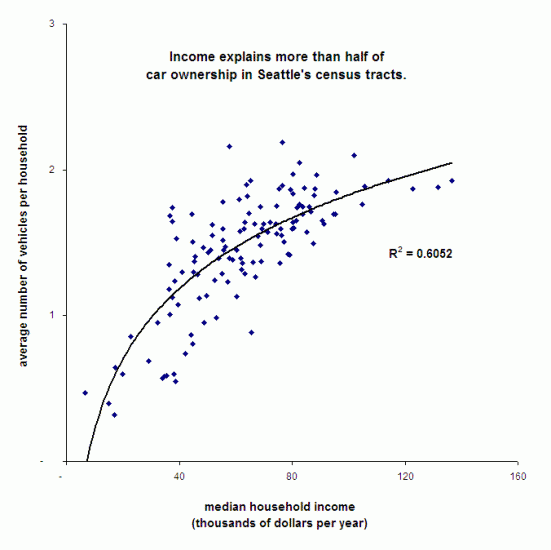
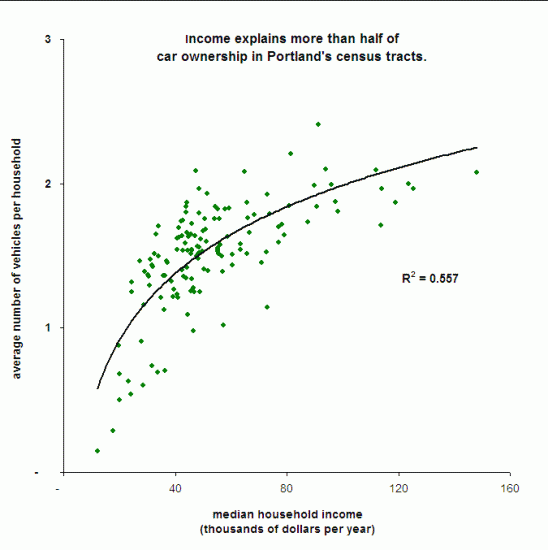
It’s somehow become an article of faith that fees related to cars are regressive. Yet to a larger extent, car ownership appears to be a function of wealth. In fact, in the Northwest’s big cities, household income explains more than half of vehicle ownership in neighborhoods: the higher the incomes, the more cars there are — at least up to a point.

Here’s car ownership plotted against income for each census tract in Portland.

Here’s the same chart for Seattle:

Read more

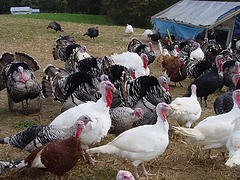
Thankful for a Bite at the Farm Bill?

What does the apparent collapse of the supercommittee charged with cutting the US deficit have to do with what appears on your plate this Thanksgiving? People are still sorting through the rubble, but it appears that one side effect may be a fuller debate over the next version of the farm bill. And what does … Read more

Where Cascadians Come and Go

I just extracted myself from this time warp of an interactive map at Forbes. It lets you analyze domestic migration in recent years for every county in the US. Not only can you see population and income summaries for each place, but you can get specific information about the counties that are donating or receiving residents.

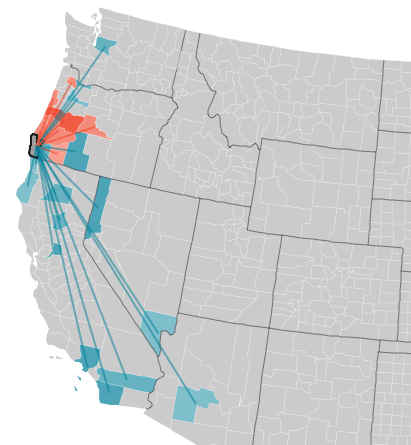
Here’s a look at how domestic migration plays out in Curry County, Oregon, population 22,364.

The blue indicates counties that are sending net population to Curry County, while the red shows places that are, on net, taking residents away from the county. (Darker colors indicate larger net migration.) Curry attracted an influx of residents from Seattle, Los Angeles, Las Vegas, Sacramento, and Phoenix. But Curry County lost about 400 people overall from 2005 to 2009, with a net departure of folks into nearby southwest Oregon.

Here’s what Yakima County, Washington looks like.

Read more

ODOT Running on Empty

Earlier this week I heaped scorn on the Washington State Department of Transportation’s penchant for serving up B.S.  Given how harsh I was, I figure it’s my duty to point out when a Northwest transportation agency tells it like it really is.

So here’s a remarkably straight scoop from the Oregon DOT — essentially admitting that ODOT is running out of money.  In a nutshell, the agency has looked at traffic volume and gas tax revenue trends, along with its debt service commitments, and has concluded it will have to cut its construction budget by 50 percent by 2015. And what’s especially admirable is that they back up their gloomy forecast with real numbers and clear-eyed analysis, not spin.

The Hazy Tale of Air Pollution

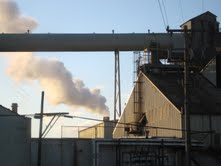
Verallia/Saint Gobain facility

Today I reported a story on some of the worst bad actors for air pollution in the Northwest. Interestingly, the facility with the most fines for air pollution violations in recent years wound up being a Seattle glass bottle maker that just a year ago was touting its eco bona fides. The folks at Verallia, which is owned by Paris-based Saint-Gobain, boasted about making $20 million in improvements to modernize its operations and save energy, and it crowed about its goal of increasing its use of recycled glass.

It’s great stuff for a manufacturer to do, but those improvements were the result of years of violations and lawsuits at the local and national level that forced the company to toe the green line. In the past five years, Verallia/Saint-Gobain was slapped with nearly $1 million in pollution penalties.

The article, which I wrote with Robert McClure for Investigate West, goes on to look deeper into Verallia/Saint-Gobain’s pollution problems, as well as other top recipients for air pollution penalties.

But there’s more to the story and it’s kind of interesting.

Read more

Report: Northwest Ocean Acidification

Editor’s Note 8/11/2015: Everyone in the Northwest is feeling the heat this summer, and the Pacific Ocean is no exception. Record-breaking warm water temperatures have negative impacts on marine ecosystems, from toxic algae blooms to early shellfish closures and salmon deaths. Possibly worse than rising ocean temperatures is ocean acidification, the absorption of carbon dioxide into the sea. Ocean acidification also negatively affects mollusks and other marine animals, and hurts lucrative Northwest industries. Want to learn more about ocean acidification and its impact on the Northwest? Here’s your primer.

This primer is also available in a two-page summary format.

Tiny sea butterflies dissolve before researchers’ eyes. Baby oysters die by the tankful. Sea urchins grow deformed. These are a few consequences of raising marine creatures in increasingly corrosive water. And they could preview what’s in store for the Northwest as carbon dioxide pollution from cars, power plants, and other human sources changes the chemistry of our marine waters.

The Instability of Coal Exports II

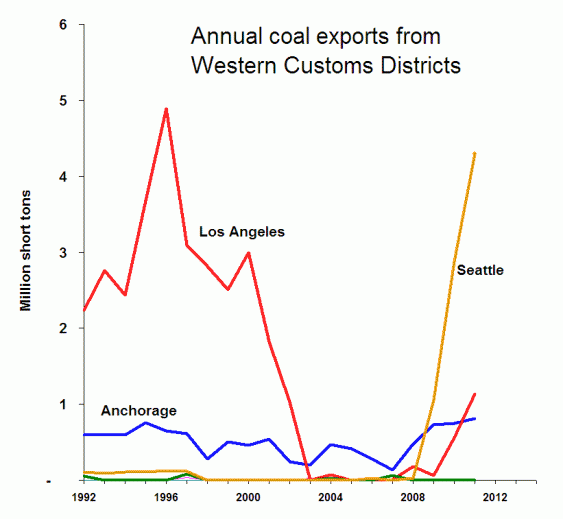
Following up on my last analysis of the instability of coal exports historically, here’s another look at the data. It’s confirmation that the Western US has had a rocky run in international coal markets. The following chart depicts annual export volumes by Customs District over the last two decades.


In the past, at least, coal has clearly been a volatile commodity. (The quarterly picture is even more ragged.)

Only three of the Western region’s nine customs districts have registered meaningful levels of coal exports since the early 1990s. The Los Angeles district’s trend line shows the spectacular implosion of the LAXT coal terminal. The Anchorage line shows the fairly modest but still unpredictable shipments from Seward. And the Seattle line shows the sudden rise in Powder River Basin coal making its way north to British Columbia’s Westshore Terminal for shipment to Asia.

Yet as volatile as the past has been, it’s nothing compared to what the future may hold.

Read more

Easy As Pizza Pie

The effects of some food labels on our eating habits are debatable. But it’s still exciting to see businesses making an effort to educate their customers about the sustainability of their products. Seattle pizza chain Pagliacci’s is taking one step in that direction. They’re switching to Forest Stewardship Council-certified cardboard, and using the cardboard itself … Read more

Licensed to Work

Alan Durning: Food Handler

I just got my Oregon Food Handler’s Badge. It took 52 minutes online and cost $10. Now I can work legally in Oregon restaurants!

If, however, I wanted to work braiding hair African-style in Oregon, or kickboxing for prize money in Washington, or selling timeshares in Montana, or promoting concerts in Alaska, or as an athletic trainer in Idaho or as scores of other things across the Northwest, I’d have to endure a more onerous licensing process.

Much more onerous.

Consider African-style hair braiding. To braid hair for money in Oregon legally, I would need (in addition to actual braiding skills—no small thing), a hairstylist or barber license. Earning a cosmetology badge requires 1,700 hours of training and classes. That’s often two years of coursework, and it costs thousands of dollars. Worse, the schooling is largely irrelevant to African-style hair braiding.

Read more

×