Donate Newsletters

Gambling on Coal, and Losing

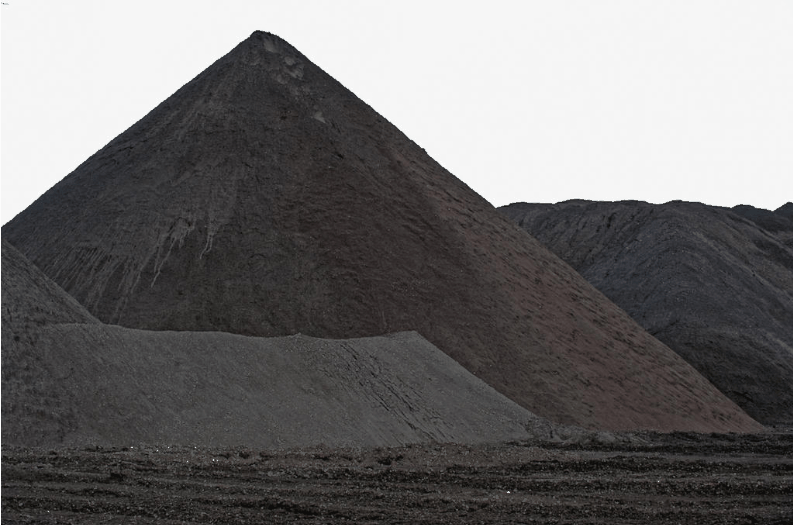
West Coast port cities have already gambled and lost on coal export facilities. After investing millions of dollars in infrastructure and setting aside sizeable harbor acreage to coal export facilities, both Portland and Los Angeles watched their promised revenue from coal exports evaporate.

Worse yet, local communities were stuck with the tab. The abandoned coal export facilities locked up millions of dollars in stranded investments and clean-up expenses, not to mention years-long missed opportunities for more durable economic development choices.
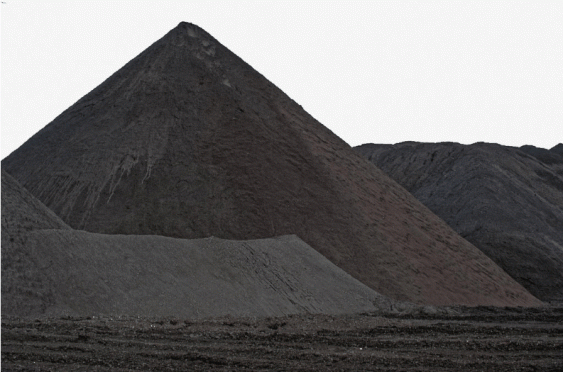
Copyright Paul K. Anderson, www.paulkanderson.com. Used with permission.

What happened in Portland?

The early 1980s saw a rush of coal companies proposing export terminals in Washington and Oregon to satisfy a hungry Asian market. Longview, Kalama, Vancouver, and Astoria all entertained proposals, but the Port of Portland bought in. Portland committed to a 25-year lease with Pacific Coal for 90 acres and 900 feet of prime riverfront for a coal export terminal. Governor Atiyeh even broke ground at the site with a giant gold-painted power shovel in 1982.
Read more

The Risky Business of Coal Exports

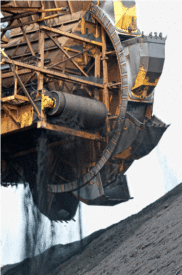
Copyright Paul K. Anderson, www.paulkanderson.com. Used with permission.

With all the hullabaloo surrounding a handful of ports considering coal exports, it’s easy to forget that many communities are flatly rejecting it. In fact, coal is so unattractive that a number of Northwest ports have already said no, despite aggressively pursuing new business. Recently, the Port of Tacoma, located on Puget Sound, and the Columbia River Ports of Vancouver, Kalama, and Portland have all considered—and rejected—coal export proposals.

Port of Vancouver, Washington
The Columbian newspaper framed up the Port’s choice, writing, “faced with a choice of helping to grow food or feed industry, the Port of Vancouver picked a fertilizer ingredient over the dirtiest fossil fuel on the planet.”

Larry Paulson, the Port of Vancouver’s executive director, pointed out that “coal facilities have a tendency to come and go,” and that was a big reason why Vancouver favored a terminal for potash, a more stable commodity. The Port’s operations manager, Mike Schiller, put it even more directly: “coal is the most risky bulk mineral market.”

Read more

A History of Failure

The coal industry is promising that new export facilities will mean jobs, tax revenue, and economic growth for the Northwest. Yet the region’s history tells a cautionary tale. Twice before, West Coast ports have tried to build “world class” coal export facilities—and the result was pollution, broken promises, and bad debt.

In a new research memo, “Coal Export: A history of failure for western ports,” Sightline and Columbia Riverkeeper examine the history and risks of coal exports. The memo evaluates the alleged employment benefits of coal terminals, and it highlights real local examples of clean redevelopment projects doing better.

Read the whole thing here.

Tackling the Other Carbon Problem

In this blog series, we’ve explained how carbon dioxide pollution is making the oceans more acidic, demonstrated that it’s happening now, looked at which marine creatures are most at risk and talked to oyster growers, commercial fishermen, and Native American teenagers about their prospects if the ocean systems that support their businesses and culture collapse.

So what can we do about ocean acidification? Here are some of the key solutions:

  • Reduce carbon emissions by developing policies that assign a cost to that pollution and encourage a shift away from fossil fuels and towards clean energy.
  • Use existing laws—from local land use planning to building codes to the Clean Water Act—to curb pollutants that make the problem worse.
  • Invest in research and monitoring to see how important marine species will be affected, inform fisheries and ocean management plans, and help seafood producers adapt.

Read more

An Obscure California Regulation Fills Homes with Toxics

The test is simple: 12 seconds exposed to a small flame like a cigarette lighter. If the furniture foam doesn’t burn, it passes the test and can be sold. If it burns, it fails and cannot. That’s been California’s trial by fire for furnishings—its “flammability standard”—since 1975.

It sounds reasonable enough. Unfortunately, though, this obscure rule turns out to cause an inordinate amount of toxic harm to people, the environment, and pets. Worse, it does this harm without providing any benefits. The rule may have made sense in 1975, when fire-safety science was young, but it’s long past its sell-by date. Simply deleting it from the law books in Sacramento would send benefits rippling up the coast to the Northwest and far beyond as well.

The 12-second rule applies to the foam in couch cushions—not the fabric, just the foam. It also governs the foam in other furnishings such as chairs. And it covers foam-padded child-rearing equipment such as crib mattresses, nursing pillows, and strollers.

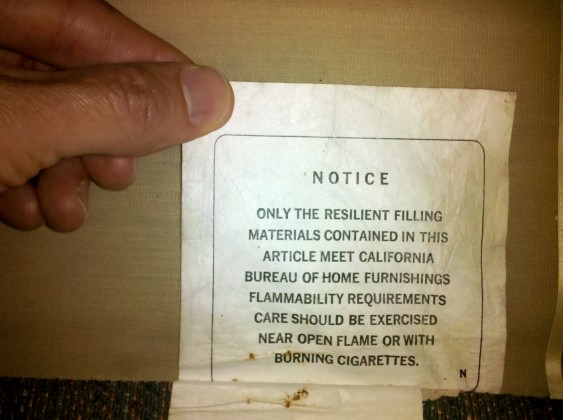
Because California is the biggest US market, manufacturers tend to treat the 12-second rule as a North American standard. They don’t want different polyurethane foam formulas for different states and provinces, so most of them make everything to pass the 12-second rule. Consequently, if you check under your couch cushions anywhere in Cascadia, you’re likely to find a tag saying that your sofa satisfies the California flammability standard. (That’s what my couch tag says, below.) Even if you do not find a tag,though, you’re still probably sitting on foam manufactured to pass the 12-second rule.

by Alan Durning
by Alan Durning

Read more

Carbon Dioxide: The Evil Ninja

To explain ocean acidification to second graders, here’s a start: Think of carbon dioxide as an evil ninja.

He’s buried in the ground in the form of coal, oil or some other fossil fuel. Someone digs him up and lights him on fire, sending him up into the atmosphere in a plume of smoke, or perhaps a polluting helicopter. The stealthy ninja parachutes out and lands in the ocean, where he begins to turn the ocean more acidic.

The ninja also runs into a happy clam, whose shell is made of calcium and carbonate. But the evil ninja breaks the molecule apart, kidnaps the carbonate and locks it away where no one can get to it. With that fundamental bond broken, the shell dissolves, the clam inside dies, and sea life as we know it is under attack.

That, at least, is the way students from the Suquamish Tribe Middle School see the situation unfolding in our oceans, as they brainstorm ideas for an animated video that will help younger kids understand the mechanics of ocean acidification. It’s a problem that people like Paul Williams, the shellfish management policy advisor for the tribe, sees as a grave threat to their culture. As he explained to a room of 11- to 14-year-old students on a recent summer day:

The goal today is to make videos to explain what’s going on out on the water because this is your future. If any of you want to be fishermen or fisherwomen, it’s really up to you guys. This is something that’s happening right now and it’s getting worse. If we want to have any alternative to McDonald’s, we’re going to have to work on this. And I have to apologize to you because my generation couldn’t do it. It’s a shame to have to tell you guys that this is your problem…but it’s the truth and I think you guys are old enough to be told the truth.

Read more

Ocean Acidification Event in Portland

Care about the Pacific Northwest’s oceans? Worried our fossil-fuel addiction is jeopardizing our marine and shellfish industries? Learn more about ocean acidification in the Northwest at E2’s event, the Acid Test: Ocean Acidification and the Pacific Northwest.

Speakers will include Washington Representative Brian Baird, NRDC oceans attorney Leila Monroe, and commercial fisherman Amy Grondin. E2 will also screen NRDC’s new short film, Acid Test: The Global Challenge of Ocean Acidification.

Where: White Stag Block, University of Oregon – Portland
When: Monday, September 12, 6:00-8:00 PM.

More info.

It’ll be a great, informative event about the Northwest’s “other” carbon problem.

Unchain Bike Sharing

flickr, Jason Pier

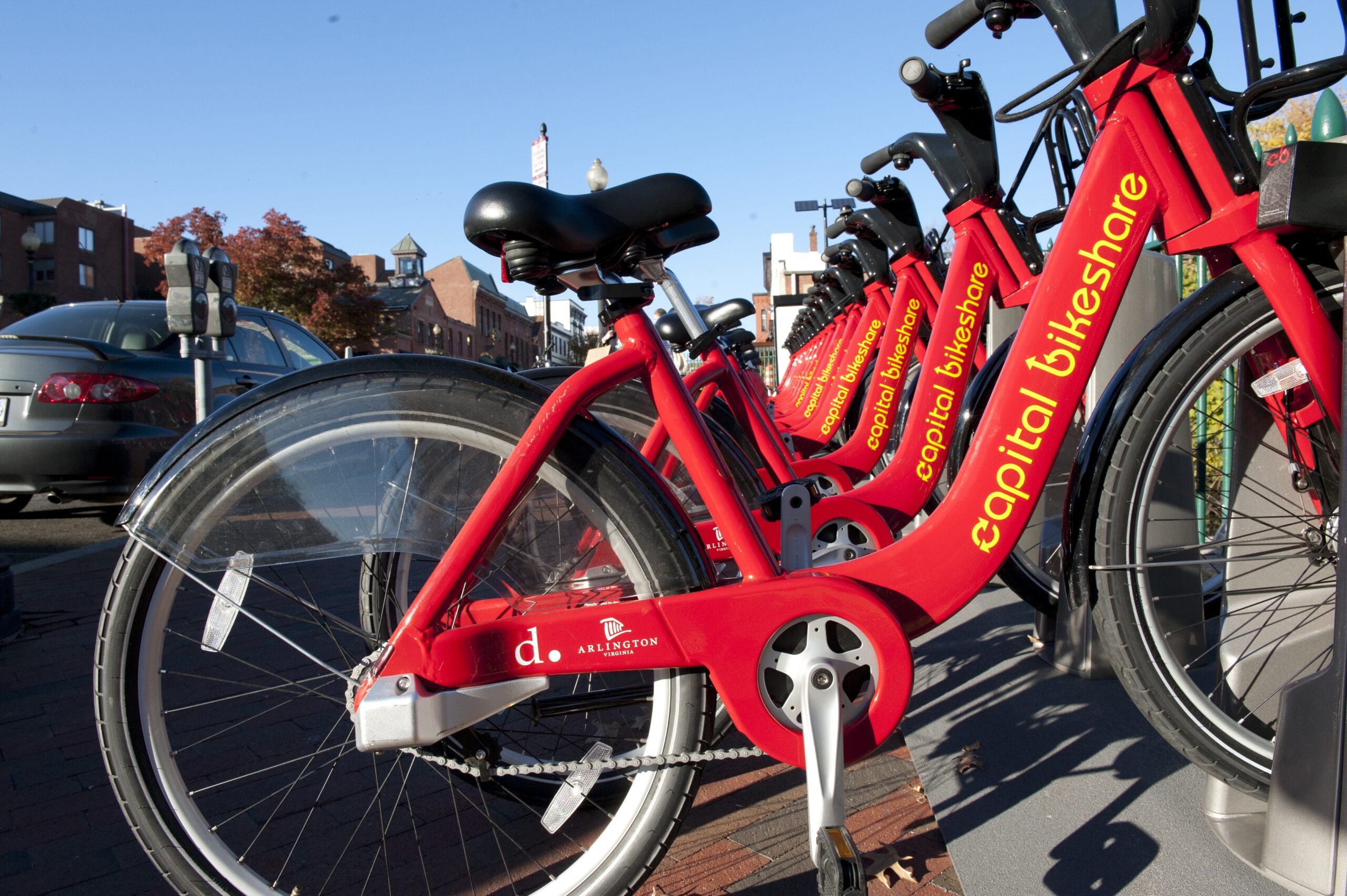
Imagine for a moment that cities around the world are rolling out fleets of magic carpets and that those carpets are having truly wizardly effects: improved public health and safety, reduced traffic congestion and carbon emissions, and reduced dependence on foreign oil. City dwellers can check them out or drop them off at stations everywhere, and they are free to use for up to 30 minutes. After that, they cost something, but not much. Picture literally millions of citizens using these carpets for short, speedy trips all over town. Now imagine being in the Northwest and watching this opportunity fly by because fanatical carpet helmet laws discourage would-be riders.

This is exactly what’s happening. The magic’s not in carpets, though: it’s in the humble bicycle.

Read more

Pavement to Parklets

Courtesy of Streetfilms, here’s a video on the trend of converting pavement (parking spaces, awkward roadways, etc.) into little parks (h/t to Matt Lerner).

It’s a great idea—one that many cities are catching on to. The benefits are numerous: better street life, additional space for businesses, more green space to filter stormwater, and they’re just plain fun. (Back in March, the New York Times catalogs some of the downsides.)

Freeing Taxis, Addendum

Last week’s article on the way taxis are regulated in the Pacific Northwest has generated a lot of attention and raised a lot of questions. (We’ve seen some conversations on Reddit feeds for Seattle, Portland, and Vancouver; been on the front page of 24 Hours Vancouver; and been heard on several radio and TV stations.) It’s a complex issue, and I’d like to revisit a few points that could have been covered in a longer article.

Many observers focused on the price differences, pointing out that the correlation between cab availability and price is not direct. That’s right. It’s not a one-to-one relationship.

×