Donate Newsletters

Food Labels Of The Future

Do visual symbols of nutrition help us eat healthier? With the USDA recently replacing the confusing and unhelpful food pyramid with a more streamlined plate logo, it’s clear that the way we represent food matters. The food plate’s simple depiction of what a healthy diet looks like has the potential to be extremely effective—it allows people to rate their plate against a healthy standard at a glance.

An effective food icon could have a huge impact on the food choices we make, in-store and at home. So why not piggyback on the release of the food plate with a redesign of our food labels?

Current nutrition labels are a labyrinth of dietary information that most consumers don’t have time to decipher. The FDA has been working, slowly, on an overhaul of the food labeling system since 2005, and since 2010 has toyed with restrictions for front-of-package claims, which are notoriously misleading and have been blamed for contributing to rising obesity levels.

Read more

Gasoline vs. Forests: A Carbon Smackdown

Photo courtesy of Flickr user McD22 (CC BY 2.0)

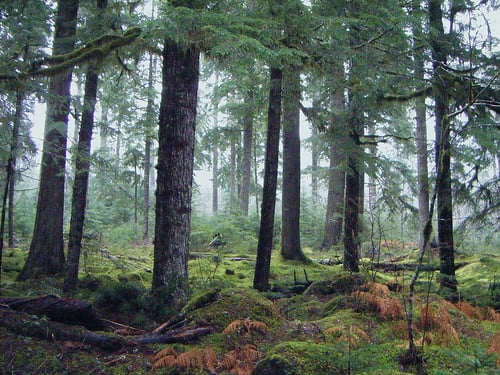
As anyone who’s spent some time in the woods out here might guess, the coastal forests of the Pacific Northwest store an awful lot of carbon. Yet for many years, a combination of rapid logging and occasional forest fires meant that the region’s “net ecosystem carbon balance”—the scientific term for how much carbon the forests contain—was on the decline.

But a new study (pdf link) out of Oregon State University shows that, on public lands at least, carbon sequestration in Northwest forests has shot up since 1995.  After the Northwest Forest Plan took effect, timber harvests from publicly-owned forests fell, leading to rapid and dramatic increases in carbon storage. (Note that harvests on privately owned woodlands remained high, so increases in carbon storage on private lands weren’t nearly as dramatic.)

Yet even as carbon storage in Northwest forests increased, the human residents of the Northwest continued to burn fossil fuels at a prodigious clip.  Today, for example, folks in Washington and Oregon burn about 4 billion gallons of gasoline each year—or more than a gallon each day for every man, woman, and child in the two states combined.

Which led me to wonder about forest sequestration vs. gasoline emissions.  How do the two stack up?  Let’s run the numbers…

Read more

Freeing Taxis

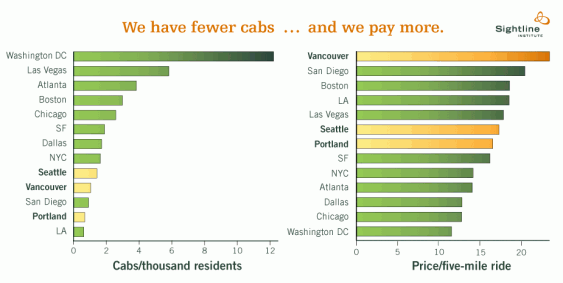
Update 8/11: I have an addendum to this post published here. Also, the chart was altered to reflect a slightly higher number for Vancouver.

What if the Northwest’s cities legally capped the number of pizza delivery cars? What if, despite growing urban population and disposable incomes, our Pizza Delivery Oversight Boards had scarcely issued new delivery licenses since 1975? Pizza delivery would be expensive and slow; citizens would rise up in revolt.

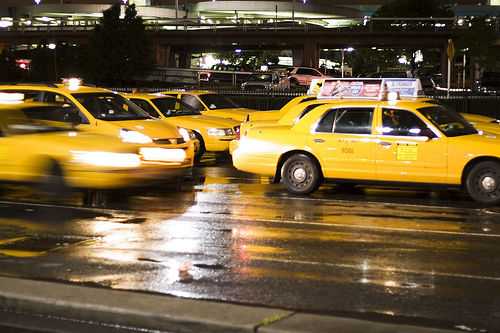
Substitute “taxicab” for “pizza delivery” and you have a reasonable facsimile of the taxi industry in Portland, Seattle, and Vancouver, BC: tightly restricted taxi numbers, high fares, and low availability.

Plentiful, affordable taxis facilitate greener urban travel. They help families shed second cars, ride transit more often, and walk to work on could-be-rainy days. They fill gaps in transit systems and provide a fallback in case of unexpected events.

(click for larger image)

Read more

Getting Smart on Sewage

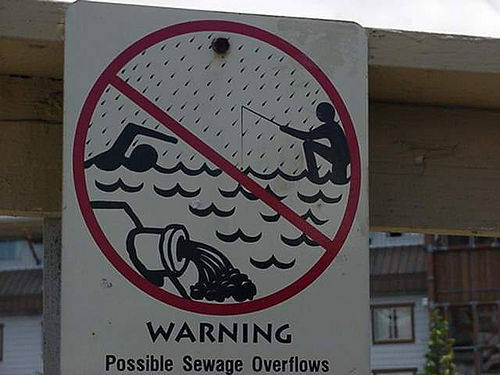
WARNING: possible sewage overflows

A rainstorm—a real gully washer—hits the Northwest. In numerous cities with antiquated public plumbing, the rain seeps into cracked sewage lines and flows into stormwater drains that link to the sewer system. From Port Angeles to Seattle to Spokane, treatment plants are overwhelmed by the deluge, causing raw sewage to spill into Port Angeles Harbor, Puget Sound, and the Spokane River. The sewage carries bacteria, viruses, and other pollutants that pose a risk to beach goers hunting clams or swimmers taking a dip.

Spewing sewage into waterways is potentially dangerous to people, and just plain gross. So Seattle and King County alone are preparing to spend $1.3 billion on projects to fix the problem.  The navy town of Bremerton on Puget Sound’s west shore recently finished a project costing more than $50 million to staunch the annual flow of hundreds of millions of gallons of sewage-tainted waste. Outside of the state, Vancouver, BC, is working to separate its sewage system and Portland this year is scheduled to complete its $1.4 billion Big Pipe projects to control sewage spills.

But there’s increasing concern that the regulations driving these costly fixes are based on an arbitrary benchmark. A recent article that I wrote for Crosscut and last Sunday’s piece by Lynda Mapes at the Seattle Times both called into question the sewage rule and the priority being placed on shrinking the number of combined-sewer overflows (CSOs) at a time when the region faces arguably more urgent water-quality challenges.

Washington’s leaders need to reconsider a rule that limits the number of sewage overflows to an average of one per outfall. Instead, they need to craft rules grounded in the actual harm being caused by the spill by considering how much and what kind of pollution is being dumped. By focusing the regulation on the environmental and human health effects, cities, counties, and utility rate payers will be able to direct their time and money to projects that will have the greatest benefits to the region. Reshaping the CSO rules could save money by shifting restoration dollars to projects that pay the largest dividends.

Read more

Letting Cities Slow Traffic

Update: The Washington Legislature passed the Neighborhood Safe Streets bill in April 2013, finally cutting red tape that cities and towns previously faced when they chose to set speed limits at 20 miles an hour on residential and business non-arterial streets. This common sense win for pedestrians, kids, and the elderly had overwhelming support in the House (86-10) and Senate (45-2), yet took three years to clear the roadblocks embedded in our political system.

A shorter version of this item ran on the Seattle Times’ op-ed page on August 2, 2011. This version includes links, a chart, and additional analysis.

On Thursday afternoon, I got a pit in my stomach when I found strings of yellow police tape blocking the bike commute on Seattle’s Dexter Avenue. I learned over the hours that followed, with all of Seattle, that an SUV had struck and fatally injured Mike Wang, a PATH photographer of my age, in his forties. Mr. Wang had been riding in the Dexter bike lane at Thomas Street when the SUV sped across traffic, slammed into him, and fled the scene.

Such calamities are far too common. In 2009, traffic collisions killed 1,095 people—including 106 pedestrians and cyclists—in the Northwest states of Idaho, Oregon, and Washington. Car crashes are the number one cause of death among American children and young adults, and the group of pedestrians most in jeopardy is seniors. The pedestrian traffic death rate is more than twice as high among seniors as among others in Oregon and Washington. It’s three times as high in Idaho. (Sources for this paragraph and the next are at the bottom of this post.)

In almost all of these deaths, traffic speed is a critical variable. Some 91 percent of 2009 Northwest traffic deaths occurred on streets with speed limits of 30 mph, like Dexter, or higher. That’s a big number. Let’s make it more real: A new mapping tool allows you to pinpoint the exact locations, with street-view photos, of every scene where a motor vehicle killed an American pedestrian in the last decade. The map is harrowing. In a few short minutes of clicking and zooming, for example, I saw the death scenes of an 89-year-old man, a 73-year-old man, a 16-year-old boy, and a 1-year-old boy in Spokane; a 75-year-old woman and a 37-year-old man in Federal Way, Washington; and a 13-year-old girl in Sumner, Washington. Every one of these deaths was on a local street, the speed limit of which is dictated by state law at either 25 or 30 mph.

Read more

Unbanning Clotheslines

Editor’s Note: We’ve followed up on this post here and here, documenting how many bans are actually void.

Elizabeth Morris and her family bought their house in the High Point neighborhood for a reason. “High Point is the City of Seattle’s premier ‘Green Community,’ having been touted internationally as such, as well as [for] mixing Seattle Housing Authority [SHA] rental properties and private home ownership,” she explained. It’s a compact, walkable, mixed-income, energy-efficient, green-built neighborhood peppered with bicycle commuters and rain barrels. So Morris was shocked to find that at High Point, clotheslines are banned.

“Homeowners have even been warned that it is illegal,” Morris said. “Not only are owners not allowed to save energy by hanging out laundry but those who rent from SHA (read: low income) aren’t allowed to save on their energy bills either.”

Like over 60 million other Americans and Canadians, Morris lives in a neighborhood governed by a homeowners association (HOA). These quasi-private governments, along with some apartment blocks and condominiums, are largely free to set rules as they see fit. Penalties for violations range from fines to forced expulsion. Imagine being banished by your neighbors for drying your clothes!

Clothesline bans are wrong headed, because line drying’s advantages are numerous. For one, anyone who hang dries will tell you that clothes last much longer: all that lint in your dryer filter has to come from somewhere! Benefits go beyond that, however: according to the Northwest Power and Conservation Council, households in the Northwest states use 4.3 percent of their annual electricity consumption to dry laundry. To put that into perspective, even our refrigerators only gobble up 3.5 percent. As the New York Times highlighted in an article last year, the typical US household could prevent 1,500 pounds of carbon dioxide from entering the atmosphere each year simply by turning off its dryer and hanging out the wash. Oh, and clotheslines never burn down your house; in the US alone, dryers cause more than 12,000 residential fires annually.

Read more

Are You a Banker or a Gambler?

Not every commercial fisherman is convinced that curbing carbon emissions is necessary to stop global warming. But the evidence that fossil fuel pollution is making the oceans more corrosive—and removing basic building blocks of the marine world—starts to get their attention.

In Alaska, commercial fishing supports one-sixth of the state’s economy and employs 70,000 people in high season, more than any other basic industry. Mark Vinsel, the executive director of United Fishermen of Alaska, the state’s largest commercial fishing organization, last year ranked his concerns about ocean acidification this way:

I’d say probably on a scale of 1 to 10, it would be 20 or 30.

If you sliced open the bellies of our most popular eating fish, at one point in their life cycle you would probably find krill, plankton, oceanic snails or other shelled creatures—the kinds of species likely to run into trouble as the oceans absorb more carbon dioxide from burning fossil fuels and other industrial processes.

As those carbon emissions rise, seawater becomes more acidic and sea life has more trouble finding calcium carbonate, a material that many creatures need to construct shells or skeletons, and, ultimately, to survive.

So if creatures at the bedrock layer of the marine food chain start to struggle in more corrosive seas, how might that affect an industry that provides nearly one-sixth of the world’s animal protein, not to mention $3.9 billion in personal income in Washington (roughly 2 percent of net earnings in the state) and more than $400 million in personal income in Oregon (one-half percent of net earnings)?

Here’s how Jeremy Brown, a Bellingham-based commercial fisherman who has spent nearly three decades fishing for salmon, halibut, black cod and albacore tuna, sees it:

Read more

Bremerton Seeks More Bang for its Clean-Water Buck

The city of Bremerton on the western shore of Puget Sound has scored a serious environmental achievement. The Navy town has become Washington’s first city to unravel a complicated system of mixed sewage and stormwater waste, dramatically shrinking the amount of pollution dumped into the Sound. The city recently celebrated its $50 million achievement, receiving kudos from the governor and head of the Ecology Department.

But as I explore in a story posted today on Crosscut, even as the city officials feel the love of their eco success, some of them wonder if it would have benefited local waters more to have spread that money around to other green endeavors.

Read more

×