Donate Newsletters

WalkScore's New Rankings for Cities

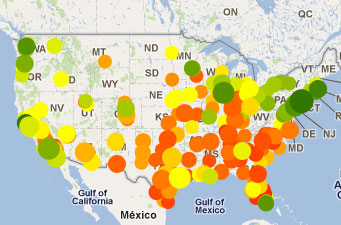
My heroes at WalkScore are out today with updated walkability rankings for American cities. Using the new 2010 Census data and enlarging their analysis to include 2,500 cities, WalkScore’s new analysis includes some changes from last time around in 2008.

Here are the top 10 big cities for walking. There are some changes from last time around: New York nudged San Francisco out of the top spot; Seattle stuck to the number 6 position with a score of 73.7 (just behind Philadelphia and just ahead of DC); but Portland fell out of the top 10 to the 12th spot with a score of 66.3 (between Long Beach and Los Angeles).

Law and Order and Parking Lots

There’s no better measure of our perverse relationship with cars than the fact that nearly every city and town in North America has laws requiring drinking establishments to provide parking, and yet roadside memorials to victims of drunk driving are mostly illegal. A single year of alcohol-impaired driving kills more Americans than the last decade of war has, but our land use codes practically encourage driving home from taverns. Bar owners can be held legally liable for their patrons who imbibe too much, but our laws force owners to offer parking for their customers.

Can we stop the madness?

In this post, we take a look at how Northwest municipalities deal with parking at drinking establishments. Who gets it wrong, and who gets it (almost) right? The answers may surprise you. At the end, I’ll explain how easy it would be to fix the problem.

Let’s start with the laggards.

Despite its vaunted reputation for sustainable urbanism, Vancouver, BC may have among the worst parking mandates in the region (code, p. 9). Calculated based on the amount of floor space open to the public, the baseline requirement for businesses that sell liquor for on-site consumption is 1 parking space per 60 square feet (5.6 square metres).

Given that a typical parking space somewhere in the range of 170 square feet, and that the smallest parking space Vancouver allows is 148 square feet, it means that in many cases Vancouver bars must provide nearly three times more space for cars than for drinkers. Factor in the non-stall parts of a parking lot and the multiple is higher yet.

Vancouver’s “cabarets” that sell liquor must provide 1 for each 100 square feet (9.3 square metres). The city’s “neigbourhood grocery stores” need not provide any parking at all, but “neighbourhood pubs” must, by law, provide 1 per 200 square feet (18.6 square meters). Even designated “detoxification centres” are required to house 1 parking space per 300 square feet.

Vancouver’s parking laws seem almost directly at odds with British Columbia’s toughest-in-the-region alcohol-impaired driving enforcement. As of late 2010, police can impound vehicles and fine drivers who register a 0.05 blood alcohol level or higher, as compared to the usual criminal level of 0.08. Much to its credit, BC’s new enforcement provisions seem to be substantially reducing alcohol-related fatalities. Yet even so, drinking and driving is still killing more than 4 residents of BC each month, on average.

Read more

Decriminalize Green, Affordable Car Insurance

Imagine if state law made it difficult for pizza joints to sell by the slice. You’d have to buy and eat a lot of pizza when you got a hankering. Either that, or you’d have to give up pizza entirely. By-the-slice pizza lets light eaters save money.

The car insurance market today is like an alternate reality where no pizza joints sell by the slice. You have to buy a lot of insurance, even if you only drive a little, or you have to give up driving. If you’re poor, you may drive illegally without insurance.

The equivalent of by-the-slice pizza is by-the-mile auto insurance. It gives families a new way to save money, by driving less. It also lets low-income drivers buy just a little insurance. It gives consumers more choices. And it creates a gentle, money-saving incentive to find alternatives to driving alone. This incentive yields fewer car crashes, less consumption of imported gasoline, less congestion, and less air pollution.

Read more

Sundown at Ecotrust

Tomorrow night join Portland’s Ecotrust as they kick off their summer concert series dedicated to sustainable living in our area. Head on over to the Natural Capital Center to learn about Ecotrust Programs and partner organizations while enjoying some great solar-powered concerts! Thursday’s concert will feature performers Loveness Wesa and the Bantus and Everyday Prophets, … Read more

Why You Can’t Stop the White Pages

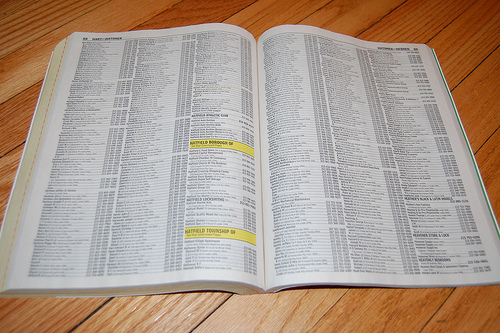
What could be more annoying than the dull thud of another unwanted phone book on your doorstep? Printed phone directories are as outdated as, well, rotary phones — and these days they amount to little more than waste for the majority of phone customers. That’s why cities like Seattle and San Francisco have recently passed legislation letting residents opt in or opt out of automatic Yellow Pages deliveries. Yet neither city’s pushback will affect the delivery of the White Pages.

The White Pages are an altogether different story. The reason the White Pages land on our front doors isn’t because phone companies want to annoy you; it’s because their delivery is required by state law. Until we make a very minor modification to existing rules, the White Pages will keep on coming to your front door, like or not.

Surprisingly, it turns out that the directory companies themselves would like to stop automatic delivery, if only the law allowed it. While the Yellow Pages generate advertising revenues, the White Pages represent only costs for the firms required to publish and deliver them, eroding the bottom line in an industry that’s already struggling. I’m not making this up: WhitePages.com is actively lobbying to end mandatory delivery laws.

The US industry claims that 5 million trees a year are cut down each year in order to print White Pages directories, and that nationwide in the United States only 22 percent of the books are recycled. (The phone companies’ concern about waste is somewhat ironic given their intransigence on Yellow Pages delivery reform.) I can’t personally vouch for those figures, but based on published numbers for other states, I calculate that reforming Northwest states’ white pages laws could save about 690 tons of paper in Oregon each year, and more than 1,200 tons of paper each year in Washington—nearly the weight of three fully-loaded 747 jumbo jets.

Read more

Trouble on the Half Shell

gautsch.net, flickr

Four summers ago, Sue Cudd couldn’t keep a baby oyster alive.

She’d start with hundreds of millions of oyster larvae in the tanks at the Whiskey Creek Shellfish Hatchery in Netarts, Oregon. Only a handful would make it.

Sometimes, they’d swim for a couple of weeks. But they’d stop developing before they grew a critical shell structure, or maybe the foot or eyespot. They’d feed poorly. One day, the larvae would simply die. A hatchery that has supplied seafood businesses for three decades had virtually nothing to sell for months, said Cudd, who owns the hatchery.

They would just sort of fade away…It was really devastating. We’re kind of the independent growers’ hatchery, and we had always been reliable up until that point. People were just shocked. I heard a lot of times how it was ruining people’s businesses.

It’s tough to say with scientific certainty that ocean acidification is the sole cause of the die-offs that have plagued two of the Northwest’s three major oyster hatcheries in the last few years.

But this much seems clear: young oysters have a hard time surviving in conditions that will only become more widespread as carbon dioxide from cars, coal plants and other industries cause the fundamental chemistry of the ocean to become more acidic. (For more on that process, see our earlier posts here, here and here).

Read more

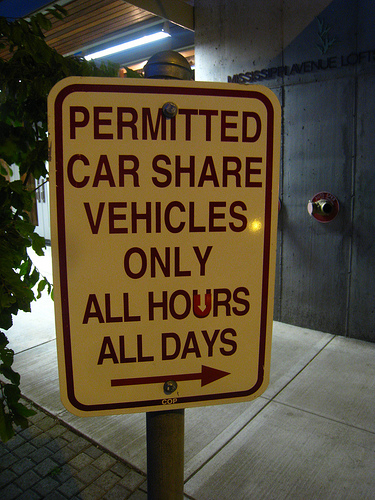
Legalize Personal Car-Sharing

What if a stupendously enormous business opportunity were hiding in plain sight before our eyes? What if this same business opportunity would bring gigantic environmental and social dividends? And what if all that was required to unleash these benefits was a simple legal reform?

Personal car sharing is such a business opportunity: a chance to trim emissions, crashes, and fuel costs, all while generating a profit for car owners and giving everyone a new way to save money. Only one legal barrier—an obscure change to insurance regulations—stands in the way.

The Pacific Northwest’s rolling stock of cars and trucks constitutes a mind-boggling amount of underutilized capital. The region has substantially more motor vehicles than licensed drivers. Everyone in the region could climb into a vehicle and no one would have to sit in the backseat. What’s more, the typical car is parked 23 hours a day. Most of us have more money tied up in our cars than in any other physical assets aside from our homes, and all that wealth is just sitting there in the driveway depreciating.

But circumstances are ripening to turn this colossal overstock into an equally massive economic and environmental opportunity.

Read more

Making Sustainability Legal

Some of the smartest, most innovative solutions for building thriving and sustainable communities in the Northwest are, at present, simply illegal.

Even the best-intended rules to protect people and shared assets can become outdated. From business strategies (think buggy whips and typewriter ribbons) to the stuff forgotten in the back of your fridge, almost everything has an expiration date. Luckily, weeding out the counterproductive rules rendered irrelevant by time can have a big impact—making it easier and cheaper to do the right thing.

Take the problem of the urban stormwater runoff that threatens the health of Puget Sound and other waterbodies throughout the Northwest. Low Impact Development (LID) solutions—including such strategies as rain gardens, street-side swales, porous pavement, and green roofs—can treat stormwater more effectively, and for less money, than the costly “hard” infrastructure of downspouts, pipes, and sewers. Yet many development codes mandate the more-expensive, less-effective plumbing solution. If only codes would allow LID as an alternative, the region could see a proliferation of lower-impact techniques that could spare government coffers in lean times, and give developers and homeowners a financial break—even while providing cleaner water and patches of urban habitat.

Read more

Google Steps Up on Transit

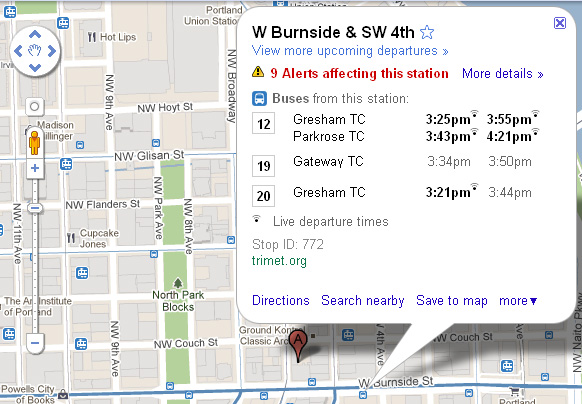
I’ve written before how transit apps for smart phones aren’t the silver bullet to getting everyone on the bus. But they can get make riding transit convenient enough for some people to make the switch from their car once in a while. So I thought it was pretty cool that Google is upping their game … Read more

Mapping Pedestrian Fatalities

From the realm of ghoulishly fascinating comes this tool, launched last month by Transportation for America: Dangerous by Design, a map of all pedestrian fatalities from 2001 to 2009. Not only does it show you where they happened, it tells you the age, gender, and race of the victim along with a photo of the street where it happened. (H/t to Price Tags)

Here’s Portland:

Read more

×