Donate Newsletters

Northwest Food Deserts?

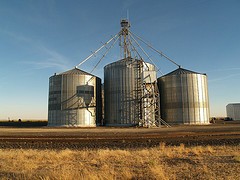
grain elevator flickr afilerGrant County, Washington has no shortage of food. There’s plenty of land devoted to growing wheat, potatoes, apples, mint, grapes, and peas in a county that ranked second in the state for agricultural sales in 2007.

But, according to the new USDA Food Desert Locator database and mapping program, nearly one in four county residents lives in a food desert with limited access to affordable and nutritious food. Roughly half of those people are low income.

When it comes to addressing obesity and hunger, food deserts are only one part of a much more complicated picture. They may be a problem for a relatively small percentage of households, and it’s easy to overstate their importance. But for someone living in one and having trouble meeting such a basic need as eating, it’s probably a big deal. At least in the US Northwest, new maps show a significant number of people who may lack easy access to affordable and healthy food live in rural areas, including places that grow huge quantities of food.

The new federal Food Desert Locator identifies census tracts that the USDA considers food deserts, which means the population has lower than average income and a significant number of residents (either 20 percent or 500 total) have low access to a large grocery store or supermarket. In urban areas, that means living more than a mile away from the grocery. In rural areas, the threshold is 10 miles.

In each food desert, you can zoom in on street boundaries and see how many low-income residents, kids, households without cars, and seniors live in that particular neighborhood.

You can certainly argue about whether the USDA food desert definition has any real meaning, and I get into the considerable limitations of the data below. But I was still a little curious about what the maps showed. So here are some charts ranking which counties in Northwest states (Washington, Oregon, Montana and Idaho) have the highest percentage of residents living in the USDA’s definition of a food desert:
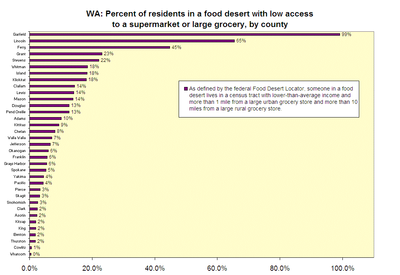
WA food desert chart

Click here for larger version of Washington chart.
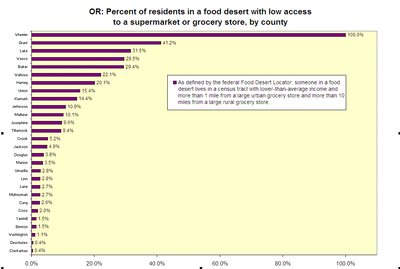
OR food desert chart

Click here for larger version of Oregon chart.
Read more

Stormwater Legislative Wrap Up

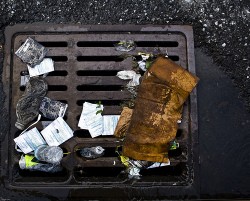
Trashed drain_Flickr_Chloe DietzNew rules approved by Washington’s lawmakers will cut the amount of salmon-harming copper,   toxic coal pollutants, and algae-stoking fertilizers that foul local waterways. Oregon legislators are halfway to approving a ban on copper brake pads—a ban that Washington approved last year.
It’s exciting news for Puget Sound, the Columbia and Willamette rivers, and countless other waterways threatened by the region’s fire hose of stormwater filth. But in truth, the stormwater cup is only half full as the Washington legislative session nears its close for the year. City and county organizations, green groups, and labor interests have again lost their fight to create a fee to pay for projects to reduce the stormwater runoff that imperils human health; salmon, orcas, and insects; and our buildings and roadways.

But let’s review the stormwater wins in more detail first.

Read more

Trading One Sippy-Cup Toxic for Another

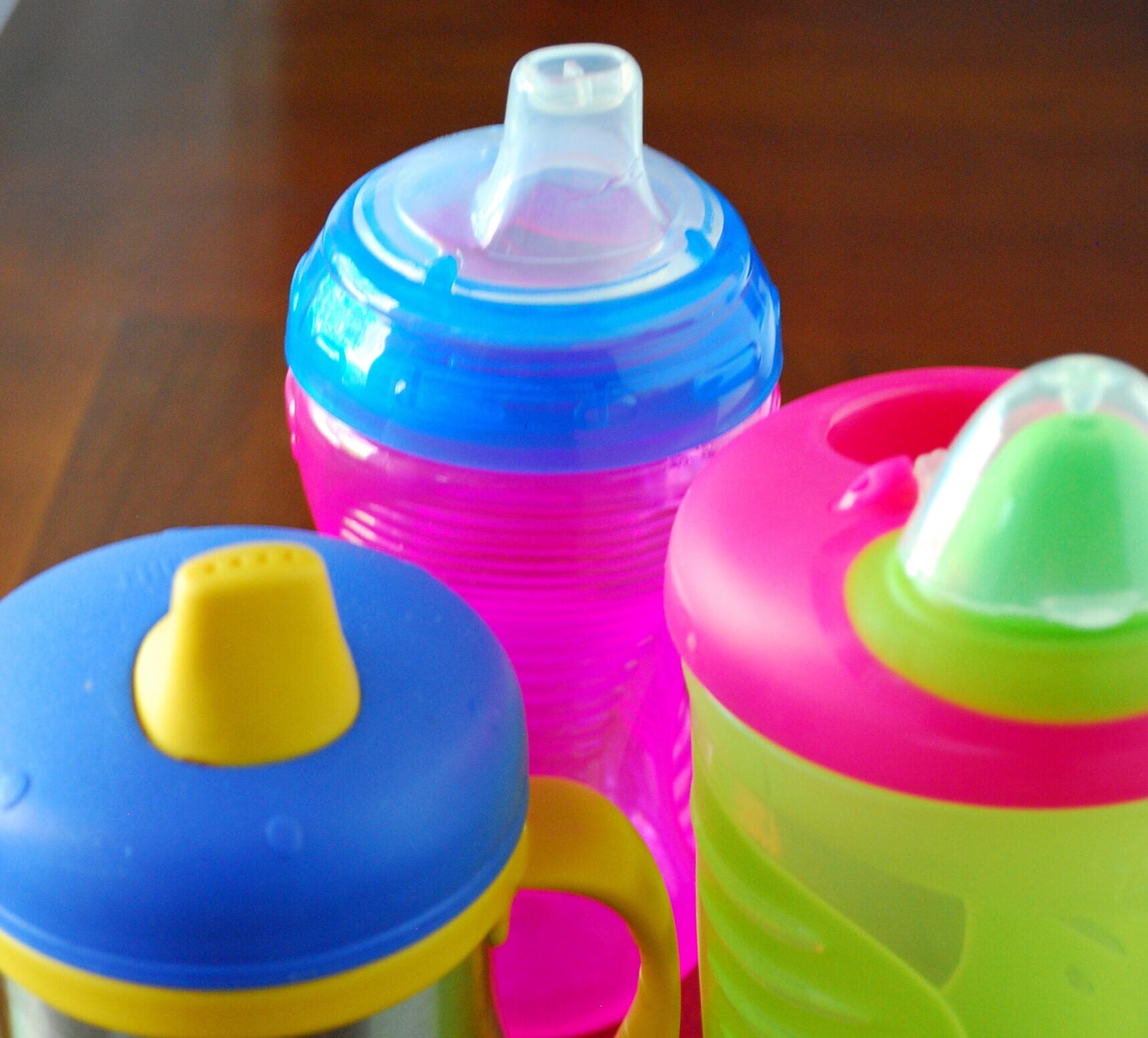
Colorful sippy cups on the table.

You’d think that humans would be smart enough to stop poisoning ourselves—or at least our babies. But, no.

Turns out that all the BPA-free products—the ones I’ve sought out to protect my dear little girl’s reproductive system and to ward off cancer and neurological problems—may have given me a false sense of security.

The power of concerned parents to get manufacturers—and sometimes governments (Maine just approved a ban on BPA in reusable food and beverage containers that will go into effect next year; Oregon is considering banning it in sippy cups and baby bottles)—to remove certain toxics from kids’ products can be a double-edged sword. The problem is that when we all got on the BPA-free bandwagon, BPA began to be replaced by other toxics—some of them known to be linked to health hazards and others totally unknown and untested!

Basically, we’re swapping one endocrine-system disrupting, cancer causing bisphenol for another. Dominique Browning, a blogger at Moms CleanAirForce and author of “Slow Love: How I Lost My Job, Put on My Pajamas and Found Happiness,” wrote about it in a New York Times op-ed this week:

Read more

Children in the Northwest

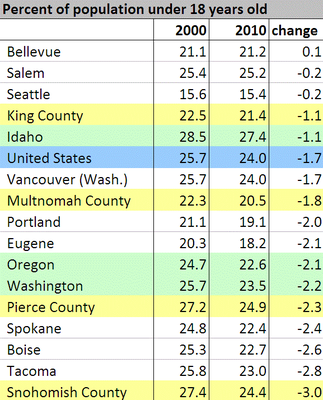
With the new 2010 Census data out, I thought it would be interesting to run the numbers on children in the Northwest. Like the nation as a whole, the region is aging. In many places, children now represent a smaller share of the population than they have in decades, and perhaps ever.

Here’s how the last decade shook out in the Northwest’s most populous areas:

kids table

In keeping with national trends, nearly every large city and county in the Northwest saw its percentage of children shrink. Yet three cities stood out as relative child magnets with basically stable shares of kids: Bellevue and Seattle (both in King County, Washington) and Salem, Oregon. No other populous area in the region even comes close.

The reasons for the declining share of children are manifold. The biggest driver is probably the demographic fundamentals, as the nation and region experience the cycle of baby boom, bust, and echo boom. Other factors include temporary effects such as (perhaps) recession-induced anxiety, as well as longstanding shifts like reductions in teen pregnancy, women delaying or declining childbearing, and families choosing to raise smaller numbers of kids.

Still, in absolute terms, most places added kids. Over the last 10 years, for example, Bellevue grew by nearly 13,000 people, about 2,800 of whom were children. Salem added nearly 18,000, including more than 4,100 children. And Seattle added about 45,000 people, including more than 5,800 in the under 18 set.

Below the jump, I’ve included more specific analysis for Seattle, where hand-wringing about children sometimes feels like a civic duty.

Read more

Rain Garden Goof in Ballard

For more than a decade, all of the eco-friendly stormwater projects that Seattle touched turned to green. The city rebuilt block after neighborhood block to incorporate rain gardens and other natural strategies that can clean up and reduce polluted runoff. The projects worked great: they showcased native plants and sucked up the extra rainwater like … Read more

It’s Raining Rain Gardens

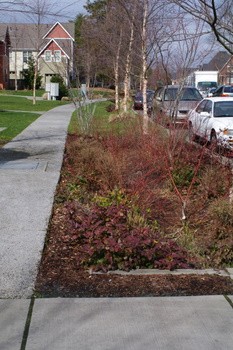
HP rain garden_StifflerResearchers have pointed the finger at stormwater runoff as the top source of pollution that’s getting into Puget Sound and other Northwest waterways. And because runoff comes from just about everywhere—roofs, roadways, parking lots, farms, and lawns—the solution has to be just as widespread.

Enter 12,000 Rain Gardens.

This week Washington State University and Stewardship Partners, a nonprofit working on land preservation, announced a campaign to promote the installing of 12,000 rain gardens around Puget Sound by 2016. The website even has a counter tracking the number of gardens and encourages folks to enter their rain garden into the database.

Here’s how a rain garden works. The garden is essentially a sloped ditch or pond that’s typically about 6 to 12 inches deep. The bottom of the depression is 1 to 2 feet of a soil mix that’s more absorbent than regular dirt. The garden is planted with shrubs and grass that can tolerate soggy soil.

Rain runoff is channeled into the garden, perhaps with a pipe that connects to a roof downspout or through a gap in a street curb that funnels road water into the depression. There’s also a route out of the garden should it overflow, which can be a drain linking to the stormwater system or into another area of the yard or road.

It’s a nice idea, but is 12,000 Rain Gardens just a feel-good gimmick that won’t amount to much?

I don’t think so, and in two words here’s why: Curtis Hinman.

Read more

A Reluctant Cyclist Hits the Road

I have a confession to make: I don’t own a bike. (Don’t tell any of my bike-loving coworkers.) Truth is, I hadn’t ridden a bike in over a decade—until last weekend. Six months ago I sold my broken-down, paperweight of a car and have been mooching rides for trips too far outside my neighborhood ever since. … Read more

All You Need to Know About Stormwater Runoff

Editor’s note: This blog is also available as a printer friendly pdf, and a similar version was published this week in Trim Tab, the publication of the Cascadia Green Building Council. 

A woman drowns when the basement of her Seattle home suddenly fills with a torrent of filthy water.

An overflow of 15 million gallons of sewage and stormwater fouls the shoreline of picturesque Port Angeles, putting the waterfront off limits to the residents and visitors of the Olympic Peninsula town due to health concerns.

Portlanders are socked with some of the nation’s highest water utility rates in order to pay for the city’s $1.4 billion “Big Pipe” projects.

Northwest scientists document coho salmon dying in urban streams with their bellies full of eggs, perishing before they can spawn.

Storm pipe_Flickr_Mike AncientThe culprit in each of these stories is the most mundane of villains: the rain. As rainwater streams off roofs and over roadways and landscaped yards, it mixes a massive toxic cocktail. It scoops up oil, grease, antifreeze, and heavy metals from cars; pesticides that poison aquatic insects and fish; fertilizers that stoke algal blooms; and bacteria from pet and farm-animal waste. A heavy rainfall delivers this potent shot of pollutants straight into streams, lakes, and bays—threatening everything from tiny herring to the region’s beloved orcas to our families’ health.

Stormwater doesn’t match the traditional image of pollution. There are no factory smokestacks belching waste, no pipes with a steady trickle of noxious industrial effluent. Despite appearances, stormwater packs a wallop. Polluted runoff long ago surpassed industry as the number one source for petroleum and other toxic chemicals that wash into the Northwest’s water bodies.

Each year, the Puget Sound is sullied by 14 million pounds of toxic chemicals and oil and grease—and that’s a conservative estimate.The amount of petroleum waste is so vast, it’s as if more than 70,000 cars pulled up to the beach and emptied their tanks straight into the Sound each year.*

Read more

Cities Slicker

Umbrella Man - flickr user Major ClangerThe Census Bureau makes it official:  center cities are hip.  According to a new analysis of data from the American Community Survey, over the past decade the number of 24-35 year-olds with college degrees grew by over a quarter in America’s central cities.  CEOs for Cities, which commissioned the analysis, has this to say:
In 2000, young adults with a four- ­year degree were about 61% more likely to live in close- ­in urban neighborhoods than their counterparts with less education. Now, these well- ­educated young adults are about 94% more likely to live in these close‐in urban neighborhoods.

Having graduated from that demographic myself, I’m old enough to remember when people felt like the city center had no future.  But now, downtowns are veritable magnets for the “young and restless” demographic.  Of course, not every young college grad chooses to live near downtown—yet in 36 out of 51 major cities analyzed, the growth rates for young educated folks were higher in the city center than in the suburbs.

Oddly, though, Portland was among the handful of cities where this wasn’t true.  And in Seattle, the city center just barely edged out the outlying suburbs in the growth rates for young college grads.

What gives in the Northwest?

Read more

Three (Unexpected) Reasons to Support Oregon's Plastic Bag Ban

I’ll admit it:  I’m a bit of a skeptic about the anti-plastic bag hullabaloo. Just about every study I’ve seen suggests that, when you compare plastic bags with paper grocery sacks, plastic is the unexpected winner:  they produce less air and water pollution, take up less space in landfills, consume less energy over their life cycles, take less energy to recycle, and are responsible for lower levels of global warming emissions.  

null

And I’m not just talking about industry-funded studies either:  as far as I can tell, disinterested academics find the same things.  This old Washington Post infographic isn’t definitive, but does a decent job of summarizing the statistics.

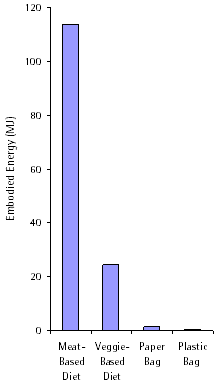
But perhaps more importantly, all the attention that gets focused on the paper-vs.-plastic debate is something of a distraction.  When we looked at the issue a few years back, we discovered that the environmental impact of decisions in the grocery aisles were way, way more important than bag choices. The chart to the right shows the “embodied energy” in a high-carbon sack of groceries, a lower-carbon alternative diet, and in the bags themselves.  Clearly, if you don’t think about the impacts of your personal choices until you’re in the checkout line, you’ve waited too long. 

So given all that, why do I think that the proposed Oregon law to ban plastic bags deserves lawmakers’ support?

Three reasons:

Read more

×