Donate Newsletters

Talking Points: Middle-Out Economics

You may have noticed that President Obama recently started talking about middle-out economics—the idea that a thriving economy doesn’t start with the ultra-rich or with big corporations but, instead, with ensuring financial security for regular Americans.

But Obama didn’t coin the phrase middle-out economics. That honor goes to Seattle thinkers Eric Liu and Nick Hanauer, authors of The Gardens of Democracy and The True Patriot, and co-founders of the True Patriot Network. Liu and Hanauer present compelling evidence that the real job creators in the American economy are ordinary working families. When wealth concentrates only at the very top, ordinary folks have less to spend, and businesses have fewer customers. But when more Americans have a chance to attain financial security, our economy gets stronger.
Read more

Let’s Get Visual

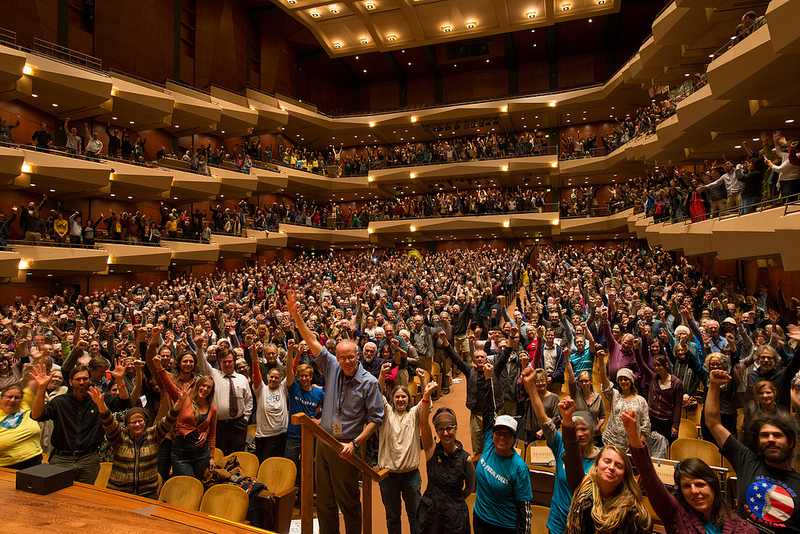
It’s time to get serious about getting visual. Leaving photos and video out of our communications, or dropping them in as mere afterthoughts, equates to lost opportunity. Here’s why.

First, despite our better judgment, emotions drive our decisions. Neuroscientists, using highly sensitive brain scanning technology, have shown that our decisions and actions are based more on emotional reactions than rational thought.

Second, humans are a visual species. Pictures and text reinforce one another; in cognitive science this is called dual coding theory. Pairing words with visuals enhances not only attention, but believability and memory recall. In one study, adding visuals to a presentation boosted recall from 10 percent to 65 percent.

All this has a lot to do with the fact that visuals can quickly evoke emotion, more quickly and in ways that words alone cannot. In fact, the right images can activate mirror neurons, where your brain responds as if you are feeling what you see someone else experiencing.

It all adds up — with good visuals, we invite our audiences to feel first, then to think, and this has the potential to cement our message in their minds.

Read more

Finding Common Ground on Climate Change

Yale and George Mason University recently asked American Republicans and Republican-leaning Independents about their views on energy and climate change.

The good news: There are ways to find common ground across political divides.

Republicans prefer clean energy as America’s energy future

A large majority of respondents (77 percent) support using clean, renewable energy in the US much more (51 percent) or somewhat more (26 percent) than it is used today. Among those who support expanded use of clean energy, 69 percent feel we should be taking action immediately.

Only 9 percent think we should use clean energy less in the future and only 8 percent think the amount we’re using now is just right.

A slight majority (52 percent) supports using fossil fuels in the US much less (21 percent) or somewhat less (31 percent) than we do today. Among those who’d like to see less fossil fuel use, the most common preference is to do it “immediately” (52 percent).

Notably, the terms that resonate most for describing energy types are “fossil fuel”—over terms like conventional energy or dirty energy—and “clean energy”—rather than terms like renewable or advanced.

Read more

Talking Points: Why Taxes Matter

“Taxes are what we pay for civilized society.”

Oliver Wendell Holmes, Jr. said it nearly a century ago. And, “no one’s said it better since,” New Yorker staff writer and Harvard professor Jill Lepore reminds us, “and that, right there, is the problem.”

[P]oliticians don’t like to talk about taxes, except to use them the way a matador uses a red cape. Those interested in getting voters to seethe will find no means easier. Read their lips.

The persistence of anti-tax rhetoric in the US is especially strange, Lepore points out, given that “ninety percent of Americans receive direct social or economic security benefits from the federal government.” Yet we find it easier to see what we pay than what we get.

It’s a failure not only of attention but also of communication: scarcely anybody reminds us what taxes actually fund. We talk about taxes without connecting them to the countless systems and structures that make our society tick, the protections that keep us safe and secure, and the investments and infrastructure that make up the foundation of our economy—benefits we all rely on and take advantage of, every day.

Read more

Climate Message Essentials for All Six Americas

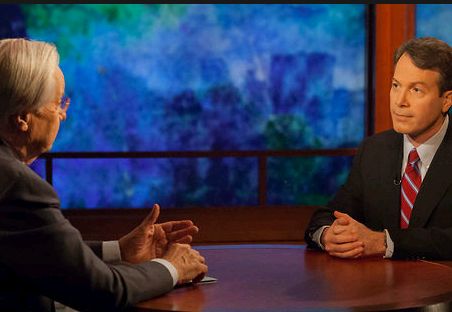
If you haven’t yet watched Bill Moyers’ interview with research scientist and climate change communication expert Anthony Leiserowitz, I recommend doing it ASAP. (Stream it on the Bill Moyers & Co website).

Meanwhile, here are some top takeaways for climate messengers.

×