In the last 20 years, we’ve learned more and more about air pollution from Asia that blows across the Pacific Ocean and falls out of the atmosphere here in the Northwest.
But a recent study poses an interesting question, particularly in light of efforts to block Northwest coal export terminals: How much of the industrial pollution we get from fossil fuels burned in China is arguably because of us?
The Bakken oil train that derailed and exploded in Lac-Mégantic, Quebec killed 47 people. It also made clear that the oil-by-rail industry is radically underinsured for the risks of shipping volatile Bakken crude. The financial risk falls instead on the taxpayers who would ultimately be expected to pick up the nearly incalculable costs of an oil explosion in an urban area.
The Lac-Mégantic disaster generated an estimated $2 billion in liabilities with the cleanup alone projected at $200 million. The train’s operator, MM&A, a short line railroad transporting the crude from a Canadian Pacific (CP) yard to a refinery in New Brunswick, had just $25 million in liability insurance. Soon after the accident, MM&A filed for bankruptcy protection. So far, the Canadian federal and provincial governments are paying the cleanup costs.
Under Quebec environmental law, the government can order the owner of spilled hazardous material to pay for and manage the cleanup, and the province ordered the US-based oil service companies involved with the crude oil shipment to take over the cleanup. These companies have refusedQuebec’s order. They are in court fighting the government, just as they are fighting the wrongful death lawsuits filed on behalf of the town’s residents.
These oil service companies claim that, through the complicated legal structures used to ship oil, they were not technically the owners of the oil at the time of the explosion. The wrongful death lawsuits are not expected to be settled for years. Just so, CP Railway, which hauled the oil from North Dakota before turning it over to MM&A, and Irving Oil, whose refinery was the final destination for the oil, are also resisting legal liability.
Underinsurance is the norm
Tank cars are almost all owned by shippers and leasing corporations, not railroads. Railroads, however, operate under a “common carrier obligation,” which prohibits them from refusing to haul any legally allowable load even if would be inconvenient or unprofitable. In other words, they are actually required by law to transport hazardous materials, including volatile Bakken crude oil, in unsafe legacy DOT-111 tank cars until such time as the federal regulator determines these tank cars are no longer okay to use. And if the railroad hauls it, then they are liable for it.
After a string of high profile derailments and explosions, communities across North America are rightly concerned about the risks of an oil train explosion. Railroad workers generally do an excellent job of moving cargo through cities without incident. Yet accidents do occasionally happen; and in an era when a derailment might lead to a deadly explosion in an urban area, it’s worth understanding the risks more thoroughly.
So to get a better sense of the threat to local areas in the Northwest, we investigated accidents reports submitted to the US Federal Railroad Administration (FRA) to map every derailment in the Northwest from June 2011 (when regulators began requiring railroads to report the exact location of mishaps) through December 2013. Here they are:
[sightline-embed]
Our map shows 81 derailments in the first half of 2011 (yellow); 95 in 2012 (orange); and 100 in 2013 (red). You can zoom in, scan, and click on the markers to find some basic information about each of the derailments.
The board president of an environmental group, who is on the board of a second, will soon leave his partnership with a major law firm to go to work full time in support of coal exports, according to knowledgeable sources in the legal community.
Media accounts of the Lynchburg oil train fire are routinely misreporting that the tank cars belong to the CSX railroad. In fact, CSX does not own the tank cars. As we pointed out in our train spotting piece, their true ownership is revealed by the markings on their sides, CBTX or CTCX, that are clearly … Read more
Update 5/19/2014: USDOT Secretary Anthony Foxx has now confirmed that the tank car that exploded and leaked oil into the James River was built to the newer CPC-1232 standard. But he didn’t say exactly how the tank car was breached, or if damage to the CPC-1232’s bottom outlet valve contributed to the fire. We expect to see this information when the NTSB comes out with their preliminary report in a few weeks.
Update 5/9/14: Preliminary reporting and statements by the NTSB confirm our findings here. At least 14 of the 17 derailed cars appear to be the newer CPC-1232 model; the other three have not yet been determined. (This article at Reuters says 10 of 13 were the newer model.)
In the wake of several high-profile oil train explosions, the industry has tried to assuage public fears by pointing out that it is building newer, and allegedly safer, models to haul crude oil. But yesterday, the alarming derailment and inferno in Lynchburg, Virginia clearly involved the newer-standard tank cars.
Take a close look at this footage from a drone posted by East Coast Drone:
Or take a look at the AP photo posted by Think Progress of the derailment. (Or glance at the dozens of high-quality images of the train derailment on the AP website.) Many of the tank cars, including at least one in the river, have a half-height head shield, which indicates that these were built to the standard, known as CPC-1232, adopted by the industry for tank cars ordered after October 2011.
Here are some of the questions we will be following as the investigation progresses:
** Was this unit train made up solely of the newer CPC-1232 tank cars? Tesoro and a few other oil-by-rail operators have said they can make oil-by-rail safe by requiring tank cars serving their facility to be newer-model.
** Were legacy tank cars mixed in with CPC-1232 tank cars, and did the older tank cars explode? In the drone video starting at 1:21 it looks like a number of the tank cars may not have the half height head shield, which would suggest they are the older legacy version, but it is difficult to tell from the video angle and resolution. (Notably, the industry has essentially told the federal government that it does not intend to phase out any of the older and notoriously unsafe models in the next few years.)
It remains to be seen whether the fire resulted from the newer cars, the older ones (if there were any), or from a combination of them. Either way, it’s a serious problem. If the train was composed solely of new-model tank cars, the Lynchburg accident may be evidence that crude oil trains are inherently unsafe regardless of the tank car models in use.
Editor’s note: The report referenced below is a living document, and Sightline researchers update it regularly to reflect new developments. For the most recent facts and figures, please see the report, The Northwest’s Pipeline on Rails.
Sightline is re-releasing a popular report: The Northwest’s Pipeline on Rails. It’s the most comprehensive regional analysis of plans to ship crude oil by train. This update includes important new information showing far greater increases in oil train transport than previously thought. All told, the Northwest could soon be seeing 858,800 barrel of oil by rail per day—that more than the Keystone XL Pipeline would move.
Original Sightline Institute graphic, available under our Free Use Policy.
Moving large quantities of oil by rail would represent a major change for the Northwest’s energy economy, and the plans now in development puts the region’s communities at risk.
Why does it matter?
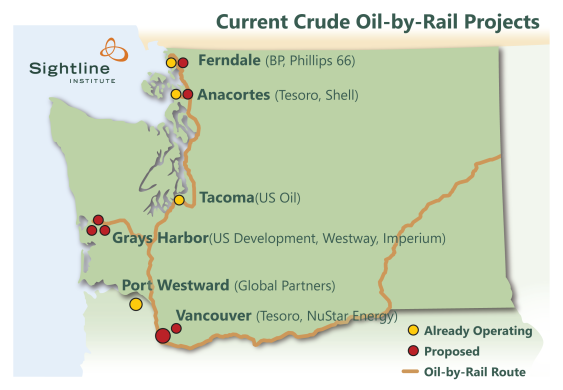
In Oregon and Washington, 11 refineries and port terminals are planning, building, or already operating oil-by-rail shipments.
If all of the projects were built and operated at full capacity, they would put more than 12 loaded mile-long trains per day on the Northwest’s railway system. Many worry about the risk of oil spills from thousands of loaded oil trains that may soon traverse the region each year.
Word is that a crude oil-bearing train derailed in downtown Lynchburg, Virginia and caught fire. Photos and preliminary coverage here. Additional coverage here. There’s particularly good coverage on Huffington Post, here, and at the Roanoke Times, here: A CSX train carrying crude oil derailed Wednesday afternoon by the James River in downtown Lynchburg, sparking a massive … Read more
The time is ripe for divestment from the fossil fuel industry. Although we usually think about divestment as reallocating long-term financial holdings, it can take a much more direct form. If your business or organization objects to the outrageous harm caused by coal, you can vote with your pocketbook: you can choose not to do business with coal agents in the Northwest.
It’s an ideal that the firm apparently thinks plays well with the public, but it is inconsistent with their work supporting large-scale coal exports on Puget Sound.
In a classic instance of the revolving door between government and industry, Governor Inslee has decided to hire Matt Steuerwalt as the director of his policy office effective May 1. In recent years, Steuerwalt has acted as a lead lobbyist for coal-fired power in Washington, as well as for a now-defunct coal export proposal. The news was first announced by Steuerwalt in a mass email sent last night.
The state is now wrestling with two major policy issues connected to coal: whether to permit large-scale coal export terminals and whether to phase out coal-fired electricity imported from other states. Given that Steuerwalt has recently been a paid lobbyist in support of coal in Washington, the move raises question about whether he will use his influence in the Inslee administration to advance an agenda more favorable to the coal industry.