Donate Newsletters

The Wall Street Consensus: Coal Exports Are Risky Business

As Eric mentions below, Goldman Sachs just sold its interest in the Gateway Pacific coal export project to a Mexican billionaire. It’s far too soon to say what this development will mean for Gateway’s prospects. But when coupled with Ambre’s difficulties finding new financing, Goldman’s move underscores an important new reality: Wall Street now views Northwest coal exports as too risky to touch.

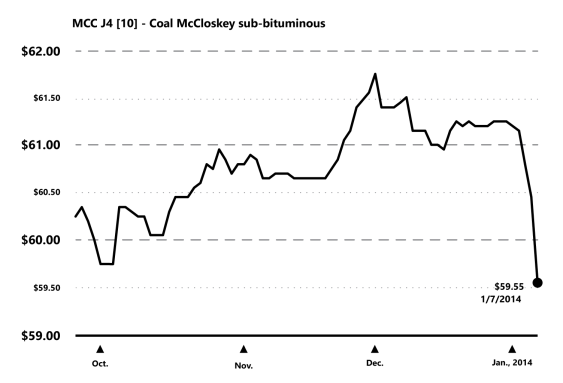
And for good reason. Pacific Rim coal prices have taken a severe beating over the past few years, with prices for benchmark Australian coal falling from more than $132/ton in early 2011 to less than $78/ton in September 2013. And after clawing back a few dollars late last fall, Pacific Rim coal has been caught in yet another sell-off over the past week, as shown in this chart of Indonesian sub-bituminous coal futures…
coal_graph_remake-010814-150ppi

So it could be that Goldman got out of the coal export business just in time. Of course, they had plenty of warning: Wall Street analysts have been issuing increasingly dire assessments of coal export prospects for more than a year. Take a look:


Read more

Another Oil Train Blows Up, Because That’s What They Do

This one in New Brunswick: A Canadian National Railway Co. (CNR) train carrying crude oil and propane derailed in the eastern province of New Brunswick and sparked a blaze that was still burning more than 12 hours after the accident. A helicopter is being brought in today to pinpoint what is ablaze in the wreckage … Read more

Is the Smart Money Bailing on Northwest Coal Exports?

The news is everywhere: finance titan Goldman Sachs is selling off its stake in SSA Marine, the would-be coal exporter of Whatcom County. (To be precise, Goldman Sachs Infrastructure Partners, a subsidiary of the big firm, is selling its stake in FRS Capital Corp and Carrix, the parent companies that house SSA.) Many see the move as a major bet against the economic viability of Northwest coal export schemes.

Though it is important to remember that SSA Marine is a big company with a range of port terminal holdings around the globe, there is evidence for believing that the sale is connected to worries about coal.

As usual, Crosscut’s Floyd McKay has some of the best coverage:

Goldman Sachs last July posted a warning for investors that coal exports would decline in future years. Tuesday’s announcement prompted a prominent coal opponent, Crina Hoyer of ReSources for Sustainable Communities, to say, “Goldman Sachs’ stepping away from coal export is yet another sign from Wall Street that coal export is a losing investment.”

Just as interesting as Goldman bailing out is that a billionaire Mexican investor, Fernando Chico Pardo, is stepping up to buy the 49 percent equity stake Goldman is unloading. Pardo is a longtime partner of oligarch Carlos Slim, one of the richest people on earth and the dominant player in numerous economic sectors of Mexico.

Read more

Oil Trains: What You Should Be Reading

Screen shot of BBC footage of ND oil train explosion.

With the recent blow-up in North Dakota, it seems everyone is (finally) paying attention to the risks of oil train explosions. I’m planning more analysis of the issue later, but for now here’s a roundup of some of the better pieces to read on the subject.

Hands down, the best reporting on the risk of oil-by-rail is coming from Canada’s flagship newspaper, the Globe and Mail. Grant Robertson’s first-hand investigation into the Bakken oil industry is particularly noteworthy. Among the damning findings:

A four-month investigation by the Globe and Mail found the oil being shipped from the Bakken region—which straddles North Dakota, and parts of Manitoba and Saskatchewan—is far more volatile than regulators and railways believed. The Globe found evidence that companies often don’t test their oil shipments for explosiveness before sending the trains, since crude oil, though flammable, hasn’t historically been considered extremely combustible.

The investigation also found that as more oil moved by rail in the past few years, no additional safety regulations were put in place by regulators to govern this growing method of shipping crude.

Robertson also had a good piece connecting the recent explosion in Cassleton, North Dakota to the lethal explosion in Lac-Mégantic, Quebec. For further Globe and Mail coverage of the North Dakota incident, I recommend the following: Town ‘Dodged a Bullet’ in Oil-Train Explosion, North Dakota Mayor Says; Booming North Dakota Takes Latest Oil-Train Wreck in Stride; and Pollution Level Dropping After Oil Train Crash in North Dakota.

Read more

King County Stands Up To Coal

Yesterday afternoon, the most populous and economically dynamic county in Washington stood up to coal exports in a big way.

The King County Council issued a strongly-worded resolution taking direct aim at coal. The official statement expresses deep concern about coal export terminal proposals and calls for a broad review of the impacts on Washington and beyond. It calls on the federal government to reduce greenhouse gas emissions and review leasing practices in the Powder River Basin. The resolution is, I believe, one of the strongest anti-coal statements yet seen from a local government in the Northwest.

Remarkably, the motion passed unanimously. Although the council is nominally nonpartisan, four of the nine members are Republican-aligned (of whom three were in attendance).

Read more

Washington’s Oil: Where Does it Come From and Where Does it Go?

As a raft of oil-by-rail projects in the Northwest has gotten underway, I’ve been asked by any number of folks about the source of Washington’s oil. So as a reference point, here are three snapshots of the state’s oil flow, circa 2011. All of the charts below are taken directly from a report from the Washington Department of Ecology.

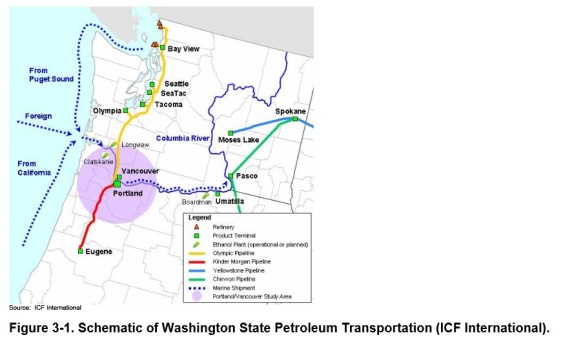
Here’s a map—click to enlarge it—of the routes taken by refined products in Washington.

ScreenHunter_239 Dec. 04 10.18As the Ecology report explains, fuels refined in Washington—mainly at the four refineries indicated by red triangles in north Puget Sound—travel along the Olympic Pipeline to terminals located nearby and to Portland. From Portland, some of the fuel is barged to a terminal in Pasco. Eastern Washington gets the balance of its gasoline and diesel from Montana and Utah via pipeline.

Read more

Video: Sightline On Oil Trains

For your viewing pleasure, I give you two takes on how fossil fuel export plans could reshape life in the Northwest. Number one, a forum on oil transport hosted by Washington Environmental Council. My act, which provides an abbreviated overview of the changing nature of oil in the Northwest, starts at about 6:10 here: You … Read more

US Oil Train Trends: Four Basic Pictures

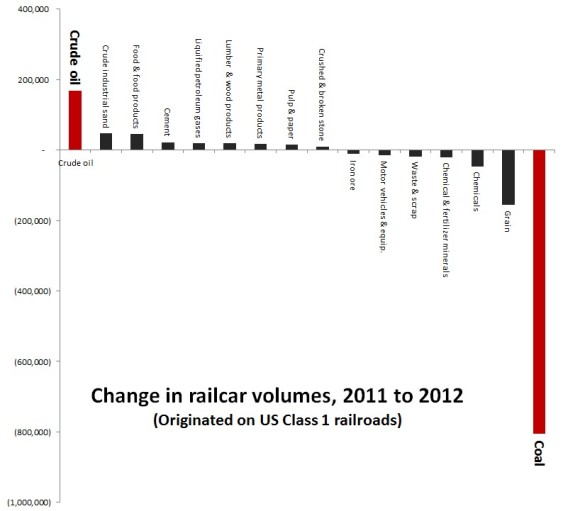
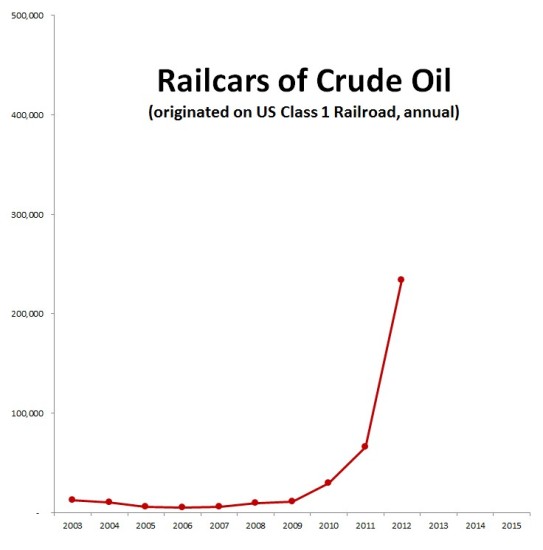
Oil-by-rail schemes are popping up across the Northwest and beyond, raising serious questions about public safety given that they have a nasty tendency to explode catastrophically. Even more worrisome, oil train numbers are increasing at a rate so astonishing that we cannot rely on historical trends or safety statistics. To illustrate the new era of freight rail, I put together four charts drawn from data published by the American Association of Railroads.

Oil is far and away the fastest growing type of freight hauled by rail in the US (although its increase does not come close to offsetting the recent precipitous decline in coal transport).

change in railcar volumes

From 2009 to 2012, oil by rail volumes multiplied more than 21 times, from fewer than 11,000 railcars nationally to well over 230,000:

oil train volumes, annual

Read more

Cloud Peak Lost Money Selling Coal to Asia

If any company can profit from exporting Powder River Basin (PRB) coal to Asia, it’s Cloud Peak Energy. The company’s Spring Creek mine offers a shorter rail trip to West Coast ports than many other PRB mines, saving a few dollars on rail costs. And because its coal has a slightly higher energy content than most other PRB coals, it earns a premium in Asian coal markets. With those two advantages, Cloud Peak can earn money on Asian coal exports when its competitors are still racking up losses.

That makes Cloud Peak a bellwether for the financial prospects of Powder River Basin coal exports. When Cloud Peak isn’t making money on exports, nobody else in the PRB is either.

And that makes the company’s third quarter earnings announcement quite a shock: Cloud Peak’s management announced that the firm’s export arm is now losing money selling its coal to Asia.

Read more

×