


Editor’s note: We’re curious what readers think of this series. Is it useful? What do you like most? How can we make it better? Leave a note in comments.
Eric dP:
My top recommendation this week goes to James Wells’ righteous rant at Daily Kos, “Pretty Much the Dumbest Idea Ever.” Wells unleashes a real fire-breather on the Northwest coal export plans:
The plan is to dig up two trillion pounds of rocks and ship them 6,000 miles to China. There they will light those rocks on fire, so they can make more pieces of cheap plastic crap that we will buy and then owe them even more money, while we choke on their pollution. What could possibly go wrong?
In the year 2012, if this is the best new project we can think of to improve our livelihood, we are in serious trouble.
Considerably more measured in tone, I also recommend the Economist on the inevitable decline of American coal.
I also appreciated Judy Lightfoot’s Crosscut piece on Seattle’s new “safe parking” program. It’s an issue that’s literally close to home for me. A surprising number of individuals and families in my neighborhood live a precarious existence out of their vehicles, always at risk of running afoul of parking enforcement or more serious safety problems. Kudos to Councilmember Mike O’Brien for shepherding through the city’s new program that will provide a measure of relief for those folks.
Alan:
In the New Yorker, Ryan Lizza gets a deep, inside look at the Obama presidency. Lesson: Sure, he and his team made some misjudgments, but mostly, the US Congress is broken. (It’s the best thing I’ve read in the New Yorker since Lizza’s 2010 piece on how the White House missed its chance to pass a climate law.)
Clark:
Here’s a fascinating article on the work of “free” parking critic Donald Shoup. Some key quotes:
“Shoup’s writings…can be reduced to a single question: What if the free and abundant parking drivers crave is about the worst thing for the life of cities?”
“L.A. wasn’t built around the car. It was built around the parking lot.”
There’s a description of a 1975 study of the effect of free parking on commuting:
“[C]ounty workers were offered free parking downtown when federal workers had to pay…72 percent of county workers drove to work alone…but 60 percent of federal employees carpooled, took public transportation, or even walked. These were workers in the same professions, driving to the same location.” When forced to pay a practical value for their parking, drivers were twice as likely to carpool—traffic congestion was halved, carbon emissions were halved.
And here’s a science experiment that’s been running continuously since 1927.
Anna:
The proprietor of Café Solstice, one of my favorite Seattle coffee shops, turned me on to this alternative wind energy harvesting technology. Stalks! Gigantic cattails that sway in the breeze! Wind power without the blades. They’re quite stunning, IMO, and they have the potential to collect abundant clean energy without some of the pitfalls of wind turbines (noise, bird kills, friction loss).
The designers, Atelier DNA, came up with the idea for the planned city Masdar, a 2.3-square-mile, automobile-free area being built outside of Abu Dhabi. The wind park becomes a pleasant public space, designed to encourage plants and places to sit and walk. I don’t know how feasible any of this is or how efficient it is at capturing wind energy. But it looks cool.
Eric H:
What’s that? Seattle crept into the #1 spot for most philanthropic city in the country (with Bellevue also cracking the top 10?). We feel the love on a regular basis, thanks to our supporters. (H/t to Sightliner Migee Han.)
Here’s a video explaining 10 common misconceptions. E.g. Great Wall of China—not the only thing visible from space (or really that visible, in fact).
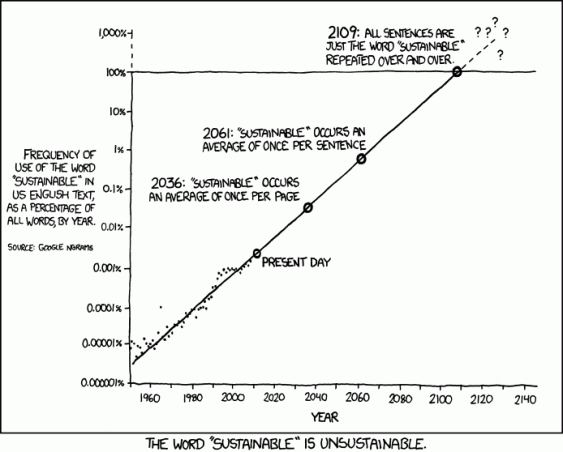
We’ll end with some bad news for Sightline: the word “sustainable” is unsustainable. We’re looking at putting an economy wide cap on the word to help extend our time:


Love, love, love this series. In fact, I make it a point to check out the blog (if I haven’t already earlier in the week) to make sure I see it on Fridays. Please keep it up!
Love this series too. I use it to open up a bunch of tabs in my browser then spend the weekend slowly reading and closing them.
My favprite section. I always read it first when I get my weekly reminder mail.
d’accord. It’s always great to get a digest of what interests the geeks at Sightline – even if I don’t get to all of them every week. And of course I use the word geek with the greatest affection….
I love this series too. As an Alaskan, I’m a little outside the area of a lot of your stuff, but I always look at the “weekend reading” posts.
Since weekends are the time I actually have to read, and many other sites don’t add content on the weekends, I’m a huge fan of this.
This reminds me of an exercise we did in my environmental impact statement class at Huxley in 1976.
We took the following data:
a) number of EISs published per year, 1969 – 1975
b) average number of pages per eis, 1969 – 1975
and
c) number of copies of each EIS printed, as shown in the EIS
Needless to say, this was a period when all three of these independent variables was rising rapidly.
We concluded that by 1994, every tree in the world would be consumed to publish environmental impact statements.
The same professor taught me that 7% per year electricity growth was not a long-term trend. Eventually we’d all fry from the corona effect.
To change subjects slightly, on the “meaning” of “sustainable.”
If someone says his marriage is “sustainable” is that a positive characterization?
—
Big fan! Love the references to nice long articles full of information for leisurely perusal – not the little snippets that are good to see on work days. I think it’s “just right”.