Donate Newsletters
Home » Sustainable Living » Lane County’s Latino Residents

Lane County’s Latino Residents

SwatchJunkies

May 8, 2012

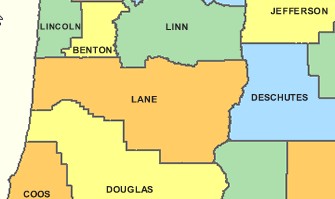
Sightline is working with University of Oregon Planning Professor Gerardo Sandoval to develop indicators of equity and sustainability for the Eugene-Springfield metro area, with special attention to the Latino community.

So, as part of our ongoing work on Cascadian demographics, I thought it worthwhile to see what recent Census numbers say about the distribution of Lane County’s Latino residents. (Last month, we conducted a state-by-state analysis of Latino residents in the Northwest.)

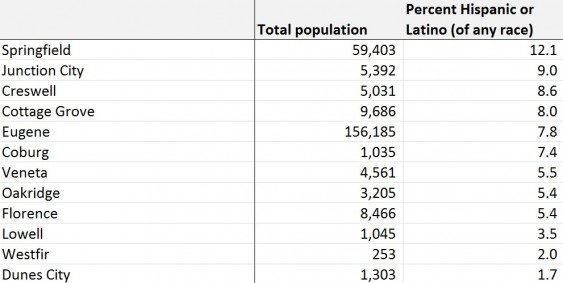
Here’s a rank-ordered view of the Lane County’s cities:
And here’s how Lane County’s demographics look when sliced by metropolitan area:
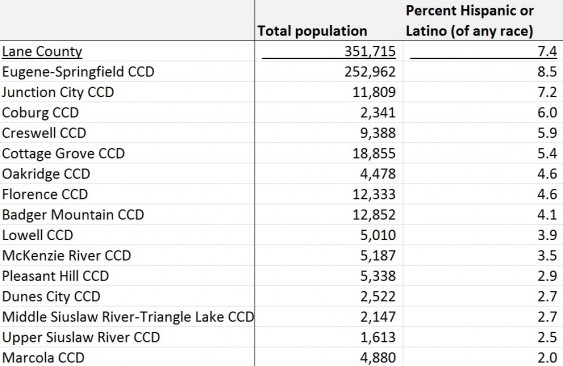
 

(“CCD” means “Census county division.” CCD’s are, basically, geographic areas that the US Census Bureau invents to provide information on clusters of people that don’t fall neatly along municipal or other boundaries.)

Finally, here’s a look at how Lane County’s Hispanic population breaks down.
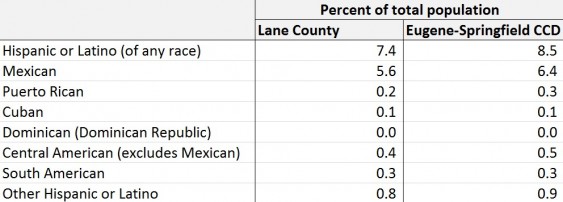
As in most of the Northwest, the vast majority of people in Lane County who self-identify as Latino also identify themselves as having Mexican lineage.

Notes and methods: I used data from the US Census Bureau’s 2010 Census Summary File 1, “Table QT-P10:Hispanic or Latino by Type: 2010.” Data refer to residents who self-identify as “Hispanic or Latino (of any race).” In this post I’ve used the terms “Latino” and “Hispanic” interchangeably.

Talk to the Author

SwatchJunkies

Talk to the Author

Eric de Place

Eric de Place spearheaded Sightline’s work on energy policy for two decades. A leading expert on coal, oil, and gas export plans in the Pacific Northwest, he is an authority on a range of issues connected to fossil fuel transport, including carbon emissions, local pollution, transportation system impacts, rail policy, and economics.

About Sightline

Sightline Institute is an independent, nonpartisan, nonprofit think tank providing leading original analysis of democracy, energy, and housing policy in the Pacific Northwest, Alaska, British Columbia, and beyond.

For press inquiries and interview requests, please contact Martina Pansze.

Sightline Institute is a 501(c)3 non-profit organization and does not support, endorse, or oppose any candidate or political party.

See an error? Have a question?

Find the author's contact information on our staff page to reach out to them, or send a message to editor@sightline.org.

Thanks to Ruth Haasl & Deborah Wiese for supporting a sustainable Cascadia.

Our work is made possible by the generosity of people like you.

×
Privacy Overview
Sightline Institute

More information about our privacy notice

Strictly Necessary Cookies

Strictly Necessary Cookie should be enabled at all times so that we can save your preferences for cookie settings.

3rd Party Cookies

This website uses Google Analytics to collect anonymous information such as the number of visitors to the site, and the most popular pages.

Keeping this cookie enabled helps us to improve our website.

Additional Cookies

This website uses social media to collect anonymous information such as which platform are our users coming from.

Keeping this cookie enabled helps us better reach our audiences.