


Here’s a blast from the past: WSDOT’S early forecasts, dating from 2002, of traffic on the SR-520 floating bridge after the start of tolling. Depending on the tolling scenario, WSDOT predicted that the floating bridge would carry between 90,000 and 98,000 cars per day in the first year of tolling, down from a projected baseline of 118,000 cars per day with no tolling. (The report isn’t available online, but I’ve uploaded a scanned copy here.)
But the reality for January through June, the first six months of tolling: an average of 63,500 cars on weekdays, down from a baseline of 101,100 weekday cars the prior fall. When you include weekends as well, the trends are even more striking, with a dip to fewer than 57,000 cars per day.
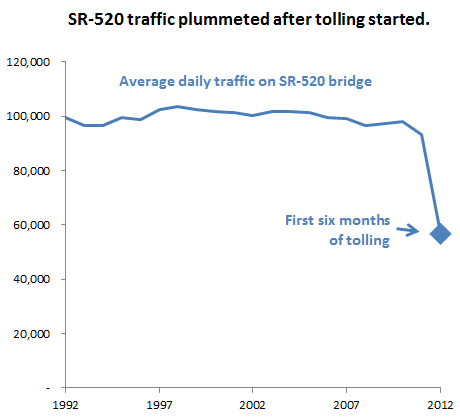
WSDOT’s early forecasts were doubly mistaken: they overestimated the growth in the traffic baseline from 2002 to the time that tolling started, and they underestimated how many cars would avoid 520 after tolling began (even though they knew there were toll-free alternatives just down the road). It’s almost as if there’s a pattern here…as if, just maybe, the Puget Sound traffic models just don’t work all that well.
In fact, given the numbers to date, I think it would be fair to ask whether WSDOT really knew what it was doing when it decided that it absolutely needed to build a 6-lane bridge.


Sweet. Let’s start tolling I-5 and I-90. Balance out the cross-lake traffic between the bridges and reduce congestion at the 5/520 merge.
If only we could! State law only allows tolling a bridge to pay for that particular bridge. What a difference it would make if a toll could have been added to the I-90 floating bridge as well.
Is that right? I thought that I-1125 tried to make facility-specific tolling state law, but it failed at the polls.
To gain a sense of the full picture, what happened to traffic numbers on parallel routes? What do we expect might happen with traffic volumes on 520 (and parallel routes, for that matter) if tolling starts on I-90? (I expect some of the traffic from I-90 would probably shift back to 520…but how much?)
Great idea. I’ll put that on my to-do list. I think it’ll mean diving in to lots of old pdfs to find traffic trends on SR-522. And I’m not sure what I’ll do about traffic on the south end. (Some traffic that might have gone on I-90 might have shifted south because of increased I-90 congestion.)
Clark,
Can you post a similar graph for I-90 traffic counts?
good idea. I think I’d need to include SR-522, though, which could take me a while. I’ll see if I have time!!
drat. I just checked the numbers, and it may be even harder than I thought to come up with apples-to-apples comparisons for I-90. The problem is that the state reports all-week averages in its Annual Traffic Report, and weekday traffic in its biennial Ramp and Roadway report. But I haven’t seen published figures that line up with the Annual Traffic Report — which best lines up with the trend above.
This is all exacerbated by the problem I’ve noted before with the baseline against which this year’s traffic is being judged: WSDOT’s reported baseline was from from October-December 2011, but traffic volumes are light in the late fall. This “low baseline” issue could make their reported 520 declines seem small, and their diversion to I-90 seem large.
So in short, I may need to wait for WSDOT to release some more data if I’m going to make an accurate chart.
Makes sense to me. Thanks for checking.
A timely reminder that models typically have sufficient degrees of freedom to allow modelers to have them predict anything they’re motivated to massage out of the data – crucially often without even consciously realizing that this is what they are doing.
I couldn’t have said it better.
The statistician Nate Silver (of FiveThirtyEight, the election modeling/statistics blog with the NYT now) has a book coming out on Sept 29th called “The Signal and The Noise” which should be quite appropriate reading for everyone, but particularly the people at WSDOT, who are interested in these kind of subjects. For all I know it could even have a chapter directly related to this kind of thing.
Traffic modelers are notorious for bad predictions when something unusual happens, like the start of tolling, or the shut down of a road. It’s simply bad modeling – you need different kinds of data for each such unusual contingency. Often the proper studies simply haven’t been done. Simple, rule-of-thumb elasticities can sometimes be very misleading in such situations.
Economic forecasters are just as bad, as they don’t include good data on critical global trends, such as world oil production. And here the uncertainties are great enough that what you really need are scenarios.
I think that you have clearly left out of your report some relevant data that clearly illustrates that the State is using the available forecasting tools to the best of their ability to help advise decision makers. Here are several things that your limited article doesnt point out:
1. You are quoting 2002 data as if it was the last estimate the State developed. That is poor reporting and obviously intended to mislead people. We could also claim that the State was wrong when they estimated SR 520 volumes would cap out around 65,000 veh per day.
2. In 2011, the State published their Traffic and Revenue study that reviewed traffic estimates in a level of detail consistent with requirements by investors. Their study was also completed to stay conservative (low traffic estimates) so that they could show a level of confidence that the proper revenue could be generated to pay back investors. That report was completed by the Office of Financial Management and it estimated lower volumes than have been recorded crossing SR 520. They estimated traffic volumes in the range of about 58,000 per day.
https://www.wsdot.wa.gov/NR/rdonlyres/A3B026EC-C9AF-4B43-BA31-4CB30FFD2CEB/0/SR520InvestmentGradeStudy.pdf
3. You say that the table you supposedly have by limited access is not on the web. If you look in the right place, you can find the information. A link to the preliminary information that you referenced in your article is provided below. It was part of the Tolling Implementation Committee’s work effort to gauge how the public would support tolls being implemented on SR 520 or on SR 520 and I-90.
https://www.wsdot.wa.gov/Partners/Build520/documents/520_OneBridgeScenarios.pdf
4. The OFM report also forecasts that by the year 2030, traffic volumes in the SR520 corridor will be at or higher than the pre-toll conditions. If no project were built, complete the HOV lane system, then buses would sit in congestion along with everyone else. Providing people with fast and reliable alternatives to driving a car is the end game.
5. Your web site is called SightLine, but your line of sight is not much further out than your big toe. You are questioning a 30 to 50 year design plan by quoting existing data.
6. The EIS process may have had higher estimates for traffic, but they were higher for every option. The relative impacts were clearly described through the entire process. The State also used those estimates to determine preliminary roadway design that would set a footprint used to determine levels of mitigation. If the forecasts are refined and less width is needed, then the design could be changed – the mitigation can not. People should really take a look at what the State will be putting back into the communities in the form of park land, water quality, neighborhood connectivity with lids and trails, transit platforms that are off the freeway and in safe landscaped areas. The list goes on.
I am amazed how a transit centric Seattle can be so vocal about their opposition to the State working to finalize a transit HOV lane system and provide a structure across Lake Washington that will allow for future light rail. I am also amazed that there is opposition to the project from the neighbors. They will get a lid over 520. Disbelievers can go to the east side and see three of them being built now. Why aren’t the neighbors writing to their legislators asking to speed up the I-90 tolling? Use the momentum and secure as much funding as possible. Work with the State to get more sooner seems smarter than opposing the State and getting less later.
You are sure passionate about stirring up the dirt. I sure wish you could use your passion to get some positive work done and help communities move forward. What is your real goal?
Some responses, in order.
1. I am not. This is explictly a “blast from the past” – the early forecasts, which we can now compare with actual results, with an eye towards understanding the track record of WSDOT’s forecasting methods.
2. Yes, I’m aware of the investment grade study. I discuss it here.
3. Good find!! Thanks!
4. I’m not sure which OFM study you’re talking about. The investment-grade analysis was released by WSDOT, but conducted by Wilbur Smith. It did project a return to pre-tolling traffic in about 20 years. These forecasts were largely based on the outputs of the PSRC travel demand model–but that model has been consistently wrong for well over a decade, forecasting traffic growth that never materialized. Of course, it may be correct about future traffic growth…but its track record over the last decade or so has been terrible.
5. OK.
6. A few responses. The early indication is that a smaller tolled facility would suffice to keep transit moving for many decades–and that carefully adjusting tolls would allow for a smaller facility. My goal: a broader public discussion about highway mega-projects. To my eye, many of these projects around the state–not just 520, but also the North Spokane Highway, Columbia River Crossing, 405 expansion, and deep bore tunnel–were based on models that were demonstrably flawed. The result has been over-sized projects with tremendous public costs, and a transportation department that’s flirting with bankruptcy, all in the face of declining gas tax revenues and flat or declining traffic volumes. It seems like we need a better process for choosing transportation spending priorities than using the outdated models and forecasts we’ve been relying on. 520 is just one instance of a larger pattern.
This seems to jibe with your earlier post that potential users of the SR 167 HOT lanes do not value their time as highly as expected.
Along similar lines, do we know anything about what people do during those marginal driving minutes? Are people doing things they consider of value that aren’t being captured? …such as talking on the phone, scanning emails, checking voice mail?
We typically say that productivity can begin once a person boards a train or bus, but this may also happen while driving.
There would have been the economic argument: given current tolls, if I drive across 520 anytime past 6am, I’d have to pay about three times the fuel cost for making the detour over I-90 instead. Given that I’d have to pay twice that much per day, I find that I am willing to live with a 10 minute difference in my commute each way.
Given the gas prices around the time when those predictions were made, I am surprised the tolls were structured as we see them today.
I’d be interested to see the same information a year from now. The first six months of any major transportation project, especially a toll project, is too early to see exactly how travel patterns will change in the long term.
I think that’s a very good point!! Already, over the first few months of tolling, traffic patterns have been evolving — and it’ll take some time to sort out whether that’s because of the usual summertime boost in traffic, or if it’s a change in how drivers are using SR-520.