
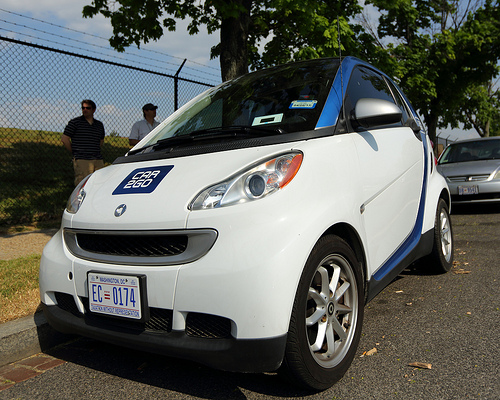


If you live in Seattle and you haven’t yet seen one of those charming little car2go vehicles humming delightfully up your local hill, I really don’t know where you’ve been hiding. There are 330 of them zipping around the city now.
And those numbers helped push the number of car-sharing locations in Seattle to 429—and sixth place nationally—according to a new infographic by the clever folks over at Walk Score. But yet again, Portland bested its northern neighbor: the Rose City ranked number four, with about ten percent more car shares than Seattle (537). That’s consistent with what we found a few months back, when we looked at the Northwest’s car-sharing Olympics—Portland lagged behind Vancouver in our initial ranking but placed well ahead of Seattle.
See the full car-sharing infographic after the jump…
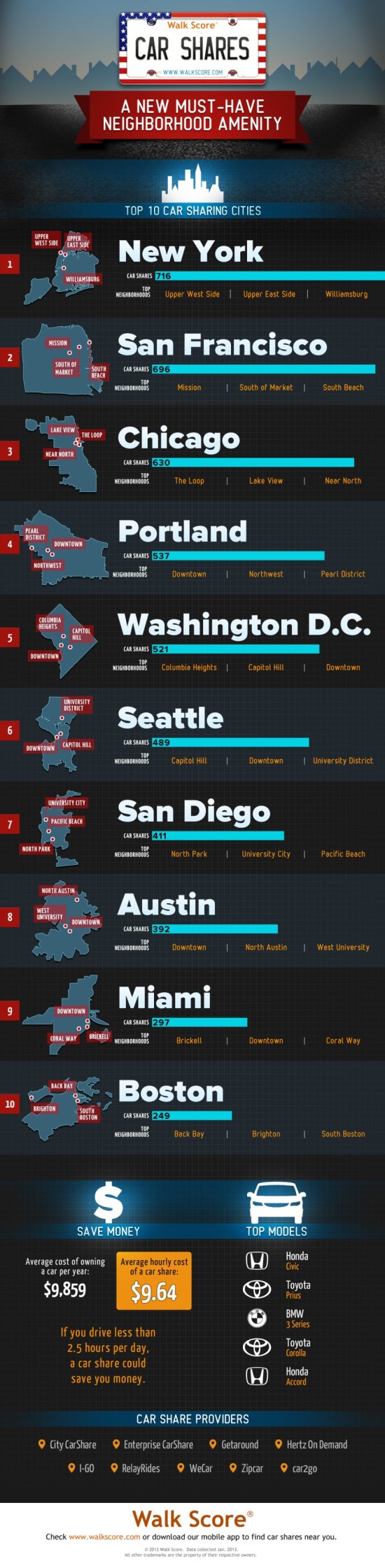
Just to be clear: this is mostly for informational purposes; it’s in no way a definitive ranking. It undercounts shared vehicles in at least two ways: first, because some car-sharing locations have more than one vehicle; and second, because it excludes peer-to-peer car-sharing services such as Relay Rides and Getaround. And the number of car-sharing locations doesn’t necessarily speak to how convenient car-sharing services are—which might be measured as the number of car-sharing locations per square mile, or perhaps the number of shared vehicles per 1,000 residents.
Still, this infographic represents a good first step towards gauging different cities’ progress with car sharing. And perhaps most important of all, car sharing makes a great addition to Walk Score’s market-leading assessment of neighborhood walkability—which has already made it easier than ever to find the sort of neighborhood that fosters the “car-lite” lifestyle.

The absolute number of car sharing vehicle locations seems like a very poor measure of car sharing availability. This effort seems to be about creating a quick ranking of cities (and not metropolitan aras) If so, at a minimum, the number should be in relation to the total number of city residents or licensed drivers. This effort seems to be about creating a quick ranking.
However, the heading immediately moves into talking about car sharing as a neighborhood amenity and identifying neighborhoods within each city that have high numbers of car share vehicles. For that kind of a ranking, however, it seems like a measure of that relates to neighborhood population/drivers and the percentage of the neighborhood land area that has easy walking access to the cars would be necessary.
Overall, this number was not really worth passing on to us. (And why is it that alternative modes and alternatives to car ownerships are frequently identified as an “amenity.” Aren’t they really a necessity?}
Hi, Steve. Thanks for that input. As we wrote below the chart, we recognized the big shortcomings in the measurements, but we hoped to give greater visibility to the national trend of growth in car-sharing.
You could also convey this feedback directly to Walk Score on its blog. Looks like another of their readers noted these flaws, too.
Despite being a two car family my husband and I are loving Car2Go because of the options for one-way or spontaneous transportation. Examples:
Going on a leasurely meander around Capitol Hill and simply walking to a car when we get tired.
Meeting each other at a gathering when one of us has a car to drive home.
Picking up a vehicle that is being worked on.
Walking to a restaurant without an umbrella and coming out to find it raining.
Getting to a friend’s house to hitch a ride for a day of skiing when our daughters need our cars during the same day.
Valerie, thanks for sharing those everyday use examples. I myself am looking forward to selling my car (I had bought it for a past job) and going full-on car2go. I anticipate I’ll walk even more than I already do, and when needed, I’ll enjoy the thrill of finally driving one of those little vehicles I’ve been starry-eyed and cooing over for a couple of months now—unabashed nerd here.