


As new debates over pipelines and oil trains heat up, I’ve been asked by all kinds of folks about the nature and history of US oil exports. So as a reference, here’s a quick look at some of the fundamentals.
The US exports very little crude oil. Yet shipments of refined petroleum products—gasoline, jet fuel, diesel and the like—have skyrocketed to levels quadruple those just a few years ago.
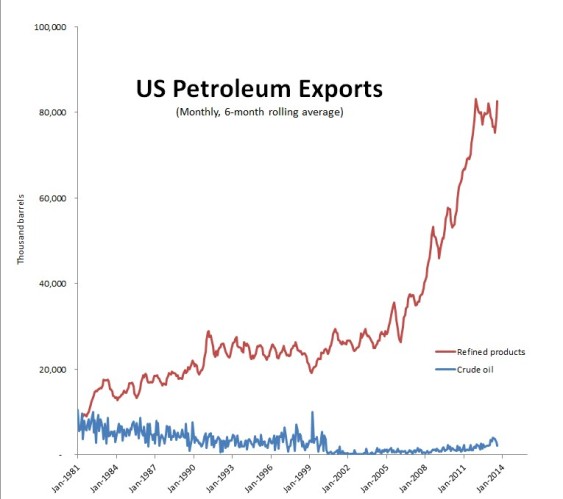
The red line indicates “Finished Petroleum Products,” the blue line indicates “Crude Oil and Petroleum Products” and I exclude “Natural Gas Liquids and Liquid Refinery Gases.”
Let’s take a closer look at the components of the blue line, above. Over the last 20 years—the longest period for which country-specific data are available—the vast majority of US crude oil exports stayed close to home.
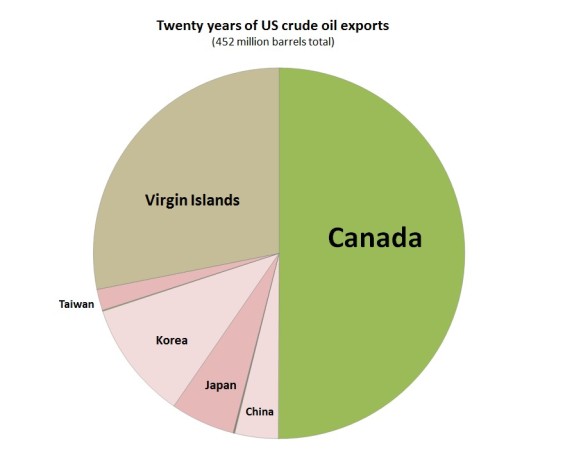
About half moved to Canada and more than a quarter went to the Virgin Islands. Another 20 percent or so made its way to four major Asian economies, mostly during the late-1990s.
The real export activity is in refined petroleum products. Over the last decade—the longest period for which country-specific data are available—more than 90 percent of US exports has gone to the 31 countries shown here. [Click the chart to enlarge it.]
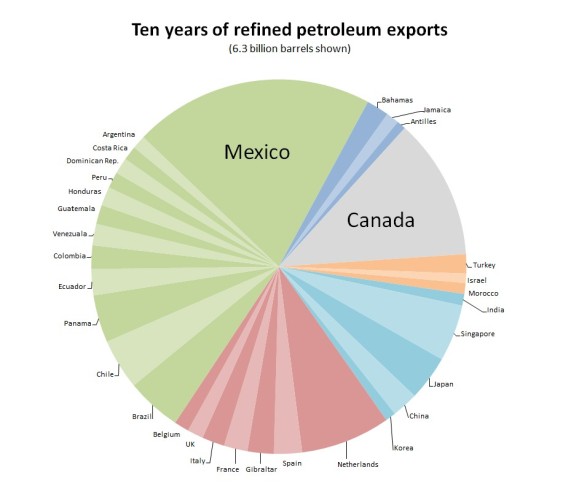
Of those exports, about two-thirds went to countries in the Western hemisphere with notable volumes going to Europe and East Asia plus a few other destinations.
All data in this post come from the US Energy Information Administration, here.


Export of U.S domestic crude oil and natural gas is banned except for exports in the national interest. See 42 USC § 6212 https://www.law.cornell.edu/uscode/text/42/6212. (As a side note, this same law allows the President to ban export of coal based on “terms and conditions as he determines appropriate”) The oil and gas industry is threatening to bring the U.S. crude oil export ban to the WTO where I imagine it would likely be found in violation if trade rules. See https://www.bloomberg.com/news/2013-11-06/oil-industry-may-invoke-trade-law-to-challenge-export-ban.html So right now the only thing really that can be exported is refined product and they can make much more money producing oil from shale refining it and exporting it.
Yes, Rich, thanks for calling out the potential of WTO action.
Properly speaking, though, it’s not technically a “ban.” It’s a license requirement where licenses are extremely difficult to obtain because they are only issued in very specific cases. This recent report from OilChange International has a great summary of the laws on pages 20 and 21:
https://priceofoil.org/content/uploads/2013/10/OCI_Stay_or_Go_FINAL.pdf