


Policy solutions often come with their own vocabulary—acronyms, insider shorthand, and jargon. It can be alienating or confusing. Worse, policy-speak can risk obscuring the most important messages: why solutions matter and the people who should care.
The folks at Seattle Neighborhood Greenways, a local coalition of safe street community groups, have seen this first hand. At countless public meetings and in hundreds of community conversations, they’ve seen how the wrong message can confuse, put off, or even backfire, pitting otherwise friendly stakeholders against one another.
They set out to find a better way. They listened, they observed, they used trial and error. And with years of road testing, they’ve learned what words and messages work to bring people together, build support for smart solutions, and create more civil and productive public discourse around how we design our streets.
The new rules of the road they’ve developed help break bad habits and more successfully engage people’s interest, values, and emotions. Here’s what they learned.
First and foremost, they realized how important it is to focus on people and their experiences—not infrastructure, not modes of transportation, not buzzwords. Other takeaways: Keep language simple. Avoid jargon. And steer clear of passive voice constructions and framing that drives discussions toward dead ends.
For example, our deeply entrenched habit of calling preventable crashes “accidents” frames traffic deaths as unavoidable by-products of our transportation system and implies that nothing can be done about it, when in reality these deaths are not inevitable. The word accident, like old infrastructure, traps us in a 1950s-era car-dominated world and limits how we think about solutions.
When they’re out and about, most people see themselves as people walking, not pedestrians. A simple word switch invites people to see themselves in the picture and reminds them that everybody gets around in different ways at different times. This helps community members begin to imagine ways to help everyone go safely from one place to another, whether they are walking, rolling a wheelchair, biking, driving, or taking transit.
We also learned how important it is to connect with people in terms of shared values —again, as people, not labels or stereotypes. Most of us can relate on a more personal level to a mom or a teacher or a neighbor who bikes than a “cyclist.”
Similarly, it’s good to use familiar, concrete examples that are easy to visualize: a quiet street to raise a family, walking to the bus stop, being safe dropping off their kids at school, etc.
Ditching wonky language in favor of everyday words has helped us change the tone of the conversations and brought people together to respectfully discuss solutions for the streets we share.
Try it for yourself. Use this crib sheet during your next conversation about a street project.
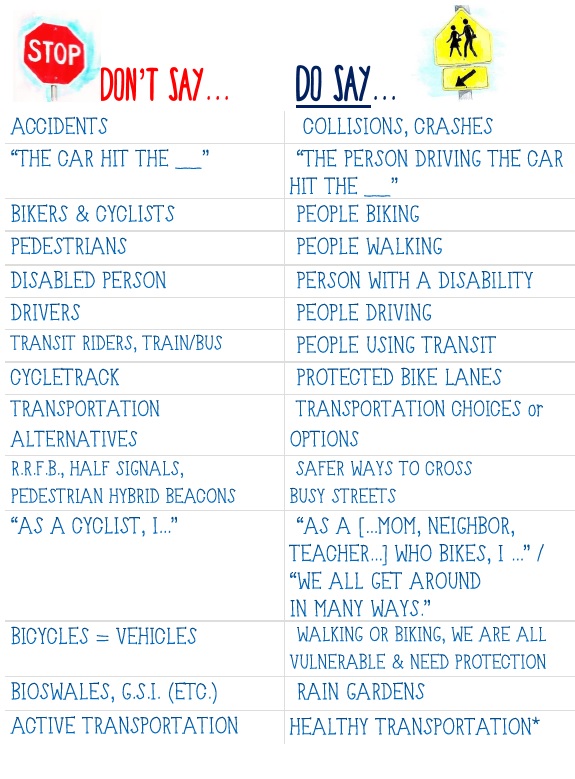
*Note: This particular language suggestion is aimed at advocates and academics who are currently using the term “active transportation” to describe walking, biking, and taking transit because these trips involves physical activity. We like the term healthy transportation because it also encompasses the pollution- and injury-reduction aspects of walking, biking, and taking transit.
Gordon Padelford is the Neighborhood Support Coordinator for Seattle Neighborhood Greenways, a coalition of community groups working to create safe and healthy streets for all in Seattle, Washington.


Most of these are great suggestions — framing the issues often determines the outcome before a discussion even starts.
But I can’t go for “protected bike lanes” as a synonym for “cycletracks.” When they’re physically separated from the roadway, they’re not bike lanes, legally speaking — very different legal rights and responsibilities for bikes and for drivers crossing the path; lower safety and engineering standards for construction and maintenance; different liability rules when accidents happen.
Also, unless the city actually closes mid-block curb cuts and has entirely separate signal phases, they’re not actually “protected” from the most common car/bike collisions.
I agree some other name is needed, “cycletrack” sounds like something for spandex racers when they’re really a low-speed facility. But “protected bike lane” is legally and practically inaccurate.
Josh: what about “Protected Bikeway” or “Separated Bikeway”?
^ I like the term bikeway or protected bikeway. Simple and intuitive.