


For every single home lost to a new apartment building in Seattle this year, some 84 new homes came onto the market for Seattle families.
The story is deeply embedded in popular perceptions of the modern city: modest, low-cost apartments succumb to the wrecking ball to make way for ritzy highrises, putting working-class residents out on the street. The displacement caused by demolitions of low-cost housing can be devastating to poorer families and their communities, and urban advocates and policymakers widely agree that minimizing displacement is a critical public policy goal.
In the case of Seattle, however, builders demolish far fewer existing homes to make way for new ones than many of us commonly believe. Furthermore, as discussed in this companion Sightline article, in rapidly growing, prosperous cities such as Seattle, displacement brought on by rising rents (“economic displacement”) is a far bigger problem than displacement caused by demolitions (“physical displacement”).
To get an accurate, up-to-date picture of demolitions precipitated by housing development in Seattle, we assessed the 19 apartment complex projects in Seattle containing eight or more units that the King County Assessor currently lists as built in 2016. We have also mapped these projects below. Though many of these projects won’t formally open their doors until next year, all of them are well underway in changing Seattle’s skyline. Together these 19 apartment buildings are adding 1,764 new homes to Seattle’s housing stock—homes for 1,764 families and individuals who would otherwise bid up the rent on other, existing apartments.
[sightline-embed]
Getting right to the punchline: exactly how many existing homes were demolished to make way for these nearly 1,800 new units?
1,000?
100?
No.
21.
In other words, for every single home lost to a new apartment building in Seattle this year, some 84 new homes came onto the market for Seattle families. As a result, a similar number of lower-income families in older, “naturally occurring affordable” homes elsewhere were spared displacement for every one household forced to move by a demolition: because if those 84 units had not been built, wealthier Seattleites would have outbid those poorer residents for their existing housing. And as we know, when housing choices are limited, the wealthy always win—and poor and vulnerable communities either pay up or suffer displacement.
Seattle’s newest apartment buildings: A before-and-after photo tour
While builders tore down a total of 21 housing units to make way for these 19 new buildings, only 7 projects replaced even a single residential unit. The other 12 went up on parking lots, empty lots, or sites with low-value commercial buildings.
The 19 apartment projects already well underway, which add 1,764 new homes to Seattle, hold more than 2,100 bedrooms. The buildings range in size, location, and style, from a 39-story tower in the heart of downtown to a modest 4-story apartment building in Columbia City to a 5-story building of all studio apartments near the University of Washington.
While builders tore down a total of 21 housing units to make way for these 19 new buildings, only 7 projects replaced even a single residential unit. The other 12 went up on parking lots, empty lots, or sites with low-value commercial buildings. These examples also demonstrate a somewhat intuitive point about new home construction: that in general, the greater the density of the new housing, the greater the ratio of new homes gained to demolished ones lost. To help illustrate what this looks like across Seattle, here’s a photo tour of 8 of these newest additions to Seattle’s housing stock and what they replaced.
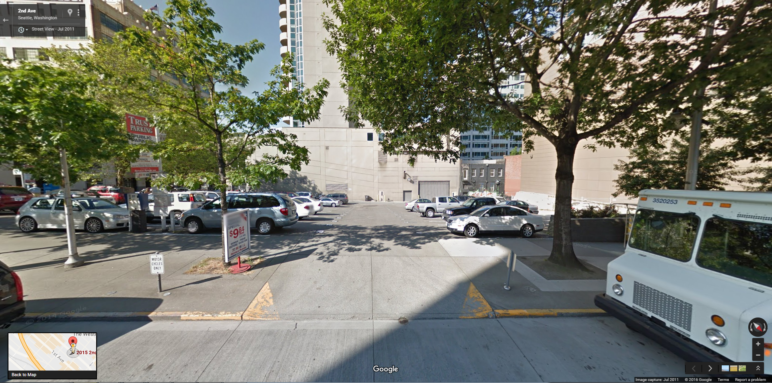
1. Tower 12
Families displaced: zero
Families housed: 246
Before
After
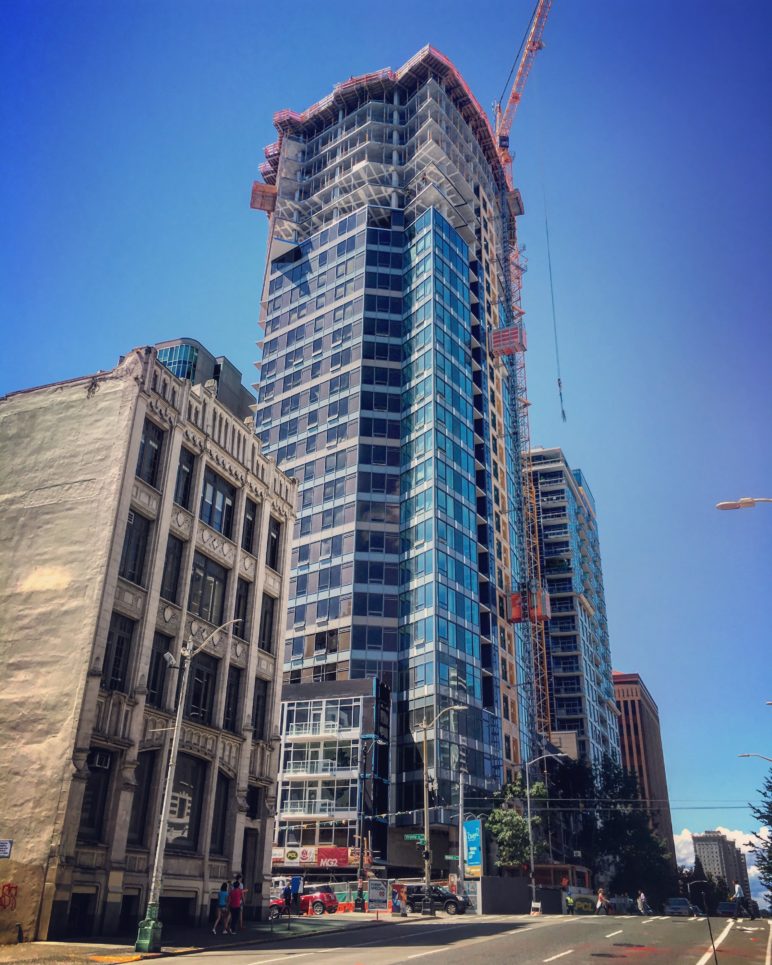
The largest building in our sample is a 39-story, 246-unit apartment at the corner of 2nd Ave and Virginia St in Seattle’s downtown core. It replaced a former surface parking lot. About 60 cars lost their stalls in favor of 246 families finding new homes (though the new building will include 305 parking spaces, resulting in a net increase in parking).
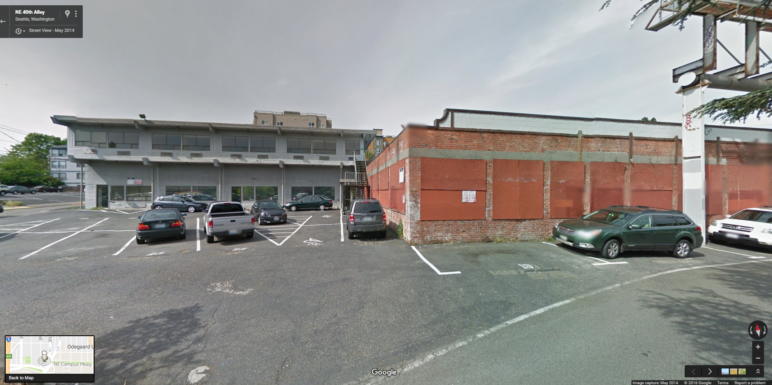
2. The Augusta Apartments
Families displaced: zero
Families housed: 209
before
After
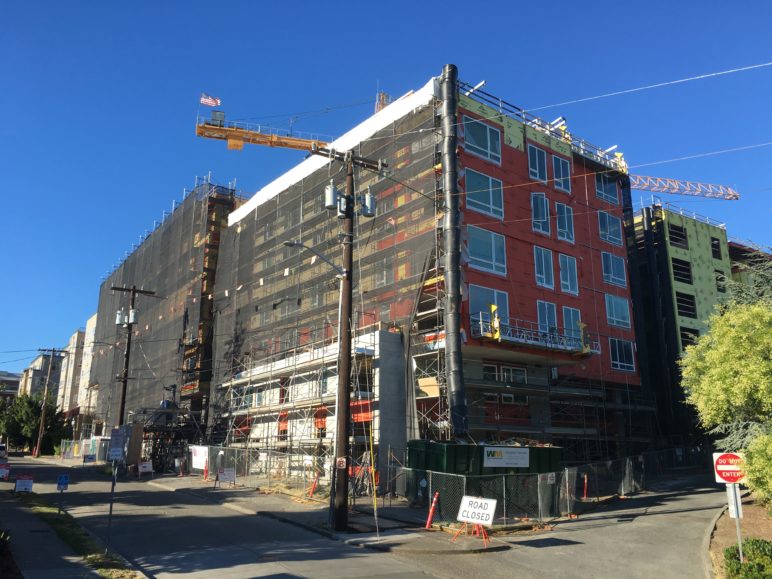
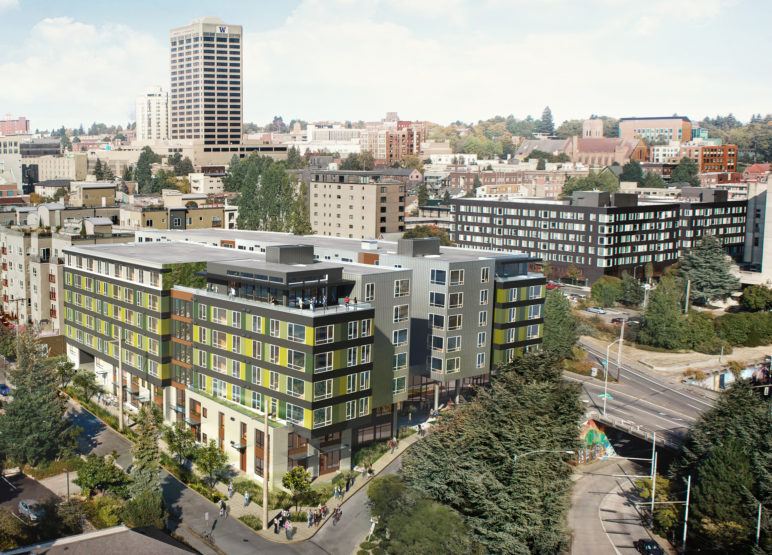
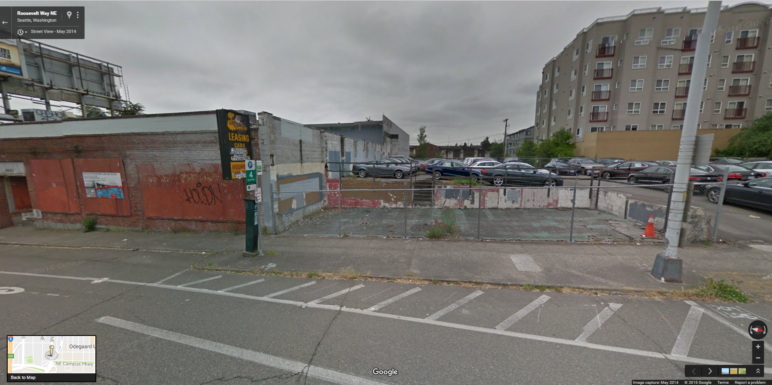
The second largest apartment building in our study is the Augusta Apartments, at 4041 Roosevelt Way NE, not far from the University of Washington. Builders took down two commercial buildings, one of them abandoned, to make way for 209 new homes a few blocks from Cascadia’s premier educational and research institution.
3. The Cyrene
Families displaced: zero
Families housed: 169
Before
After
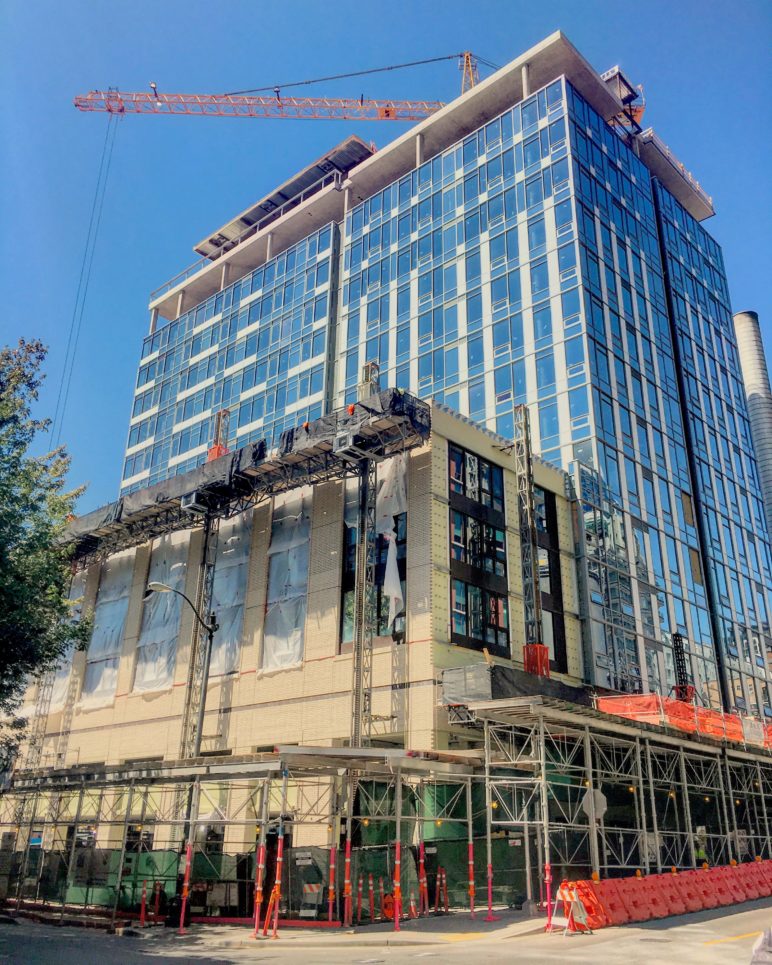
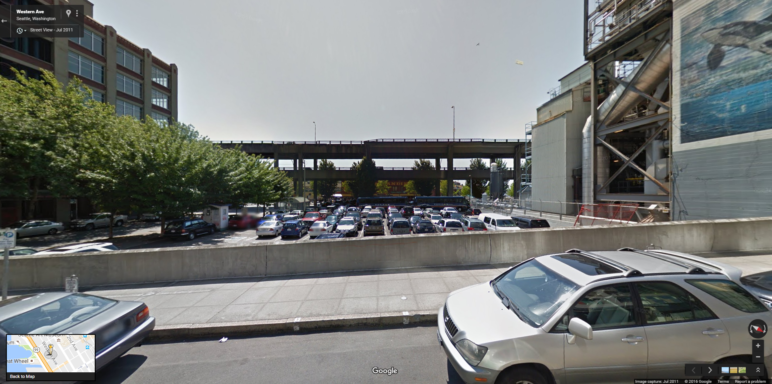
The Cyrene is the third largest apartment complex currently underway in Seattle. It will add apartment homes to the city for 169 households who want a front-row seat to the Viaduct replacement project or who want to live smack dab in the Pacific Northwest’s largest job center. It replaced a surface parking lot at the corner of Western Avenue and University Street, adjacent to the Highway 99 viaduct.
4. Modera Ballard
Families displaced: zero
Families housed: 132
Before
After
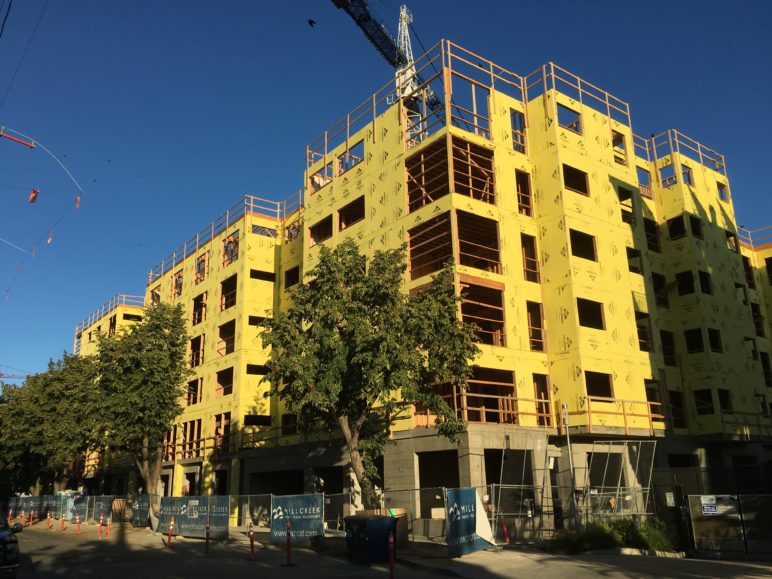
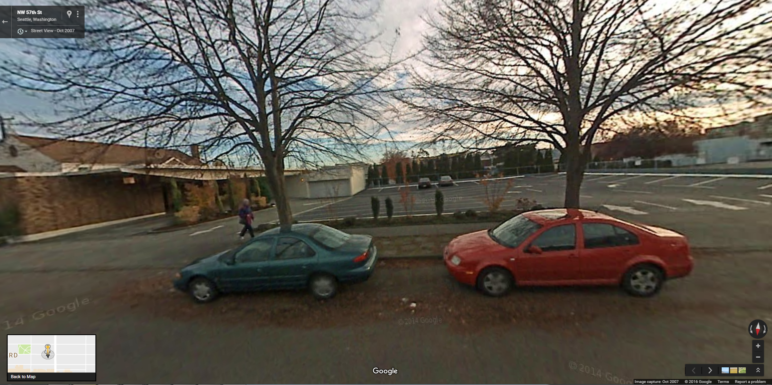
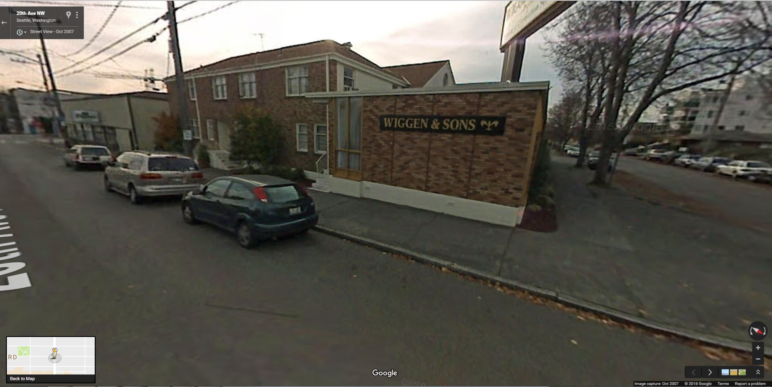
Wiggen and Sons Funeral Home in Ballard wasn’t as busy as it used to be, as more of today’s families choose to say their farewells at locations other than funeral homes. In 2013, the original owners sold the property. Modera Ballard, a six-story, mixed-use apartment complex, with space for 132 families, will take its place in the heart of walkable and transit-rich Ballard: Walkscore 88.
5. Lillehammer (tentative name)
Families displaced: 6
Families housed: 93
Before
After
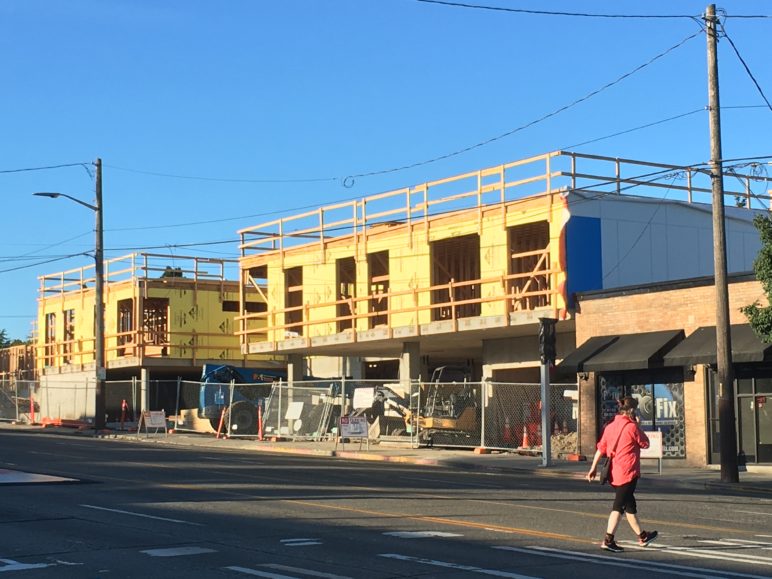
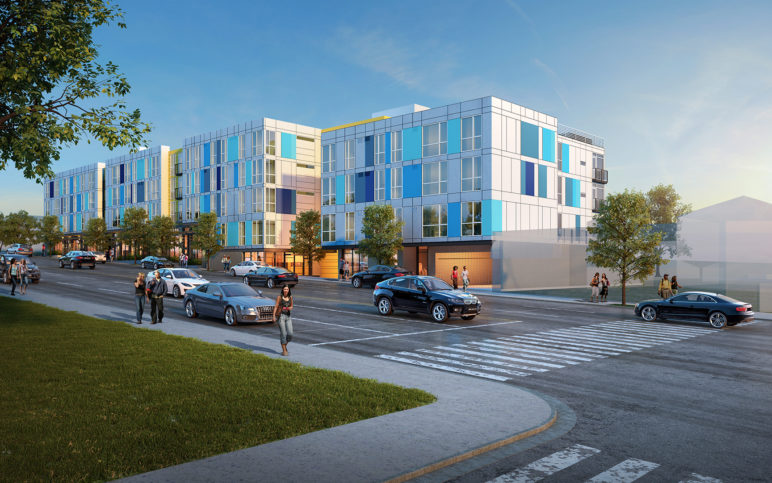
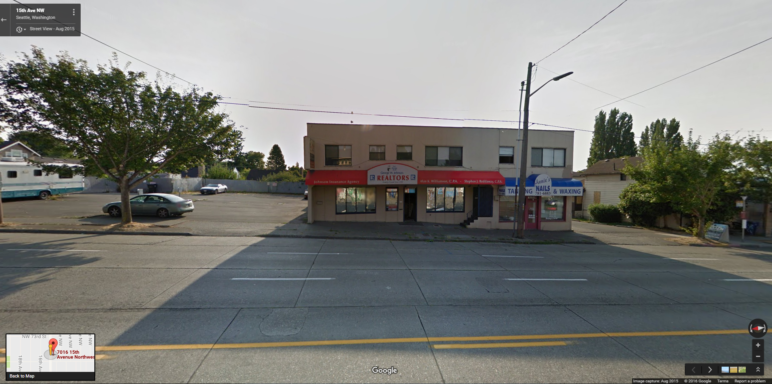
The 93-unit Lillehammer apartment complex (name tentative) currently going up at 7016 15th Ave NW, just one block north of Ballard High School, replaced a dilapidated single-family home and five units in a small mixed-use apartment building, along with an old realtor’s office and a nail salon.
6. Junction Flats
Families displaced: 3
Families housed: 80
Before
After
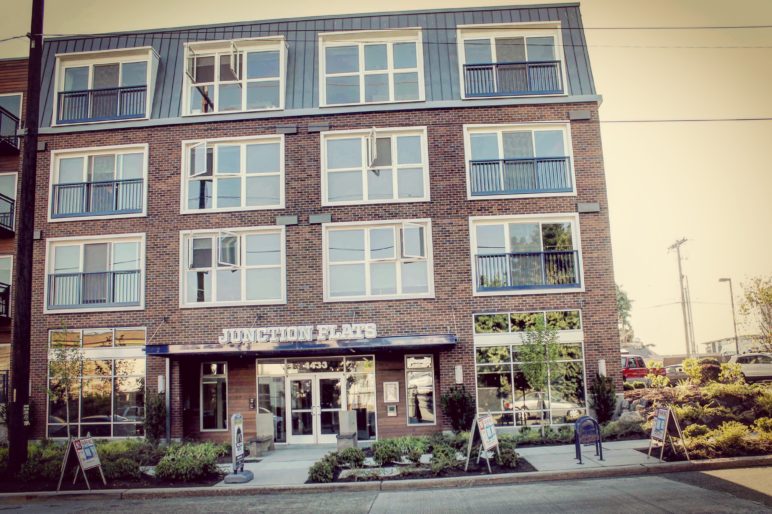
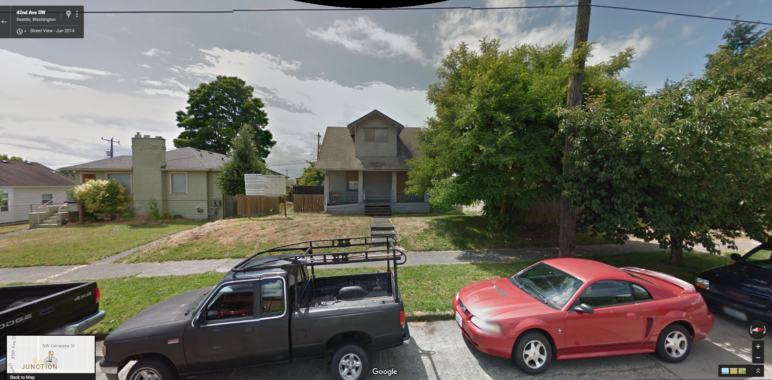
The newly completed Junction Flats at 4433 42nd Ave SW replaced three single-family homes with 80 new apartments. Eighty families can now live within walking access to the restaurants, grocery stores, cafes, and bookstores of the West Seattle Junction, where only three households had such access before.
7. Vesseliye Apartments
Families displaced: zero
Families housed: 41
Before
after
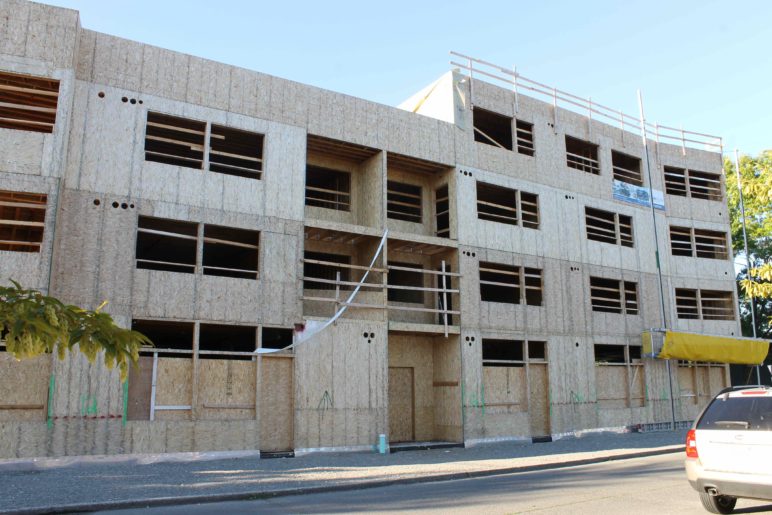
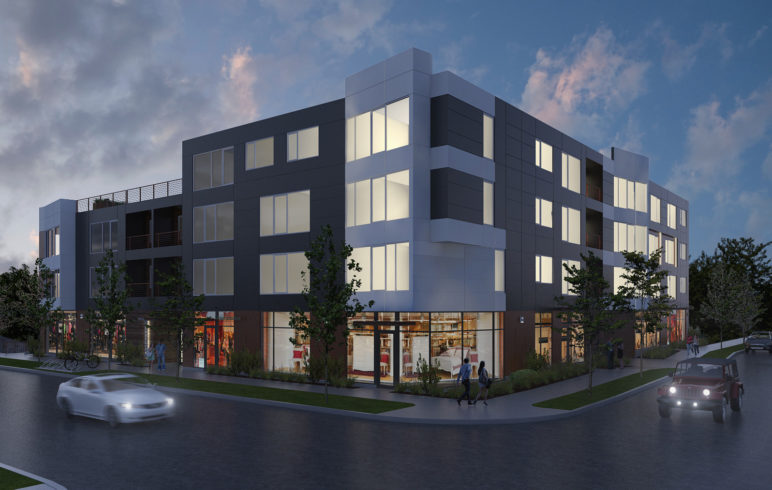
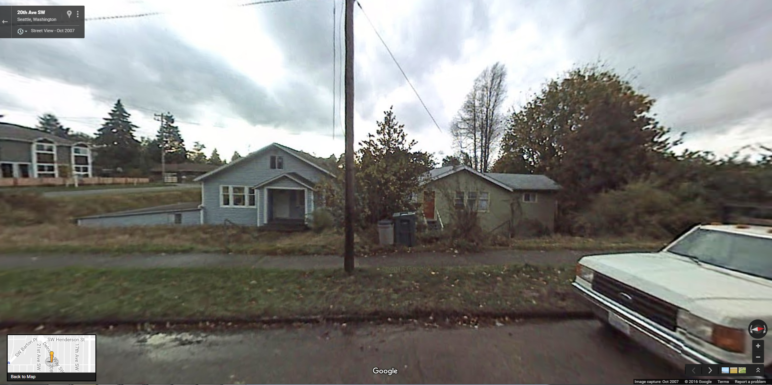
Builders demolished two vacant single-family houses to clear the way for the Vesseliye Apartments under construction at 9051 20th Avenue SW. In exchange, the city will gain 41 new homes with convenient, walkable access to the shops, grocery stores, and services at Westwood Village.
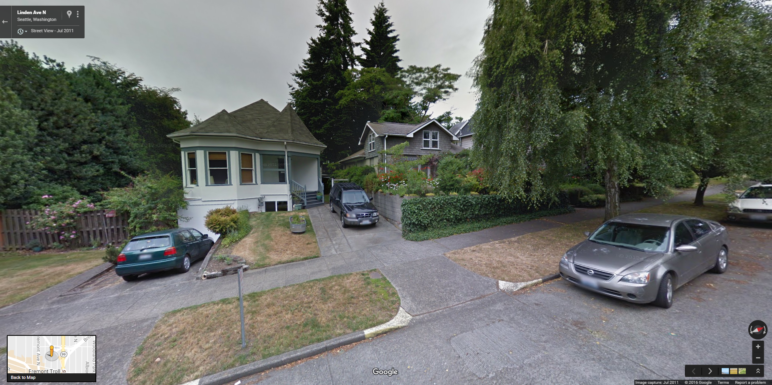
8. Linden Ave Apartments
Families displaced: Four
Families housed: 35
Before
After
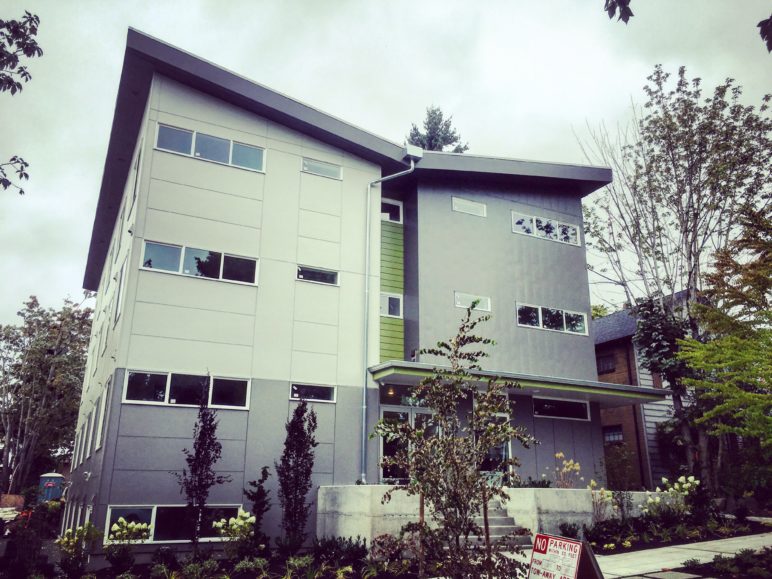
Thirty-five new homes are currently under construction at 3639 Linden Ave N, just steps from the vibrant, transit-rich center of the Fremont neighborhood. This project replaced four single-family homes.
Conclusion
So far, fully 19 new apartment projects peppered across Seattle will add nearly 1,800 much needed new homes to the Emerald City this year. And the total number of dwellings demolished to make space for them, by actual count, is just 21. Some of those dwellings were already so derelict that they were vacant, so the number of actual families displaced by new construction was fewer than 18.
Yet in the public conversation, we often hear an inflated version of the demolition side of the displacement story. It’s easy to point to the buildings that fall and the owners or tenants who leave them. Meanwhile, it’s just as easy to overlook all the people who find homes in new buildings. Still more abstract is the bidding process that cascades down the housing market, by which any new housing—even if it’s expensive—prevents the economic displacement of low-income households elsewhere. Though my own family certainly won’t be renting a brand new apartment in downtown Seattle anytime soon, perhaps the family that does will leave another, more modest, home available for us.
The real-world examples above demonstrate that preventing new housing development in order to forestall physical displacement caused by demolitions is ultimately a losing game. Instead, new homes offer one tool to combat the much greater force of economic displacement. Their impact isn’t something we can easily point to on a map or snap photos of. Instead, it is a process of stopping displacements that might have been, and so we can never be sure of the families and individuals who kept their homes because of it. Even with this benefit of new housing, more vulnerable families who lose their homes to demolition deserve public support to mitigate the impacts of Seattle’s booming housing market, such as just cause eviction protections and greater relocation assistance, as proposed by Seattle’s Housing Affordability and Livability Agenda recommendation T. 5 (see page 33).
Together, policies that protect vulnerable communities alongside policies that build plenty of new homes throughout Seattle will advance the construction of the homes our community needs while staying true to the values that our community holds dearest. While protection policies are part of a long-term, balanced strategy for ensuring housing affordability for all in Seattle, the main course is going to be policies that advance the construction of the homes our community desperately needs.
[list_signup_button button_text=”Like what you|apos;re reading? Get the latest Sightline housing research right to your inbox.” form_title=”Housing Shortage Solutions Newsletter” selected_lists='{“Housing Shortage Solutions”:”Housing Shortage Solutions”}’ align=”center”]


That last example, with the anti-functional tilted roofline, took the place of at least one home with historic charm. Shame on the little boxes mentality of modern “design.”
Can’t (shouldn’t) legislate taste.
Yes, as noted in the article, that building displaced four existing homes. And yes, we need to use a different set of aesthetics when building 35 homes in a space that previously held four.
And is the butterfly roof anti-functional? It has overhangs to protect the building below, it keeps the rainwater out, and it has insulation to help keep the 35+ people inside cool or warm, depending on season. Some people even like the way it looks.
This is interesting but covers a very short period, about half of a single year. A more thorough examination would go back a few years, perhaps to the start of the current building boom.
Thanks for your comment, RDPence. You are right – this article is a snapshot of Seattle’s most current building. For a longer term perspective check out Dan Bertolet’s article published last week. About a third of the way into the article he included a graph showing new building to demolitions in every zone in Seattle between 2010-2016. You might find it of interest. Here’s the link:
https://sightline.wpenginepowered.com/2016/08/10/displacement-the-gnawing-injustice-at-the-heart-of-housing-crises/?utm_source=Sightline%20Institute&utm_medium=web-email&utm_campaign=Sightline%20News%20Selections
Regards,
Margaret
This is a good read. Wish more folks would see this. These are all improvements.
This type of analysis is very useful for those of us following the changing housing climate in Seattle. However I believe the use of the word “family” is potentially misleading. Commentary I’ve previously read is concerned that the new housing being built is predominately studio and 1 bedroom, not typical “family” housing with room for children. Does any of your data indicate how many units are being built to accommodate families or have lower income units? I fear economic and family style diversity is being sacrificed for simple volume (which we need as well). We can do both and I’m wondering if you are tracking this data as well.
Excellent work! It’s long seemed clear to me that the “we must slow the increase of housing units available to preserve ‘naturally affordable’ housing” message, when deployed by anti-development activists and politicians, is a deeply unserious and cynical way to disguise their anti-housing, anti-newcomer agenda, but it’s good to have hard data to back it up.
This is a good start but it’s misleading to refer to each unit being a “family”. You don’t know who moved in to the new units, it could be a lot of singles, especially in the studios and 1-bedrooms. I’d like to see this same analysis with a comparison between *bedrooms* lost and gained…that would provide a more apples-to-apples comparison.
How many of the houses with 3-5 bedrooms are inhabited by empty nesters? While my wife and I live in a small 1-bedroom apartment, my grandmother lives alone in a 2000 sq. ft. house. House size does not necessarily equal family size. Furthermore, the percentage of households that are families with children has been decreasing over the long-term as the population ages: https://www.citylab.com/housing/2013/08/brief-history-how-living-alone-came-seem-totally-normal/6689/
The trend for building mostly 1-bedroom units reflects demographic changes and the real need for more of these types of units.
Interesting article, and a perspective that is not usually presented. A question: what are the starting rents for the new apartments being built?
Another thought to ponder is that the landlords/building owners of the existing apartments (some of which are crummy and outdated), are using the excuse of new construction to raise rents, which can displace people, even if their building itself is not affected.
It seems to me a significant part of the tear down/replace market is left out of this article. The study included only “the 19 apartment complex projects in Seattle containing eight or more units that the King County Assessor currently lists as built in 2016”. This leaves out all projects with less that 8 units constructed on demolished sites. There is a whole different zoning requirement for 8 and larger complexes that naturally pushes them into area where single family houses are less prevalent.
On the other hand duplexes, triplexes on up to less that eight are generally more allowed in single family neighborhoods. Just look through Ballard to see all the houses demolished for fourplexes. This study seems to cherry pick data that doesn’t tell the whole story.
Yes, you’re not the only one to notice that it’s a propaganda piece cherry-picking the data.
I don’t see 1309 Dexter Ave on here. It was a nice old brick building demolished last winter. Was it vacant? If so, how long had it been vacant? It looks like there were a decent number of units there, and it was scaled nicely to the street.
I think physical displacement actually helps make the case for upzones. If we have to fully build out the zoning capacity, which NIMBYs are always harping about, then a lot of older nice-looking and classy brick apartments are going to be demolished. If we were able to build more apartments in areas dominated by detached houses there would be even less physical displacement.
Sadly, stuffing al these units into the same space will just increase the traffic and infrastructure overload, which is already an issue. Ahhh, but who cares, as long as the profiteers make their money, all is good.
Christopher James: You can find rents for open buildings with a simple search. Average rents for new buildings like the last one (in Fremont, very familiar to me) are in the range of $1,500 (and up) for tiny apartments. Not suitable for more than 2 (intimate) people.
And the touted great transit? Fremont bus service for commuters is often stand up or “watch full buses go by.”
But it is what it is; the location is in Fremont’s urban village, targeted for increased density.
And as alluded to by James’ comment, economic displacement is real. It’s driven by the overall growth of the area economy, incited by local policies. For a thorough explanation of this dynamic you can read
https://www2.ucsc.edu/whorulesamerica/local/growth_coalition_theory.html
or the chapter on what happened in South Lake Union in
https://woodsquat.files.wordpress.com/2010/01/mark-purcell-recapturing-democracy-2008.pdf
Which leads me to the most distressing aspect of this work to me; it is not the specific projects, but rather the overarching suggestion that endless growth is “sustainable.” Sightline’s mission (scroll down) is “to make the Northwest a global model of sustainability.” However, pushing for growth without limits is not sustainable by definition.
Whenever I ask folks like Morales and Bertolet whether they believe there are limits to growth, I hear, “Yes, of course.” Whenever I ask the follow up; what are they, please quantify and tell me when the resources needed to sustain continued growth have run out, I get crickets. Not now, we’ve got a housing crisis to solve.
“Can you think of
any problem in any area of
human endeavor on any scale,
from microscopic to global,
whose long-term solution
is in any demonstrable way
aided, assisted, or advanced by
further increases in population,
locally, nationally, or globally?”
– Prof. Al Bartlett
[https://www.albartlett.org/]