


We hear a lot about “what’s good for the economy.” But for most of us, the economy is only doing well if we are “good”—if the people in the economy are doing well. And we know that what may boost the economy won’t necessarily be a boost for our families.
Instead of putting that abstraction, “The Economy,” first when we make decisions about rules and standards, shouldn’t we be thinking about what’s good for our country, communities, and working people? That’s what the AFL-CIO, ASO Communications, and Lake Research suggest in their message playbook, Working. For a Better Life.
Through a multi-phase testing process, they identified messages that refocus economic issues through a people lens rather than obscuring people with an economic lens. This narrative track leads to better thinking about solutions like paid leave, higher minimum wages, strong benefits, and secure retirement. Whether it’s switching a word, using vivid examples, or elevating our values and vision, the idea is to trigger a shared recognition that all work has inherent meaning, all working people have a right to make a decent living, and we all strive to build better lives.
Quite simply, wealth, wages, and work are all about people—and we should say so. Our vocabulary about the economy should be more personal, concrete, and active.
Guiding principles:
- Provide an aspirational call to better lives that goes beyond purely financial issues.
- Connect to shared values that shape a people-centered economy: family, freedom and fairness.
- Swap abstractions for the real experiences they lead to: “can’t make ends meet” vs. “wage stagnation.”
- The economy is man-made, not a force of nature. Assert that human action deliberately created problems and that only deliberate human action can fix them.
- Name problems in an active voice, showing who did what—“CEOs decided” rather than identify them passively—“incomes fell.”
- Focus on the outcomes (concrete and personal), not the policies (abstract and removed): “time to care for a sick child” vs. “paid leave legislation.”
- Refocus on people. Emphasize “helping the family” vs. “growing the economy.”
Here’s better vocabulary for talking about work:
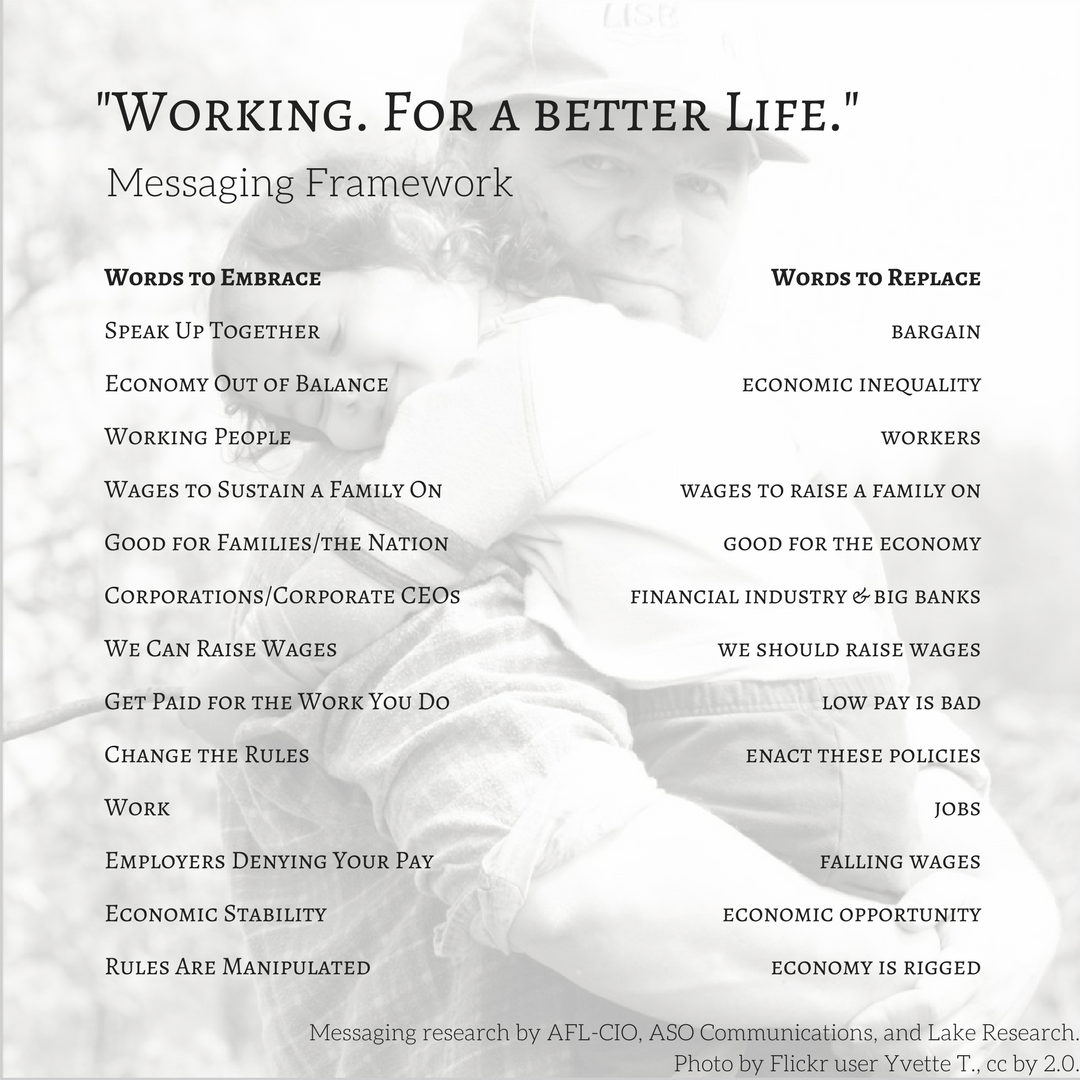
See the full AFL-CIO narrative playbook here, including sample dial-tested messages using this framework.


Thanks for this great guide, and…
Liberation is collective. As you advocate for the freedom and fairness of one group of people, be conscious of how your language may reinforce existing power structures. For instance
Words to replace: “The economy is man-made”
Words to embrace: The economy is made by people”
So, AFL/CIO unions will no longer bargain for contracts, they will speak up together instead?
Some of these alternative phrases can be useful, but some do not communicate essential meanings of the phrases they replace. For instance, economic stability suggests stasis, while economic opportunity suggests positive change.