
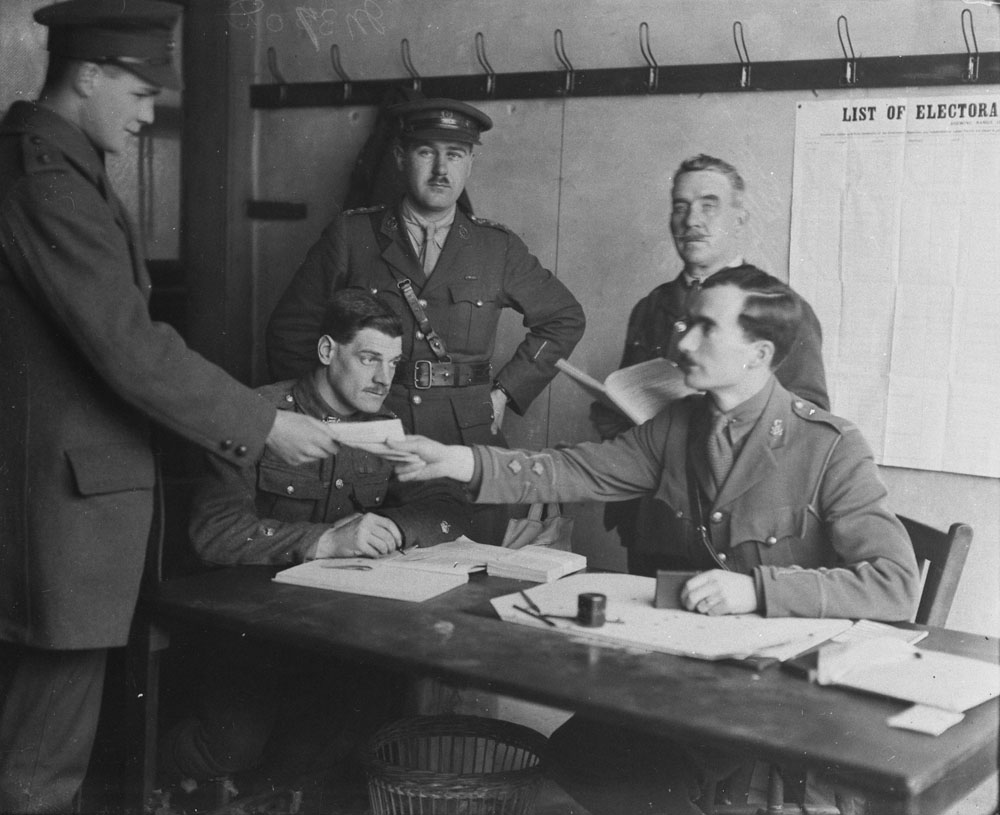
In October 2018, BC voters will get a ballot asking them to choose between First-Past-The-Post (FPTP) and Proportional Representation (ProRep) voting methods. For some voters, this may be a new idea but it is one BC has considered for a long time. As early as the 1890s, voters were calling for ProRep. Voters usually become aware of the need for ProRep when the two dominant parties become less popular or smaller parties become more popular, and voters realize they can’t translate their preferences into representation in Victoria.
Share:

Talk to the Author
Kristin Eberhard
Kristin Eberhard was a fellow with Sightline Institute and Senior Director of State & Local Policy for Rewiring America, following work as Director of Climate Policy at the Niskanen Center.


Great article. Thanks for covering this!
Kristin – very nicely done with the timeline and archives. Thanks, Cindy FairVote Whatcom
I couldn’t be more different than Aquilini.I am a union member, very poor female senior. But I don’t trust a mail in vote on voting that that only a computer, not scrutineers can verify.We will never know for sure who won. X2 in-person voters rejected proportional representation
BC Elections is an independent non-partisan crown body legally mandated to act in the public interest. They have never been accused of acting inappropriately or illegally in any referendum or election. They are there to protect you the voter. I fear you have been grossly misled and as a poor female senior who would have benefited greatly from a more collaborative government such as is typically found in PR systems I am very sad to see you vote against your interests. I hope it is not too late to change your mind.
Much appreciated. Just two observations. Winnipeg and Calgary did not return to FPTP till the mid-1950s and Gordon Campbell’s Liberals only ever promised a process whereby the voters could decide on the electoral system.
Excellent article.
One bit of history missing, however: one of the reasons the 2009 referendum failed was not only because the counting was still rigged in favour of maintaining the status quo (60% overall majority, with 50% approval in at least 60 ridings), but also because out of the two methods approved by the Citizens Assembly (STV and MMP), they were forced to choose only one to apply to the entire province.
The CA chose STV, which gives voters the most choice and control; however, the blended ridings would have been unworkable for large rural areas (as Campbell must have realized). MMP, which when open or flexible lists are used, is almost as good as STV, would have worked well in rural ridings, but was not offered to voters as an option.
This time around (in 2018), one of the options on the ballot, RUP, would give STV to the urban and semi-urban areas where it would work well, and MMP, which is the best workable system for rural areas.
But it is true that every time, in any jurisdiction, PR was instated, it was because of citizen demand. Every time there was a return to FPtP, it was instigated by a government with the power to do so, without consultation, in order to hang onto that power.
It speaks volumes to me that nearly every developed country still voting under FPtP has at least one major, citizen-fuelled electoral reform movement demanding PR; however, no PR country has a popular demand to return to FPtP.
Suggesting that local government use of PR is relevant to Provincial or National Government is a false connection. Cities, are, and especially were, more homonogenous, and the exposure and familiarity among the people across those regions allows for the reasonable representation of the collectie interest through the use of popular voting models.
The Provincial and Federal systems avoid popularity specifically because of the very distinct nature of communities and to protect the smaller population communities from the majority.
The ommision in the time line of calls for representation by population by Quebec when they were the majority, and then later by Ontario when they were the majority, is unfortunate. This period highlights the selfish pursuit of advantage by both sides which we wisely eschewed in favour of an equal voice for each community through their representative. We put exactly that plainly into the Constitution, and specifically ommitted any mention or reference to Political Party.
People are not empowered when there is a private club (political party) between them and their Representative in the Government.
Allocating FPtP winners in HOC only the voting power of their winning percentage will offer voters the power of Democratic election s, where it belongs.
Creators of any any electoral process can not be expected to not build-in any advantages possible as beneficiaries of their own design.
Partisan party power will then actually reflect voted support enabling Democratic Governance to become REALITY at last. With 338 as the divisor 100% accuracy is achieved instantly.
Implemented easily, low cost and evolutionary ~70 years late.