
Takeaways
- Whatcom County currently operates under a system of winner-take-all elections to elect a council of five district-based members and two at-large members.
- To try to ensure partisan balance on the council as a whole, this system requires laborious mapmaking decisions whose resulting districts still ace out non-majority voters from representation on council.
- Whatcom County is currently undertaking its once-per-decade charter review and could recommend adopting a system that ensures that more voters have a voice: proportional representation.
- For Whatcom County, this could take several forms and would deliver fairer, more responsive representation for voters of all political stripes.
Find audio versions of Sightline articles on any of your favorite podcast platforms, including Spotify, YouTube, and Apple.
Can your voice be heard if you’re in a small red bubble in a blue sea? Or if you see yourself as one of a handful of blue flowers in a field of red?
In most of Cascadia’s governing bodies, the answer is no. In the region’s prevailing winner-take-all elections, whichever side gets the most votes wins all the power. This system unfairly overrepresents the biggest group of voters, even if that group is just a hair larger than any others, and even if it makes up a plurality and not the majority of voters.1
But Whatcom County might be headed for a better model—one that offers fairer representation for everyone.
Whatcom voters recently elected a charter commission to review the county government’s founding document, which sets the basis for local laws, much like a constitution. One option the commission might consider: proportional representation.2
Proportional representation, where leaders are elected based on their proportion of votes, offers a slew of advantages over other methods of electing governing bodies. District lines disappear, so there’s nothing for special interests to manipulate via gerrymandering. Elected leaders are more motivated to serve all their constituents, not just their base voters or those in their district. And voters enjoy a more stable government solving their problems from one term to the next, even as district-by-district views change and people move around.
Whatcom County currently has seven county councilors, five elected from single-member districts and two elected at large, county-wide. It’s a system that has delivered a mix of representatives for now, balancing the often more conservative rural voices with the majority more liberal population based mostly around Bellingham.
Unfortunately, it’s not likely to continue to deliver fair results over time, and it’s not as responsive as proportional representation. Single-member districts rely on sensitive mapmaking decisions, and they tend to ace out voters from smaller groups in winner-take-all elections.
Why should Whatcom voters care? And why might the charter commission consider changes to the county’s government and election systems? Below I take stock of the challenges that the current single-member districts and first-past-the-post voting system pose. As ideas progress, I’ll chart out more specific opportunities the county may choose for fairer representation of all Whatcom voters, wherever they live.
With single-member districts, the mapping lines define the government
To craft a representative governing body, mapmakers had to draw Whatcom County’s five district boundaries carefully. Very carefully.
Partisan vote distributions from the most recent presidential election illustrate this point.3 Across the county, 61 percent of voters chose Vice President Kamala Harris for President in 2024, and 36 percent chose Donald Trump.4
To make the seven-seat county council mirror that partisan breakdown, mapmakers would want four or even five of the council seats to be held by Democrats and two or three by Republicans. The two at-large council seats can be assumed to be reliably liberal, because the county’s majority voting bloc gets to select both of those seats. So, to balance the whole council, the five districts ideally would collectively elect two Democrats and three Republicans.
District mapmakers succeeded in achieving this breakdown—for now. Map 1 shows how current district lines in Whatcom County play out. Districts 1 and 2 are solidly blue: the precincts in those areas voted mostly Democratic. Voters in District 4 mostly chose Trump, and Districts 3 and 5 are mixed: they lean blue in national elections but tend to elect Republican-aligned local candidates.
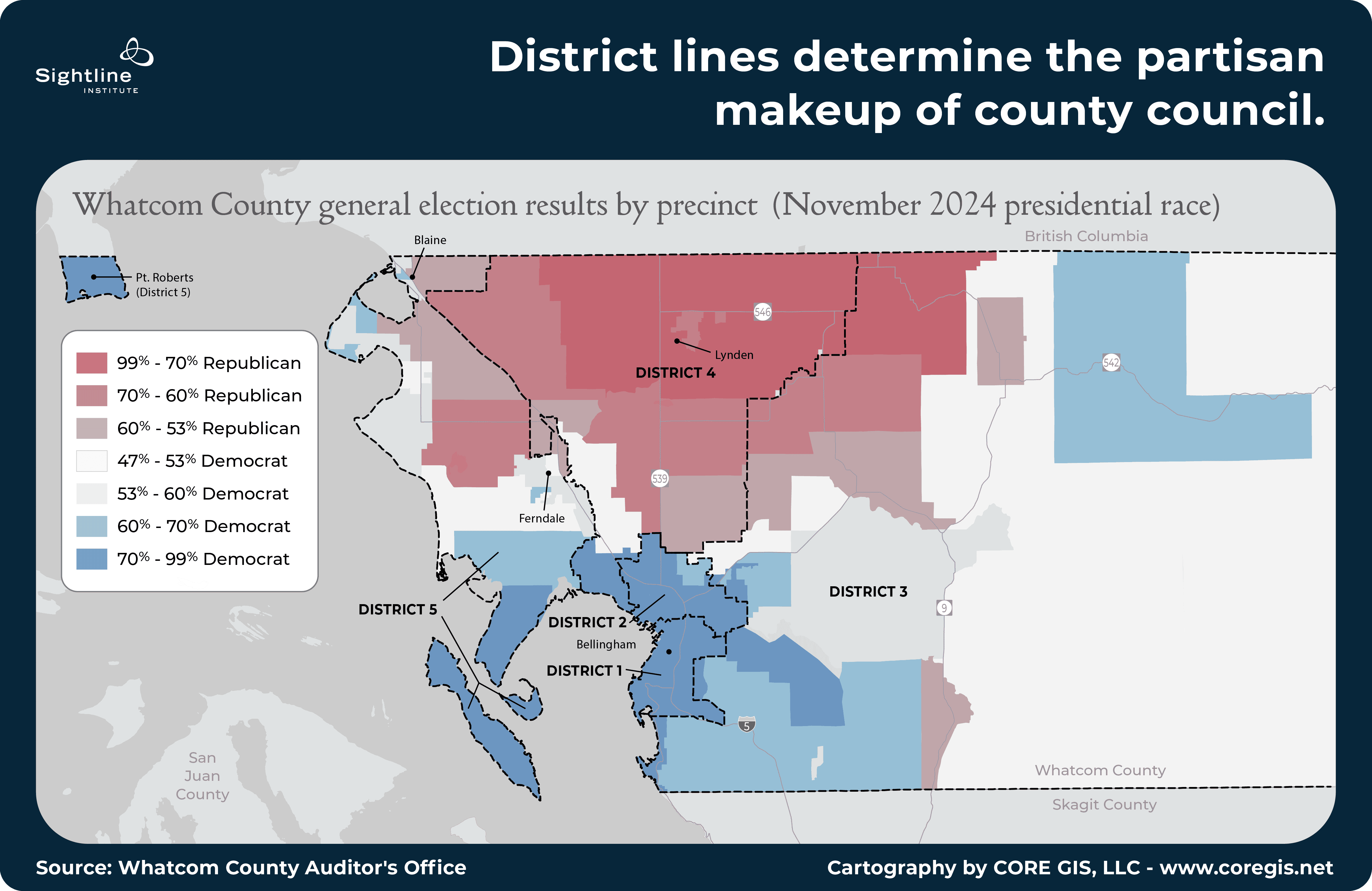
But the mapmaking team probably agonized a great deal over many options to get to these districts. Line drawing is important enough that three of the eight subsections in the elections article of the current Whatcom County charter specify districting requirements, mirroring Washington state’s districting commission. Every ten years the county council appoints a districting committee, with two Democrats, two Republicans, and a fifth Chairman, which then works with a qualified Districting Master to draft a plan for council to adopt.
If the charter didn’t dictate the districting process so precisely or if its intention of neutrality failed, stakeholders from one faction or another could easily draw biased maps for their own gain: classic gerrymandering. Democrats currently have a backstop of the at-large seats, but even if they didn’t, a Democrat-biased mapmaker could spread Bellingham’s mostly liberal voters across current Districts 1, 2, 3, and 5, ensuring a blue majority and restricting the most conservative areas in the county to a single district and thus a single seat. Republicans would have a harder time getting to majority if they took the mapmaker pen, but they could still find a way to unfairly boost their share of council seats.
Even within this carefully defined process, the requirement to bring political parties into this process belies the nonpartisan nature of the county council, and the partisans involved try to avoid drawing competitive seats to ensure continuity for their preferred members. The result—districts that strongly favor one party over another—protects partisan representatives but doesn’t give voters a real choice.
District line drawing also relies on voter preferences and population distribution staying stable within the ten-year window between district redraws. For example, if blue-leaning Ferndale and Maple Falls experienced a population boom and gained many more voters who were similar to those currently there, Districts 3 and 5 might get more consistently liberal and throw off the balance of the council.
Lastly, district representatives have little incentive to attend to the needs of constituents outside of their district. They can pay closest attention to the people within their designated boundaries (their voters) and ignore the needs of the county as a whole—without electoral consequence.
Non-majority voters can’t win any representation in winner-take-all districts
Single-member district lines determine the overall composition of the council. And the makeup of each district also determines whether individual voters get a vote that matters.
Map 2 breaks down the same 2024 presidential vote-share data into individual voters, distributed based on population. Blue voters live in majority-red areas, and red voters show up in majority-blue domains, too.
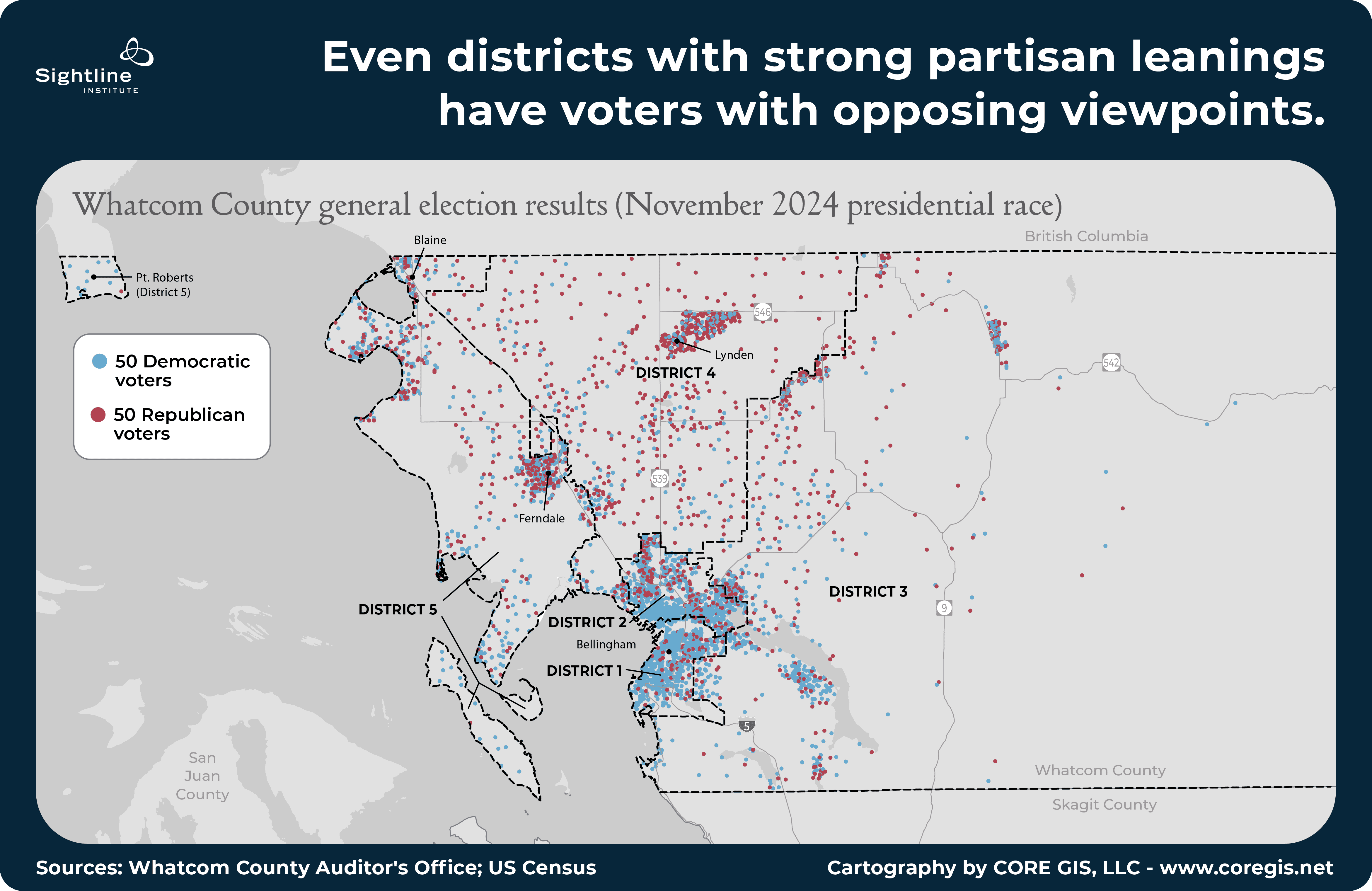
Single-member districts lock conservatives out of representation in bluer districts
District 1, for example, is mostly blue. A hefty 86 percent of voters there chose the Democratic presidential candidate in 2024. But it’s not 100 percent Democrats; many thousands of District 1 voters cast their votes for Trump. Under the current arrangement, those conservative voters (assuming they would also support a conservative local candidate) don’t get a say on county council from their district.
Because the district is set to deliver a Democrat to council to maintain the council’s overall partisan balance, any District 1 voter with a non-Democrat stance is consistently locked out of representation. A Republican voter could choose conservative candidates in dozens of elections, and they’d never elect one. In District 1’s most recent election in 2021, no conservative candidates even made it through the top-two primary election. Anyone hoping to cast a vote for someone not endorsed by the Progressive Voters Guide in the general election was out of luck.
And vice versa: Single-winner districts lock progressives out of representation in redder districts
The same dynamic is true in reverse in District 4. In the 2023 district election, two conservative candidates made it through the top-two primary election, leaving Democrats unable to select an aligned candidate in the general. Liberal-leaning voters in that district are outweighed by the conservative majority and won’t ever get a district representative who reflects their views.
County voters often, of course, align differently on a national level than they do locally. Although most people running for office have partisan alliances, county offices are technically nonpartisan, and both candidates and voters have nuanced views. More voters in District 5, for example—56 percent—chose Harris over Trump in 2024; but Republican Ben Elenbaas won 61 percent of the vote in the 2023 county council election. In District 2, Bellingham-based progressive Todd Donovan’s 78 percent vote share in 2021 closely matches Harris’s 79 percent in 2024; but Donovan’s opponent Kelley O’Connor had already withdrawn from the race, and write-ins made up a larger share of the remaining votes than hers.
What remains true in all these elections is that some voters wanted a different candidate. But winner-take-all elections lock out any voices besides those of the majority.
Proportional representation offers a better path
How can a government move beyond the challenges of single-member, winner-take-all districts?
Proportional representation. It’s a system that’s designed to elect representatives in proportion to their share of the vote—no mapmaking gymnastics or goofy-shaped districts required.
Proportional representation comes in a variety of forms and flavors, which Sightline has researched extensively. The simplest model for Whatcom County would probably be maintaining the current size of county council and electing all seven members at once through multi-winner ranked choice voting (which can be used in nonpartisan races, unlike other forms of proportional representation). There are other potential models, too, like the combination Portland, Oregon, started using for its newly expanded city council (four districts with three members elected proportionally within each district); Whatcom County could have two or even three multi-member districts, keeping the council a similar size or slightly expanding it.
Any form of proportional representation would improve on the current arrangement. Rather than relying on unwieldy and unpredictable district boundaries to secure a conservative voting bloc, conservative voters across the county could all weigh in on electing councilmembers of their choice. Liberal voters in more conservative districts could also vote for and elect someone whose views they support. Proportional representation would welcome a broader array of voices to the council: perhaps a few Democrats or Republicans, sure, but maybe an urban Republican or a rural Democrat, and a Green or Working Families party member, a Libertarian, or an independent, if they have enough support.
And voters would win, too: in the form of better representation based on what they believe, not just on where they live.

