
Takeaways
- Candidates across the political spectrum have used and appreciated the benefits that democracy vouchers offer, and vouchers haven’t privileged one political camp over another.
- Democracy vouchers primarily benefit one major stakeholder: the people of Seattle.
- Seattle voters have the chance to renew this effective, cross-political program on the August 5, 2025, primary ballot.
Find audio versions of Sightline articles on any of your favorite podcast platforms, including Spotify, YouTube, and Apple.
Pop quiz: What do Bruce Harrell and Lorena Gonzalez have in common? Hint: It’s something they also share with both Tammy Morales and Tanya Woo, as well as Ann Davison and Nichole Thomas-Kennedy, Cathy Moore and ChrisTiana ObeySumner, Dan Strauss and Heidi Wills, and many others besides.
These candidates are mostly on opposite sides of Seattle’s political spectrum. Each pair of competitors comprises one Seattle Times editorially endorsed candidate and one from the Stranger.
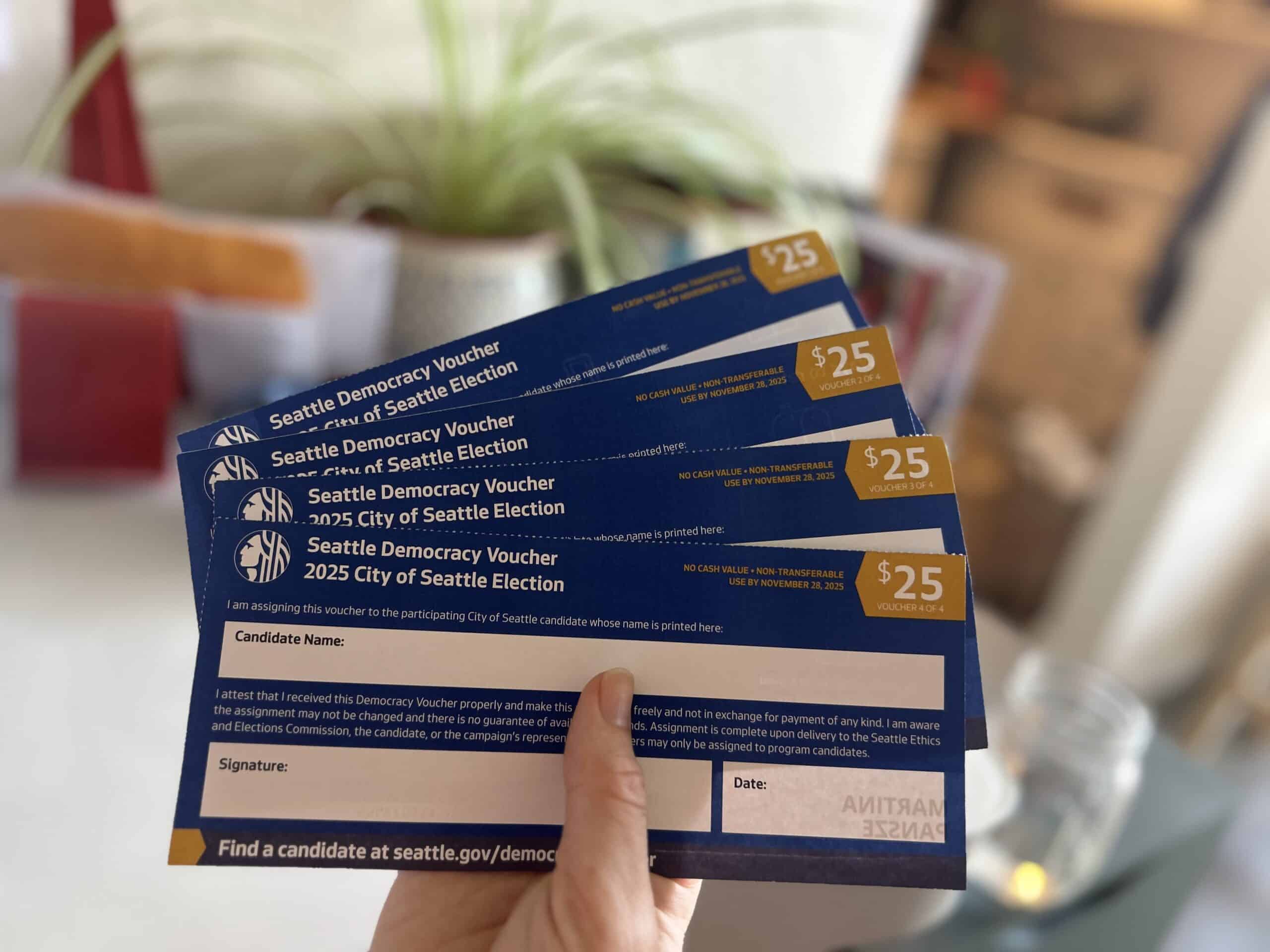
So what’s the common denominator? Democracy vouchers.
All these candidates (plus many more) took part in the city’s innovative Democracy Voucher Program when they ran for office. Of the 42 eligible city candidates (for mayor, city council, or city attorney) who made it to the general election between 2017 and 2023, all but five used the program.1
Only two non-democracy voucher candidates have won office over those years, and they also don’t share a lot of overlapping political space: Sara Nelson, the council’s current pro-business, anti-tax president, and prior socialist firebrand councilmember Kshama Sawant. Both Nelson and Sawant have expressed support for the program, though, and have offered varied reasons for not participating (for Nelson, concerns about doorknocking during COVID and other logistics; for Sawant, that opposing corporate PAC funds would swamp what she’d be allowed to spend as a democracy voucher candidate).
What does this mean for Seattle politics? Democracy vouchers are position-neutral, good for all kinds of candidates, and especially powerful for the voters of Seattle.
Seattle voters have a chance to renew this popular, fruitful, and inexpensive program on the ballot this August. In the words of Council President Nelson, it’s an “investment in democracy, the currency of your voice.”
A bonus for candidates and voters of all leanings
Seattle’s elections are nonpartisan, so they don’t exhibit the same type of partisan polarization that threatens to overwhelm current state and US federal elections. But the city still has political sides—moderate vs. progressive, centrist vs. lefty, preservationist vs. YIMBY.
Endorsements from the city’s leading media outlets are a decent proxy for these lines of competition in Seattle politics. On one end is the Seattle Times, the city’s moderate, largest news source. On the other side is the Stranger, Seattle’s irreverent and unapologetically progressive alternative paper.
The Seattle Times and the Stranger have only endorsed the same general election candidate in one city race since 2017 (plus one other contest where the Seattle Times didn’t choose a candidate).2 Every other time, they’ve supported opposite sides of the local political options. Politicos might wonder, then, whether a program like democracy vouchers benefits one side more than another.
The answer: nope.
Those political distinctions melt away when examining who has benefited from democracy vouchers. Seattle Times-endorsed candidates have won using the program; Stranger-endorsed candidates have won using the program. And the two candidates who gained office without the program are from opposite political camps. What’s more, vouchers fund a similar portion of candidates’ campaigns, making up 32 to 88 percent of contributions to Seattle Times candidates and 35 to 88 percent of contributions to Stranger candidates.
In 2023, all general election candidates used democracy vouchers. Mayor Bruce Harrell and councilmembers Rob Saka, Joy Hollingsworth, Maritza Rivera, Cathy Moore, and Bob Kettle all won with Seattle Times backing; Tammy Morales and Dan Strauss with a Stranger endorsement. In prior years the breakdown was inverted, and more Stranger-endorsed candidates have won; but they and their competitors have almost always also taken part in the voucher program. Even Ann Davison, who won election as Seattle’s city attorney in 2021 while identifying as a Republican, used the program.
The real winner: Seattle residents
Instead of advantaging one political group over another, the program has benefited a more important stakeholder: Seattle residents. Vouchers have helped everyday city residents get more say in who has a chance at winning, while letting candidates of all stripes better connect with voters.
Central District voter Gina Owens told the Seattle Times in 2017 that with democracy vouchers, “It feels like I’m more a part of the system. People like me can contribute in ways that we never have before. We can participate in ways that Big Money always has.” Some voters are surprised to be approached by candidates, like 77-year-old Hoa Chau (through an interpreter): “Because I’m old and I’m very poor, I don’t have any money.”
In 2019, one group of voters who gathered regularly to discuss politics took the voucher program as an additional incentive to swap ideas on which candidate best aligned with their political views: “We’re interested in people to the left but probably not as far to the left as Councilmember Sawant,” according to group organizer Ron Posthuma. Another group member, Columbia City resident Donna Stringer, said that her “democratic intelligence has increased considerably” as a result.
More recently, Seattle resident Gabi Muna testified:
As a student with little disposable income, this program is essential. Democracy vouchers let me make my first ever contribution to a political campaign. I grew up thinking that political donations were only for the wealthy and that politics was a game of big money. But democracy vouchers have changed that. They pushed me to engage with local politics and pay more attention to the down-ballot races because it finally felt like I had a buy-in. Democracy vouchers empower young people like me, the future of our city, to participate in our democracy when often we feel like our voices aren’t heard.
Seattle electeds of all politics agree: Democracy vouchers are a powerful benefit
Candidates-turned-officeholders echo a similar appreciation. In council hearings and committee votes to send the renewal measure to the ballot, almost all Seattle councilmembers weighed in multiple times to share the value they see in the program. The renewal legislation sailed through council without opposition from any political camp.
Mayor Bruce Harrell, who transmitted to council the legislation to put renewal on the ballot, said of them: “Democracy vouchers have allowed more people to participate in campaign financing in our city, making the political process more accessible and inclusive. Renewing this program shows Seattle’s commitment to ensuring that all voices—regardless of income or background—can help shape the future of our city.”
Other Seattle Times-endorsed officeholders made similar points. Councilmember Bob Kettle, who championed the legislation in council, lauded the program and its goals:
We should be looking to encourage participation and civic engagement. We should be looking to encourage outreach by those seeking elections, and we should be looking to encourage dialogue that can aid understanding of the challenges we face and the policies that can address those challenges… the democracy voucher program allows Seattle to show leadership, when leadership and upholding democracy is so wanting across America.
Councilmember Joy Hollingsworth added that she “fully super wholeheartedly support[s] this [program].” She noted how “it offers regular everyday people to be able to run for office. Not just people who are seeking a political career but actually at the hyper local, where it affects people the most.” Councilmember Cathy Moore similarly declared that she is “a huge supporter of the Democracy Voucher Program… I think it does truly achieve the goals it sets out to achieve.”
Council President Sara Nelson, the only sitting councilmember who did not use the program, also agreed—not only through words but in her actions to sponsor the legislation and shepherd it through her committee and the full council. At the final vote, she expressed that, “I fully support this program and what it represents: it represents people putting their values before money, and you are enabling the people to do the same thing.”
The sitting Stranger-endorsed councilors shared the enthusiasm. Councilmember Alexis Mercedes Rinck was “so excited to vote on [democracy vouchers]” as “another example of Seattle being a true leader in defending democracy.” Councilmember Dan Strauss emphasized that “democracy vouchers bring democracy into every person’s home… that means candidates don’t have to be tied to special interests to win; they can just talk to everyday people.”
Strauss shared how the program allowed him to choose to
knock on everyday Seattleites’ doors, rather than spending time on the phone calling political donors for what is commonly known as call time. The simple impact that this program has to influence candidates to prioritize being at people’s doorsteps rather than the phone is a really big deal, and this is how it increases civic participation and empowers voters to be able to have the conversation with the candidates.
Their testimonies validate not only the power of the program but also its ability to garner support across whatever partisan lines Seattle exhibits. Democracy vouchers are popular with candidates and residents alike. Rather than privileging one political camp or another, vouchers advantage everyday Seattleites of all persuasions.
Seattle voters have the chance to renew this effective, cross-political program on the August 5, 2025, primary ballot.

