

Takeaways
- Inclusionary zoning aims to ensure a share of new homes getting built are affordable to lower-income residents. It works as intended when it’s adequately funded.
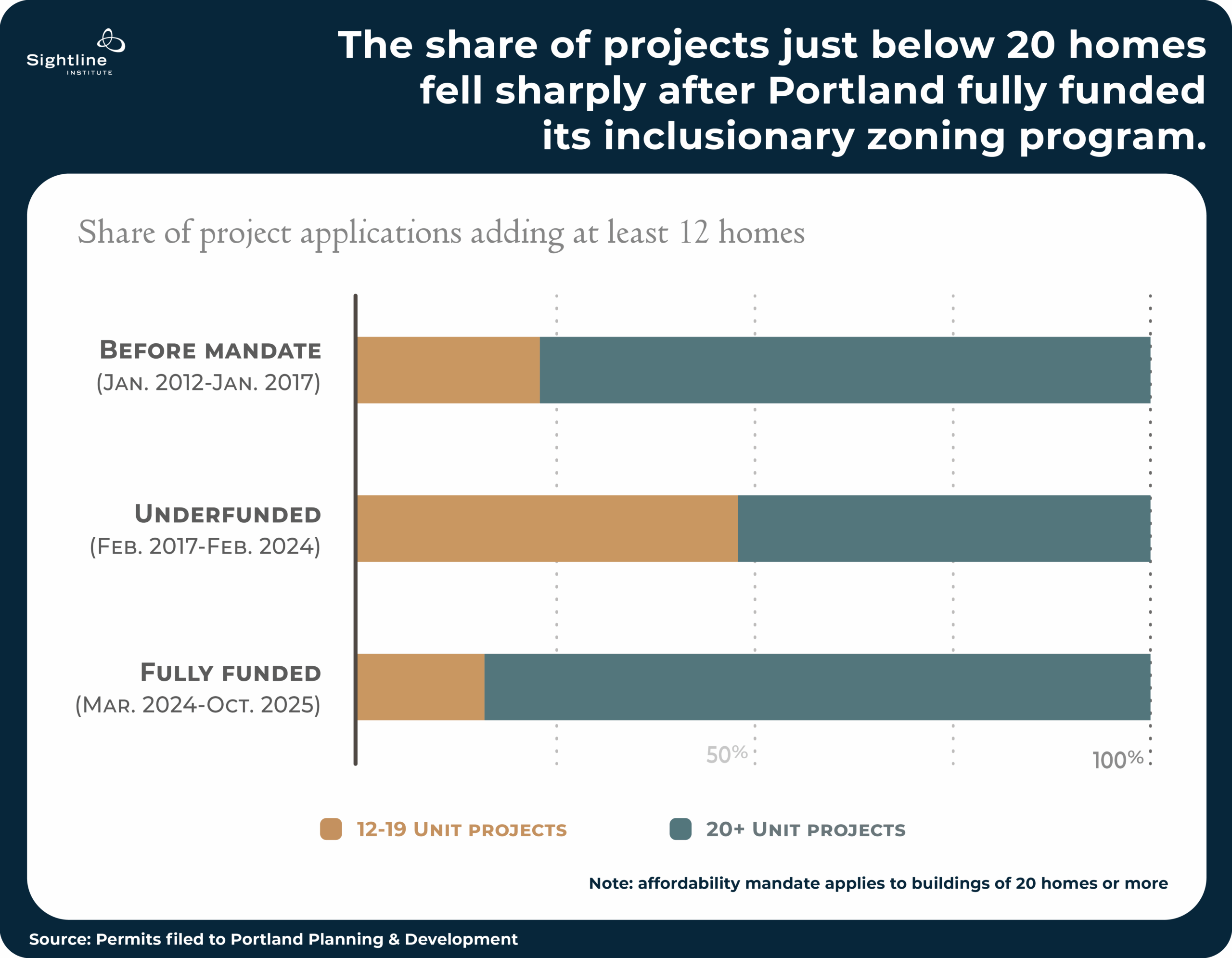
- When Portland’s affordability mandate was underfunded from 2017–2024, it produced many fewer affordable homes than intended. Most tellingly, the share of projects coming in just below its threshold of 20 homes doubled to almost half of multifamily projects.
- New data shows that after the program was fully funded across more of the city in 2024, the share of these smaller, under-20-home buildings returned to normal—a sign that the program is no longer undermining itself.
- That’s good news for Portlanders seeking homes they can afford in neighborhoods across the city. And it’ll keep working if the city continues calibrating the program over time.
Find audio versions of Sightline articles on any of your favorite podcast platforms, including Spotify, YouTube, and Apple.
For the first seven years of its existence, Portland’s inclusionary zoning program seemed to be working like the wrong end of a magnet.
Housing projects skidded, twisted, and jumped away from the city’s 2017 mandate that a share of homes in most new buildings be sold or rented for less than it had cost to build them. Tens of millions of dollars flowed instead to sites just outside the limits of Oregon’s largest city, like the Tigard Triangle and Vancouver waterfront. Multifamily permit filing rates within Portland tumbled 40 percent from their 2016 peak.
Portland’s new affordable housing mandate wasn’t the only factor in this. The city’s population growth slowed in these years, then reversed in 2020–22. As a result, rents in Portland have been more or less flat since the huge run-up in Portland home prices that ended in 2017.
But among the projects that did continue to flow into the city’s permitting pipeline from 2017–2024, there was one very clear sign that the inclusionary zoning program was underperforming: new buildings got smaller. Because the city’s program didn’t apply to buildings with fewer than 20 homes, one simple way to avoid it was to stick to buildings of fewer than 20 homes, even if larger buildings would have been allowed. In one extreme example, a project came in with thirteen separate buildings just below the threshold:
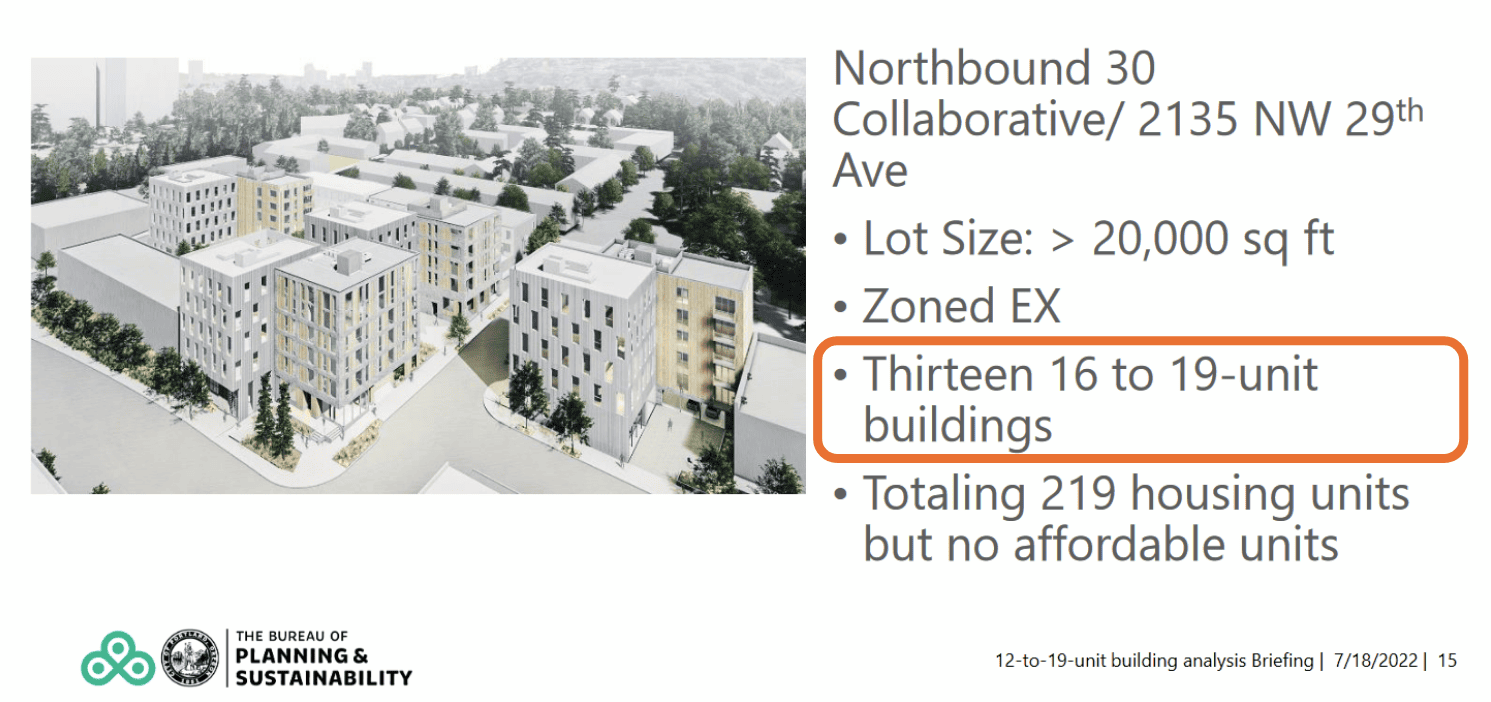
The problem wasn’t just that a few developers were finding ways to underbuild; it was that sites like Northbound 30 Collaborative were canaries keeling over in a coal mine. If it was worth it for some projects to contort themselves to escape the program, an unknown number of other mixed-income buildings were completely vanishing from Portland’s future.
The good news: Funding Portland’s IZ mandate worked
But new data shows that starting in 2024, Portland’s affordable housing magnet seems to have flipped around.
Immediately after a round of program changes that took effect in March 2024, new private apartment projects started jumping into Portland’s affordable housing program. As we reported last year, projects worth hundreds of homes opted into it in the first six months alone. Even more promisingly, the city’s trend toward underbuilt projects reversed:
What caused the change? The main difference: Portland funded its mandate.
From the day the program launched in February 2017 until the end of February 2024, new mixed-income buildings outside Portland’s central city received a relatively modest property tax break, enough to offset some of the revenue lost to discounted rents. But starting in March 2024, the city and Multnomah County both agreed to quintuple the size of that ten-year tax abatement for the neighborhoods ringing downtown. (Within the central city itself, the tax abatement had already been larger.)
That balancing of the scales was effectively a subsidy worth something like $220,000 per below-market home, which is less than the $250,000 or so that it would have cost taxpayers to subsidize a comparably priced home in a 100%-affordable building. But in interviews, some homebuilders said it was enough to flip Portland’s program from a dealbreaker to a deal-maker.
“The tax abatement changes were really the big change that brought Portland back in our mind,” said Ian Lewallen of Deacon Development, whose Russell Street Apartments is set to open in 2026 with 16 below-market and 138 market-rate homes. “Without that, frankly we had shut down looking at Portland for 18–24 months. But after that went through in March and April, we started looking at sites.”
Reacting in June to an earlier look at these numbers, the Portland Housing Bureau’s then-director Helmi Hisserich applauded the results of the 2024 reforms. “I am extremely proud of the rigorous work the PHB team put into the inclusionary housing program calibration,” she said. “Local developers have leaned into producing larger housing projects under the updated program rules. … The impact will be felt by Portlanders at all income levels in the years to come.”
To be clear, the improvements to this program didn’t change the fundamentals of Portland’s housing market. With the city’s population still below its 2019 peak, prices growing slower than inflation, tariffs and labor shortages driving up costs, and the region’s largest employers all in different sorts of trouble, nobody is building much in Portland right now.
“The bottom line is that the IZ move will help us get to the starting line faster, but we’re still 200 yards behind the starting line,” Sarah Zahn of Security Properties, who has recently been using the program to develop two mixed-income projects.
Another unresolved issue with Portland’s program: it applies to both rental and condo projects, but its 2024 reforms fully funded only rentals. In the 9 years of the program’s mandate on condo buildings, it has produced exactly three price-controlled condos in a single building, and 2024’s reforms did nothing to fix this.
The better news: With ongoing calibration, it can keep working
At the moment, the best available evidence suggests that whenever migrants and investments do return to Portland, the city is roughly on track to have a successful inclusionary zoning program for apartment buildings. It would automatically and cost-effectively sprinkle the city’s most popular neighborhoods with rental homes affordable to working-class Portlanders.
By then, of course, the economic situation will have changed again. Eventually the program will need another recalibration to ensure that shifting rents, incomes, and tax levels haven’t left it significantly overfunded or underfunded.
A funded inclusionary zoning program requires regular recalibration—a little work now and then to ensure that its IZ magnet remains pointed in the right direction. Unfortunately, the city has no way, in itself, to ensure that this will happen. Its current leaders might commit to regular calibrations, but they can’t actually speak for their successors. The State of Oregon could help by requiring regular calibrations, but current state law is silent on the issue.
And that’s the next big opportunity to improve Portland’s affordability mandate: to ensure it continues to house Portlanders for many years to come.
Correction 1/20/26: A previous version of this story said that no below-market condos had been produced as a result of Portland’s 2017 mandate. In fact, three have been listed for sale in privately financed buildings as of early 2026.

