


Takeaways
- Washington state’s landmark Parking Reform and Modernization Act is one year old today. It won’t be in effect until the end of 2026, but there are already homes under construction right now that have benefited from it.
- Several cities are adopting reforms well before deadlines or removing costly parking mandates altogether.
- Meanwhile, other states have taken note, passing or introducing similar “cap and exempt” style reforms of their own to bring down the ballooning costs of US homebuilding.
Update 6/5/2026: This article has been amended to reflect that Seattle has already adopted the state regulations, which we missed in our initial reporting. We also made a line edit to clarify that Shoreline did successfully repeal their parking mandates.
One year ago today, Washington state signed into law the Parking Reform & Modernization Act, striking long-standing legal requirements for pre-determined numbers of parking spaces for everything from apartments to art galleries. Though the law doesn’t go into effect until the end of 2026, it’s already making positive impacts for Washington communities that have adopted the rules early.
1. It’s already helping to build homes
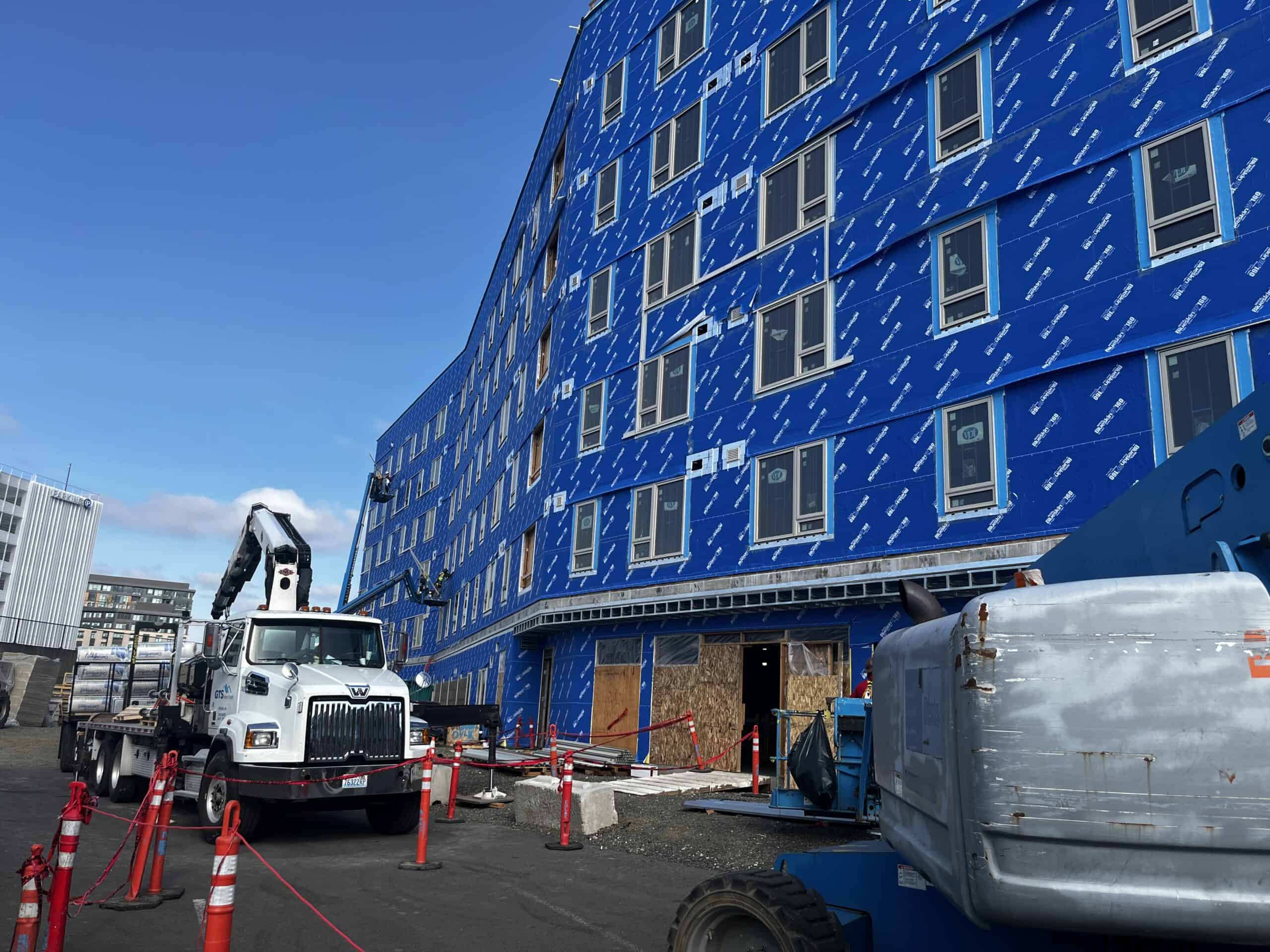
To see how the Parking Reform and Modernization Act (PRMA, or SB 5184) is playing out on the ground, head to 615 West 6th Street in downtown Vancouver, Washington. There, construction is underway to convert a city-owned parking lot into 95 affordable homes. Last summer, though, the project ran into parking trouble and stalled. The trouble, oddly enough, was that the affordable housing project was moving too quickly.
The masterplan for the site includes two other market-rate residential buildings and a parking garage to be shared by all. Back in 2023 when the project was planned, it was assumed the affordable housing would be the last building completed. But rising interest rates pushed the affordable homes out ahead of the other buildings, including the parking garage. And that created a problem for the lender, who was reluctant to finance construction of a building that technically had no on-site parking, despite its location in a city parking lot.
Left: A Google Maps aerial view of the city parking lot being redeveloped into the Waterfront Gateway Development, with new affordable and market-rate homes. Right: The white building (upper left) is the affordable housing segment of the project. Image courtesy of the City of Vancouver, Washington.
“We extended closing by two weeks, and then it was another two weeks while we worked on solutions,” said Jonathan Ledesma, Development Director at Colas Development Group. The shovel-ready project was now burning money on lawyers. The city, which was on the other side of this deal, selling the land for just $1, luckily had already been working on a solution: adopt the state-required parking exemption for affordable housing early.
“We wanted this to happen regardless,” explained Chim Chune Ko, a real estate project manager for the city. Housing production in Vancouver has plummeted over the past year. “Affordable housing, in particular, has serious financial challenges,” explained Ko. “We wanted to give them as much flexibility as soon as possible.”
He meant it. Just three weeks after SB 5184 became state law, city staff were at the Planning Commission with an ordinance that did just that, going further than the state-defined affordability limits. “Politically, it did help,” Ko said. “We’re going to have to implement something anyway.”
As the city worked on an interim parking agreement that would satisfy the lender, the ordinance sailed through city council. The sale closed two weeks later, allowing construction to finally start. The building is expected to open in December 2026.
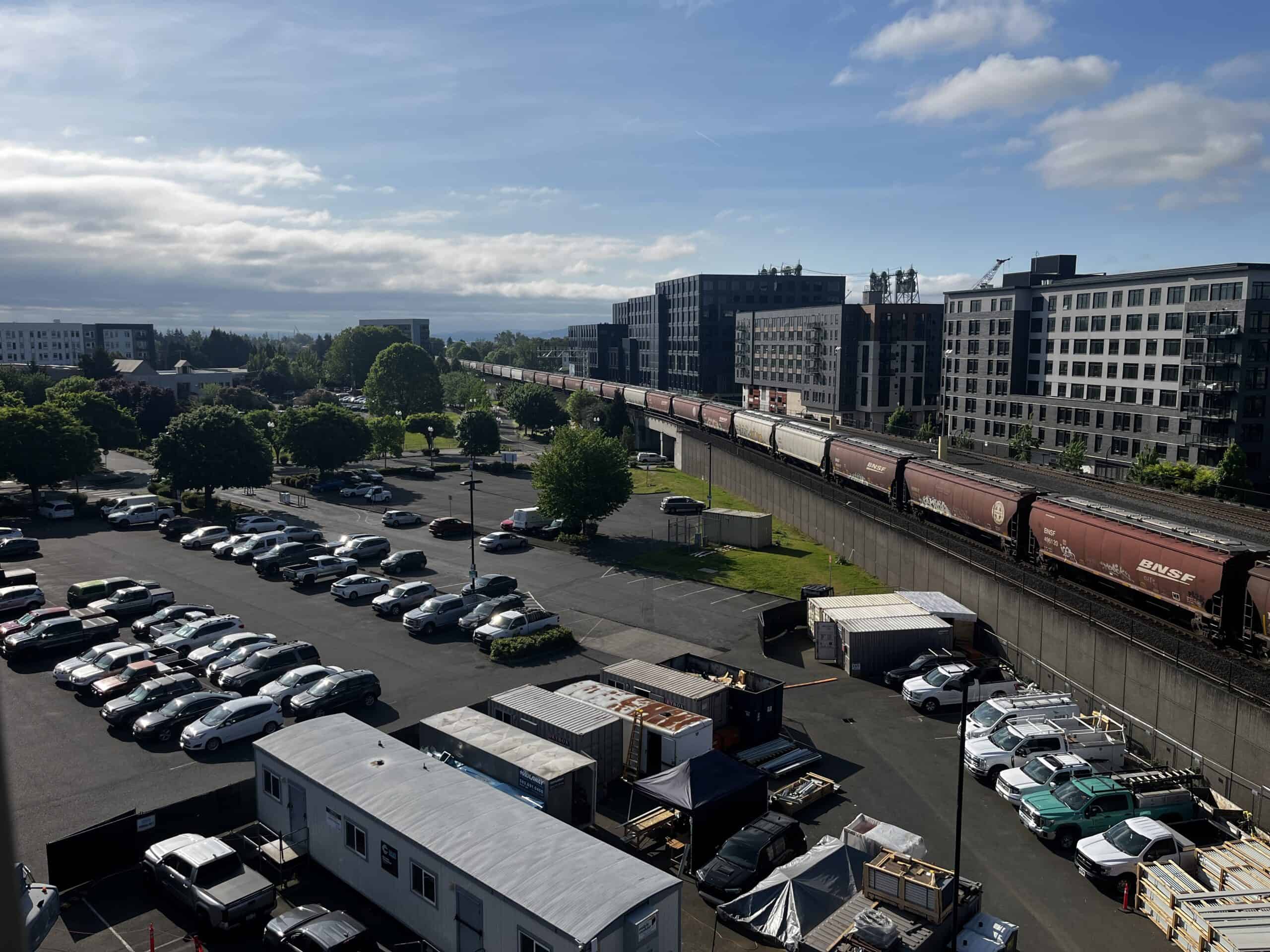
“I think this would have happened regardless of the code change,” Ledesma said about the parking agreement, “but the change gave us more options for resident parking since compliance to a parking requirement was no longer an issue.”
Under the old parking minimums, only spaces within 300 feet of the building could legally count towards the requirement, covering most (but not all) of the existing parking lot. Now any space could be reserved for residents, flexibility that may be needed for future construction phases.
Refresher: The basics of the Parking Reform and Modernization Act
Affordable housing, like the project in Vancouver, Washington, is just one of the building types that, thanks to SB 5184, will no longer be subject to costly parking minimums. The legislation took a “cap and exempt” strategy. It set a ceiling on how much parking local governments could require for broad categories of commercial and residential buildings. Further, a list of specific uses and building types were granted full flexibility over their parking. Further, a list of specific uses and building types were granted full flexibility over their parking.
| Caps (Highest parking minimum allowed) |
|---|
| 1 space per home (single-family) |
| 0.5 space per home (multifamily) |
| 2 spaces per 1,000 sq ft commercial space |
| Exempt (No minimums apply) |
|---|
| Affordable housing |
| Senior housing |
| Childcare facilities |
| Homes <1,200 square feet |
| Commercial spaces <3,000 square feet |
| Existing buildings undergoing change of use |
| Ground-floor residential space in a mixed-use building |
The lowest parking requirement is the one that applies. For example, if you wanted to build a small apartment building with eight units, the most parking you could be required to build is four spaces. But if all the units were under 1,200 square feet (common for multifamily), you wouldn’t be legally mandated to build any parking; the choice is fully yours.
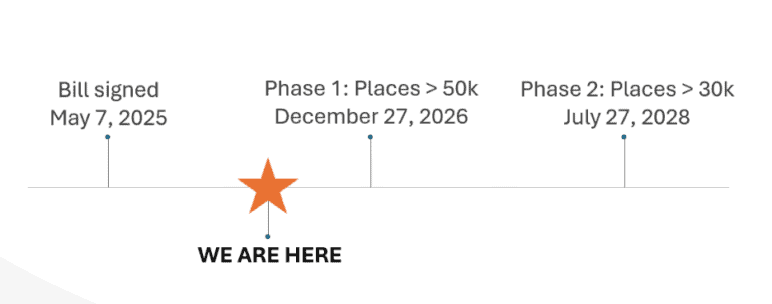
Cities and counties with a population greater than 50,000 have until December 27, 2026, to comply with the new rules, so stay tuned for this item to come up at your local city council if it hasn’t already. Cities or counties with 30,000 to 50,000 people have an additional eighteen months to adopt the rules, making their deadline July 27, 2028.
2. Cities are shedding parking minimums altogether
Prior to the PRMA adoption, just three cities in Washington state had scrapped their parking minimums, either on a pilot or permanent basis: Port Townsend, Spokane, and Bellingham. Shoreline’s city council had also voted on its intention to do so.
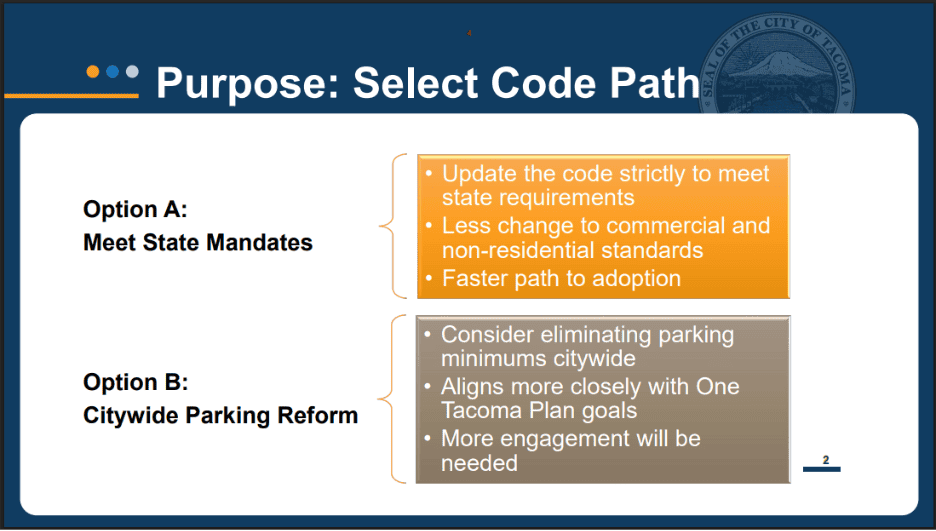
Since then, Bremerton, Bothell, and Shoreline have all eliminated their parking mandates. Vancouver, Bellevue, and Tacoma are considering doing the same. Of the cities Sightline Institute has identified as having taken legislative action to comply with the PRMA, the majority of them are opting to get out of the parking business altogether. Why? For starters, it’s just plain easier.
City-level Parking Reforms in Washington since May 2025
| ⏰ Early Adopters |
|---|
| 1. Lynnwood, June 23, 2025: Adopted rules three years early |
| 2. Vancouver, July 7, 2025: Adopted affordable housing exemption, more below |
| 3. Seattle, December 16, 2025: Adopted rules |
| 4. Kirkland, April 7, 2026: Adopted rules early plus full exemption around bus rapid transit station |
| 🚮 Full repeals |
|---|
| 1. Bremerton, June 4, 2025: Adopted full repeal |
| 2. Bothell, July 8, 2025: Adopted full repeal |
| 3. Shoreline, August 11, 2025: Adopted full repeal |
| 4. Bellevue, January 13, 2026: City Council directed staff to study citywide repeal |
| 5. Tacoma, March 4, 2026: Planning Commission advanced full repeal |
| 6. Vancouver, upcoming May 11, 2026: City council voting on Comprehensive Plan with full repeal |
The PMRA is just the latest of eight state zoning reform laws adopted since 2023 that override local parking regulations to help build more homes at lower costs.1 Given the growing swiss-cheese nature of when cities are allowed to require parking it is not surprising that the end of Commerce’s draft implementation guidance (available for comment through May 20, 2026), the first option it suggests for additional flexibility is to eliminate off-street minimums entirely and move to a market-based approach.
Steve Adkinson, a long-range planner in Tacoma, laid it out to the Planning Commission in March: “The parking standards prescribed by the state would be affected by what type of use you are, how big you are, where you are located, what kinds of materials you use to build your project,” he said. “All of those things could ultimately affect just getting to an answer about how much parking is required for a project that comes in the door.”
Staff proposed an alternative option: eliminate parking mandates altogether. “It’s a safe conclusion that option B does reduce both the permit and administrative burden of the code,” said Adkinson. The Planning Commission voted in favor of the full repeal 8–0.
The upcoming December 2026 deadline has also spurred action by places whose leaders have long thought about reforming local parking mandates but hadn’t quite gotten around to it. Take Bothell, whose city council has been talking about removing parking minimums entirely since 2022. “This effort was accelerated with the passage of Senate Bill 5184,” planner Jaclyn Samson told Bothell city council on July 8, 2025, two months after the bill had been signed. The ordinance passed 5–1.
Bothell testified in support of the PRMA when it was in the legislature, but even city council members who dislike it seem eager to go beyond the requirements. “Personally, I’m not a fan of the state mandates and how prescriptive they can be at times,” said Bellevue City Councilmember Briar in January. “Nevertheless, I do think we need to expand our scope.” Councilmember Nieuwenhuis, also opposed to the state mandates, agreed: “If we’re going to look at this and, you know, lift up the hood and look at updating this, let’s do it the right way and look at the entire city.” The council unanimously voted for planners to further develop options beyond what the state required, including a potential total repeal.
This burgeoning trend seems to put Washington in Oregon’s footsteps. After Oregon’s statewide parking reform, though, its cities had to choose an additional compliance action. Removing parking mandates altogether was the easiest administratively, and the vast majority did so. In Washington, it seems that having an occasion for planning staff to merely review the status and history of parking mandates to city councils is having a similar effect.
3. Opposition has been minimal
There have been two known challenges to the PRMA. First was an announced ballot initiative by Safe Eastside. This organization is known for its opposition to a housing project for people exiting homelessness, utilizing parking minimums in its case against the building. The organization ultimately didn’t turn in signatures by the referendum deadline.
There is an exemption process for cities who want to hang onto their parking mandates. So far, at least one jurisdiction pursuing it. Spokane Valley’s city council recently authorized $100,000 for a study that will be submitted to the Department of Commerce. To win an exception, the city will have to make a case that removing parking mandates would be less safe than keeping them.
4. Parking mandates continue to cause headaches, stalling important community assets
One place where Washington’s bill falls short is that it only covers residential and commercial uses. Left in the gap: hospitals, libraries, schools, churches, industrial uses, assisted living facilities… the list goes on. Those uses weren’t specifically excluded from the bill for a policy reason; the language “commercial” just didn’t apply to them, leaving them vulnerable to excessive and arbitrary parking mandates.
Public buildings also struggle with parking mandates, as Representative Adison Richards observed last summer in his district. A fire station expansion in Gig Harbor triggered a requirement to include 51 parking spaces, despite the station’s maximum of 11 employees per shift. On top of that, the state requires roughly a third of the parking spaces to be compatible for EVs, further increasing their cost.
“It was simply impractical for a fire station,” Richards said. Getting an exception from these pre-determined ratios took months. The mayor got involved. “It took a lot of work and a lot of conversations between the city and the fire department,” said Richards. “They ultimately got back to the same number of stalls that the old fire station had.”
If the PRMA’s commercial cap of 2 parking spaces per 1,000 square feet had applied, the project would have landed at the exact number of spots they ultimately agreed upon—43—without the onerous additional meetings or taxpayer expense. Even if public projects had been included in the bill, Gig Harbor, with a population of 12,000, would still be too small to get state relief. Through the legislative process, the PRMA ultimately excluded cities and counties with fewer than 30,000 residents, representing where approximately 20 percent of Washingtonians live—and where they need more fire stations, hospitals, schools, and other key community resources.
5. Confusing regulations around county roads
There is a big asterisk around land governed by counties. During the legislative session, the Association of Washington Counties successfully lobbied for an exemption for county roads that are not up to adopted standards.2 It was intended as a kind of proxy for rural roads without on-street parking, but it’s not totally clear if it will work that way. No standard was specified, leaving counties largely in the dark on how many county roads or adjacent properties might still be subject to parking minimums. (The cancelled daycare Sightline reported on is one such property that falls into this camp.)
The department of Commerce laid out a few different options for how counties might interpret this language:
- When on-street parking has been determined to be unsafe, Commerce recommends using the maximum parking requirements set by the PRMA.
- Counties can identify road classifications that will be required to provide off-street parking in all cases, or just in certain areas, to provide predictability for property owners or developers.
- When development completes street improvements that result in additional on-street capacity, counties may count that toward required parking.
Unfortunately, Sightline’s interpretation—that if a developer completed the required frontage improvements, the street would then qualify as up to code and thereby trigger the PRMA limits—was not listed. County zoning has a large impact, too: one in every three Washington residents lives in unincorporated areas governed by counties.
6. Other states are following Washington’s lead
Just as parking mandates were copy-pasted from one jurisdiction to another, Washington’s Parking Reform and Modernization Act has also been jumping state lines. In 2025, a similar parking reform bill in Montana was also successful, signed into law just days after Washington’s.
In 2026, four more states introduced legislation during their respective sessions that used Washington’s “cap and exempt” strategy:
- Indiana, HB 1001, Rep. Doug Miller (R)3
- Hawaii, HB 1919, Rep. Luke Evslin (D)
- Illinois, SB 4064, Sen. Javier L. Cervantes (D)
- Rhode Island, S 2628, Sen. Meghan Kallman (D)
Neither Indiana’s nor Hawaii’s bills succeeded this year, but proposals in Rhode Island and Illinois are still pending.
7. This is only the beginning…
It will likely be years before data becomes available on how these parking reforms are affecting development. Especially because construction is slowing. “It’s too early for us to draw any meaningful conclusions, especially with the way the development market is now,” said Shoreline Planning Director Andrew Bauer. Housing production overall in the United States is trending in the wrong direction. Washington is no exception, though there are some places seeing growth, like Bothell.
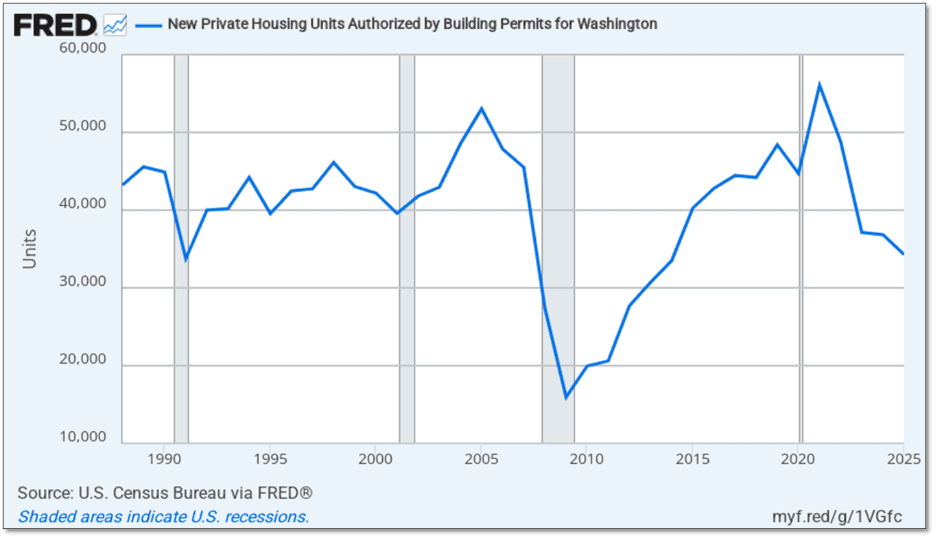
High interest rates, oscillating tariffs, labor shortages, and now the Iran War have increased construction costs and even mortgage rates. Today, construction materials remain roughly 40 percent more expensive than they were prior to the pandemic. Even after a slight rebound, permits in January 2026 (the most recent month of data) shows an annual rate 38,500 homes after adjusting for seasonal variation. To catch up with demand, Washington state needs to build 50,000 new homes each year through 2030, a feat it last managed just once since the Great Recession, back in 2021.
While city councils have little influence over interest rates or the Strait of Hormuz, reducing parking mandates above and beyond the state requirements is one lever they control completely. Every week or month of delay that can be avoided allows another Washingtonian to find a home that much sooner.

Related: How Washington State Won Parking Reform | Lessons and strategies for parking flexibility advocates elsewhere.

