Donate Newsletters

Cap and Trade—In 3 Pictures

We all rely on mental shortcuts to make sense of new information. Often, metaphor and analogy—or pictures—help us get a handle on abstract ideas.

Right now, far-reaching climate and energy policy is back in the news, this time at the state level on the west coast where California has an established cap and trade system, Oregon and Washington are thinking seriously about putting a limit on climate pollution, and British Columbia has a successful carbon tax shift in place.

The time is right to deploy the most compelling illustrations of how smart climate and energy policy works for people and our economy. Here are three mental shortcuts for talking about cap and trade:

Read more

Living Longer in British Columbia

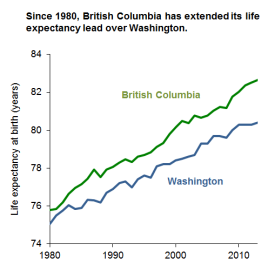
Life expectancy reached a new high in both British Columbia and in Washington last year. That’s good news, since it means that the residents of both jurisdictions are living longer, healthier lives.

In one way of looking at things, the news comes as no surprise. Lifespans through much of the industrialized world have increased fairly steadily since the end of World War II, so record-breaking years are now more the rule than the exception.

BC vs WA life expectancyBut what’s genuinely interesting is that life expectancy is rising much faster in some places than in others. As of 1980, for example, lifespans in Washington and British Columbia were nearly in a dead heat: 75.1 years for Washington, 75.8 for BC.  Yet since then, BC has pulled ahead. By 2013, lifespans in BC had reached 82.7 years, compared with just 80.4 years in Washington—a gap of 2.3 years, which is wider than at any point since Washington began annual reporting of life expectancy statistics.

Read more

Lecture: The Thin Green Line

Last week I gave a talk at Western Washington University about the massive coal, oil, and gas export projects slated for sites throughout the Pacific Northwest. Over the course of about 45 minutes I explored the changes confronting this region, as well as some of the opportunities we have to act as a sort of … Read more

Zoning: Inclusionary v. Exclusionary

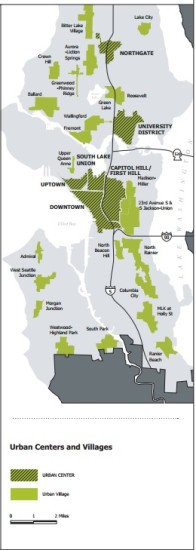
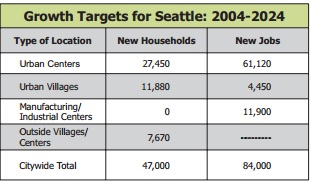
At last count, Seattle ranked as the fastest growing major city in America. The city’s growth has easily outpaced the projections of its decade-old Comprehensive Plan, which foresaw 47,000 new households (as well as 84,000 new jobs) between 2004 and 2024. Between 2005 and 2012 the city added 29,330 net new housing units—roughly 62 percent of its 2024 target in just 7 years.

Growth Targets for Seattle, 2004-2024, Map
Seattle Comprehensive Plan by Seattle Department of Planning & Development

Growth Targets for Seattle, 2004-2024
Seattle Comprehensive Plan by Seattle Department of Planning & Development

This rapid growth has stemmed in large part from the city’s relatively robust economy. From March 2013 through March 2014, for example, King County (which includes Seattle) ranked fifth among all US counties in net job growth, trailing only the likes of Los Angeles County and Manhattan.

But the population boom has sent housing prices and rents trending upwards—creating real anxiety among many renters, and fears that Seattle’s housing market will price out residents that once could afford to live in the city.

One city councilmember has described today’s housing market as being in “crisis,” and the mayor has launched a housing affordability advisory committee aiming to make affordability recommendations by next March. (Full disclosure: Sightline Executive Director Alan Durning will serve on it.)

Read more

Climate Change in Plain Language

Editor’s note January 2017: Are you participating in this morning’s #ClimateFacts “Twitter storm” (details here)? We are! And we’ll look forward to keeping up the drumbeat for climate science and activism in years to come, on our Twitter feeds and elsewhere. Of course, how we message is just as important as what we message, so we’re … Read more

Canada vs. the USA on Oil Train Standards

With what passes for chest-beating in the world of railway regulation, US politicians this summer claimed that the Transportation Department’s newly proposed crude oil, ethanol, and flammable materials train rules made the US Number One when it comes to tank car regulation—and that we are doing better than Canada. In his reading of a July … Read more

REPORT: Pacific Northwest Coal, Oil, and Gas Exports Would Have Carbon Equivalent of More than Five Keystone XL Pipelines

For immediate release: September 9, 2014 A new report from Seattle-based think tank Sightline Institute finds that new coal, oil, and gas shipments planned for the Pacific Northwest would carry more carbon annually than five Keystone XLs. The report’s author, Sightline policy director Eric de Place, calculates the carbon in active proposals across Oregon, Washington, … Read more

“If We Cannot Escape, Neither Will the Coal”

Across the Northwest, Native communities are refusing to stand idle in the face of unprecedented schemes to move coal, oil, and gas through the region. It’s a movement that could well have consequences for global energy markets, and even the pace of climate change. Now is a good moment for pausing to examine some of … Read more

The Holy Grail of Parenting

On a recent vacation, I had a perfect moment, one that so rarely occurs since I had a kid nearly six years ago. I was sitting on a deck, drinking a gin and tonic, and having civilized conversations with my husband’s oldest friends. Almost entirely uninterrupted.

That’s because sandwiched between our restaurant and another across the way was a grassy field full of roving kid gangs. They were far enough away that their entropic energy didn’t bother anyone, but close enough that you could still keep half an eye on them.

Our daughter befriended a local girl, cadged a piece of her birthday cake, and joined and lost interest in countless soccer scrimmages, dance parties, frisbee games, and sibling chases.The important point is that she was having a great time doing kid things, and we were having great time doing adult things. In the same place.

In my life, this doesn’t happen nearly as often as I’d like. Possibly because of byzantine liquor laws, the fact that urban land is pretty expensive to let kids run wild on it, and all the perfectly good reasons that not everyone wants our child around as much as we do.

Happening upon those urban spaces that serve children and adults equally well is like the Holy Grail of parenting.

Read more

Carbon Pricing and Northwest Businesses

Many business owners and workers worry that carbon pricing will hurt local economies. They need to know: How would carbon pricing affect businesses and job creation in Washington and Oregon? In particular, how would it affect energy-intensive businesses that compete in national and international markets with companies not yet covered by carbon pricing? Will these energy-intensive, trade-exposed (EITE) businesses, like steel and aluminum manufacturing, still be able to compete with businesses outside the state or will carbon pricing send their sales plummeting? Will pricing carbon in the Northwest just send production and carbon pollution elsewhere? In other words, will carbon emissions “leak” to out-of-state firms?

The answer? Most businesses are not energy-intensive and consequently would be essentially unaffected; they might even benefit from carbon pricing if they receive offsetting reductions in existing taxes. However, a small group of energy-intensive businesses, only some of them trade-exposed, would be substantially affected by a price on carbon. Fortunately, there may be ways to partially and perhaps fully address those impacts, for example by reducing existing taxes on manufacturers.

In this article, I will spell out that answer, industry by industry, for Oregon and Washington. I assume a carbon price of $25 per ton of CO2. That figure is based on the proposal for Washington State that I’m working on with CarbonWA.org, and it’s close to the $30 carbon tax in BC. If you’re more interested in a California-style system, divide most of the carbon pricing financial impacts by two because permit prices there are roughly $12 per ton at the moment. For simplicity, I concentrate on CO2 from fossil fuels, which account for more than 75 percent of the total. A more-complete review would need to study more thoroughly the handful of industries with significant emissions of other greenhouse gases (GHGs) or of CO2 from other sources.

Read more

×
Privacy Overview
Sightline Institute

More information about our privacy notice

Strictly Necessary Cookies

Strictly Necessary Cookie should be enabled at all times so that we can save your preferences for cookie settings.

3rd Party Cookies

This website uses Google Analytics to collect anonymous information such as the number of visitors to the site, and the most popular pages.

Keeping this cookie enabled helps us to improve our website.

Additional Cookies

This website uses social media to collect anonymous information such as which platform are our users coming from.

Keeping this cookie enabled helps us better reach our audiences.