Donate Newsletters

Are You Planning to Have Kids? (Part 2)

In my last post about Vancouver BC, I outlined the family-friendly policies that have helped make its downtown a magnet for families with children. But how do those policies play out in real life? What works well for families and what drives urban parents crazy?

The University of British Columbia’s planning department has actually devoted a lot of studentpower to answering those questions. They’ve collected extensive feedback from residents and parents in False Creek North, one of the first major downtown redevelopment efforts. Other students have researched how well Vancouver’s urban rowhouses are working for families with kids.

The big picture is that downtown residents and parents really like living there. A whopping 96 percent of False Creek North residents said they would recommend living there. Kids were enthusiastic about their neighborhood, and particularly liked having so many friends and things to do within walking distance. That said, families with children were also more likely to be dissatisfied with their homes, and they were only half as likely to envision staying put for the next five years. So there’s still work to be done.

Based on their input, here are 10 takeaways from Vancouver’s efforts to build family-friendly urban housing:

Read more

Why Washington State Should Adopt a BC-style Carbon Tax

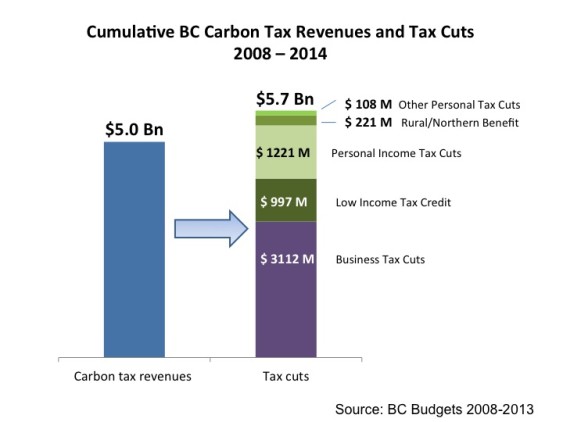
Cumulative BC Carbon Tax Revenues and Tax Cuts 2008-2014

Editor’s Note: Washington’s Carbon Emissions Reduction Taskforce is on the job, weighing alternative carbon-pricing proposals. Some members of the panel have asked what our ideal policy would be for Washington State. Yoram Bauman shares his thoughts today. Alan Durning will share his argument for a California-style cap-and-trade system, with key modifications, another day.

If I had my druthers, Washington State would push for a BC-style revenue-neutral carbon tax. Full disclosure: I’m part of the CarbonWA.org campaign to put just such a policy on the ballot in Washington State in 2016. In this article you’ll find information on the latest iteration of the CarbonWA policy proposal.

The BC approach

The basic idea behind the BC approach is to phase in a carbon tax on fossil fuels and pair it with broad-based tax reductions that benefit most households and businesses—which BC does by reducing personal and corporate income taxes—plus targeted tax reductions that focus on communities that may be disproportionately affected by the carbon tax, such as low-income households. (To match the language I’ve used in previous posts, the broad-based tax reduction is the entrée and the targeted benefits are the side dishes.)

Cumulative BC Carbon Tax Revenues and Tax Cuts 2008-2014
Chart by BC Budgets 2008-2013 (Used with permission.)

Adapting the BC approach for Washington State

Something very much like the BC approach might work in Oregon, which, like BC, has an income tax. But Washington State has no income tax, so the CarbonWA proposal is for the entrée to be a reduction in the state sales tax, which generates revenue from just about all of the state’s households, businesses, and organizations, and for the side dishes to be targeted benefits for low-income households, manufacturers, and small businesses.

Read more

Want to see a post-Citizens United America? Look North

Research by Jane Harvey

To understand how money corrupts democracy in the United States, especially in the Northwest states, look north to Canada. What you’ll see is that campaign fundraising is radically different on the two sides of the 49th parallel. It hasn’t always been, but it is now. The differences, and how they developed, reveal just how profound the impacts of US Supreme Court rulings have been on the systemic corruption of politics.

On the south side, elected officials spend their lives dialing for dollars. Citizens United and related Supreme Court cases reign: corporations are persons; money is speech; and the only kind of corruption that’s illegal is the kind that actually involves buying votes with money. Candidates spend without limits, as do “independent expenditure” (IE) campaigns such as those orchestrated by super-PACs. Individual contributions to campaigns are putatively restricted, but any fundraising chair worth her salt can find a way to launder funds through back channels. Individual and corporate contributions to IEs are utterly unrestricted, can sometimes be done anonymously, and IEs are not really independent anyway. Almost every political dollar comes from private donors, often from lobbyists; public funding is isolated in a few outposts of good-government zeal such as Connecticut and Maine. Finally, campaigns can and do run for months on end, laying siege to swing voters and blitzing them with television ads.

On the north side, politicians spend their lives talking with voters and governing. They almost never dial for dollars, er, loonies. A recent legislative leader of one of BC’s political parties reports that he focused time and energy on fundraising about twice a week when he was leader. He didn’t dial for dollars. Compare that to spending half of each day on it, as many American politicians do. Fundraising used to be even less time-consuming. A former premier of British Columbia who spent 24 years in elective office reports spending almost no time raising money; his party raised some but he wasn’t much involved. A former member of the Canadian parliament tells much the same story: a group of volunteers raised some money for his campaign, but he personally spent his campaign time, well, campaigning. One former city councilor in Vancouver remembers raising just $10,000 total (a rounding error in an American campaign) for each of his races. He says he never raised a single dollar, not one, outside of campaign season.

Read more

Are You Planning to Have Kids? (Part 1)

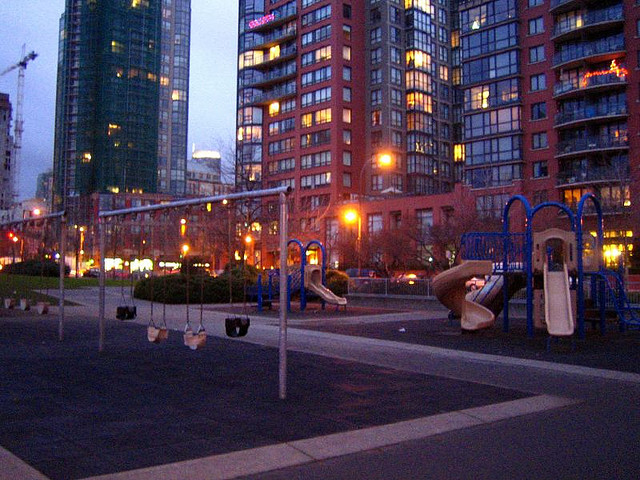
When a developer builds a family apartment in Vancouver BC’s downtown peninsula, the dining room comes with easy-to-clean floors that can handle spilled yogurt or spaghetti. Condo and rowhouse projects must have accessible stroller storage and outdoor play spaces, ideally where parents can look out a kitchen window and keep an eye on their kids.

As of Canada’s 2011 Census, downtown Vancouver’s urban neighborhoods were home to nearly five times more kids than Seattle’s and nearly 9 times more than Portland’s.

That’s in part because more than 20 years ago, Vancouver’s planners and politicians made a conscious choice: Not to relinquish the city’s urban core to empty nesters, low-income singles, and the childless.

As formerly industrial neighborhoods were converted to glass towers, Vancouver required at least 25 percent of that new housing to be suitable for families. That means at least two bedrooms, with attention to hundreds of details that make high-density housing function more like single-family homes. Where those zoning changes created enormous wealth, the city required private landowners developing the sites to incorporate parks, open space, daycares, libraries, community centers, elementary school sites, and other public amenities that families need.

Read more

The Ingredients for Pro-Kid Cities

Former Seattle Planning Commissioner Sarah Snider Komppa spent months visiting and comparing 10 North American cities to answer the following questions: What makes dense urban areas attractive to kids and parents? Why do some give up and move to the suburbs? What are the necessary ingredients to support families living downtown? What policy changes do we need to make?

Komppa took the time to answer some questions about what her travels and research in Boston, New York, Brooklyn, Chicago, Denver, Minneapolis, Washington DC, San Francisco, Toronto, and Vancouver BC can teach the Northwest about ingredients for family-friendly cities.

Q: First of all, if I’m someone without kids, why should I read this?

A: Cities that are great for children are great for everybody. Think about what type of transportation system you might want to ride as a young single woman in the city. If it’s safe for a 12-year-old to ride a transit system alone, then it’s probably safe for you. If there’s a neighborhood that’s safe for a ten-year-old to walk across the street and play with his friends and walk home to his apartment building, that park is probably going to be pretty enjoyable for seniors or young professionals in the city.

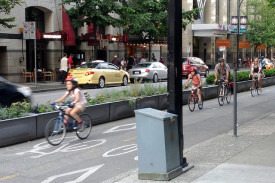
Families Biking Downtown, by Christopher Porter
Families Biking Downtown (Vancouver BC) by Christopher Porter used under CC BY-NC-ND 2.0

Taking kids’ needs into account and having a mix of ages in a city just enhances its sustainability and longevity over time because you’re not constantly trying to reinvent the wheel—it just works for everyone.

Q: How does kid-friendly housing look different from the condos and apartments more commonly built today?

A: Outdoor communal space—whether that’s a courtyard or rooftop or podium deck—is really important. You need to have some place for kids to be outside. You also need to have indoor community space that’s flexible. In New York, they build internal playgrounds or playrooms and parents or caregivers just come down with the kids. Sound isolation is important, though I would argue that’s important whether you have a barking dog or a screaming baby. Ground floor bike storage is important for singles and young parents, and it also works for strollers too.

Read more

The Carbon Pricing Café

Welcome to the Carbon Pricing Café! Do you have a reservation? Let’s see… oh yes, here you are: Washington State, table for 7 million. Right this way, please; we’ve got a spot for you by the window.

My name is Carbon Tax, and I’ll be your server today. You may know my twin sister, Cap-and-Trade, who sometimes covers for me. Some diners seem to have a strong preference between us, but in truth it really doesn’t matter that much; we can both deliver the goods.

(Besides, with all due respect to servers everywhere, when was the last time the most memorable part of a good meal was the service?)

We aim to provide a top-notch dining experience, and in order to do that our menu is limited. All we serve is carbon pricing, there are only a few really good entrées, and you only have to make two big decisions. (Remember, carbon tax and cap-and-trade are not entrée choices, and they don’t factor into the big decisions. People seem to forget that we’re your servers, not your meal.)

Two big decisions

Your first big decision is portion size: How high a carbon price do you want? Your answer will, of course, help determine how much carbon reduction you’ll get, but it will also help determine your carbon pricing revenue. (For the sake of comparison, a carbon price of $30 per ton CO2—as in British Columbia—will generate about $2 billion a year in revenue. A carbon price of $12 per ton CO2—as in California—will generate closer to $800 million a year.)

Read more

The Canadians Are Coming!

It’s common knowledge near the US-Canada border that lots of things are cheaper down south. Head to Whatcom County, Washington, and the locals will complain about Canadians holding up the line at the gas station: “They’re even filling up black plastic garbage bags!” They will point you to a video of Canadian piranhas devouring a crowd of Bellinghamsters (or at least their milk supplies at Costco). They will tell you about the Facebook page called “Bellingham Costco Needs a Special Time Just for Americans.” They may even regale you with stories of Pirate Joe’s, whose business model is to buy out the Trader Joe’s stores near the border and then resell everything to Canadians desperate for pomegranate vinegar.

All of this brings to mind two questions. One, of course, is why don’t companies in Whatcom County expand their stores? (Answer: The smart ones are expanding. For example, Costco is seeking permits for a new store in Bellingham. As for Trader Joe’s… well, instead of opening a branch near the border, the company is still trying to sue its best customer.)

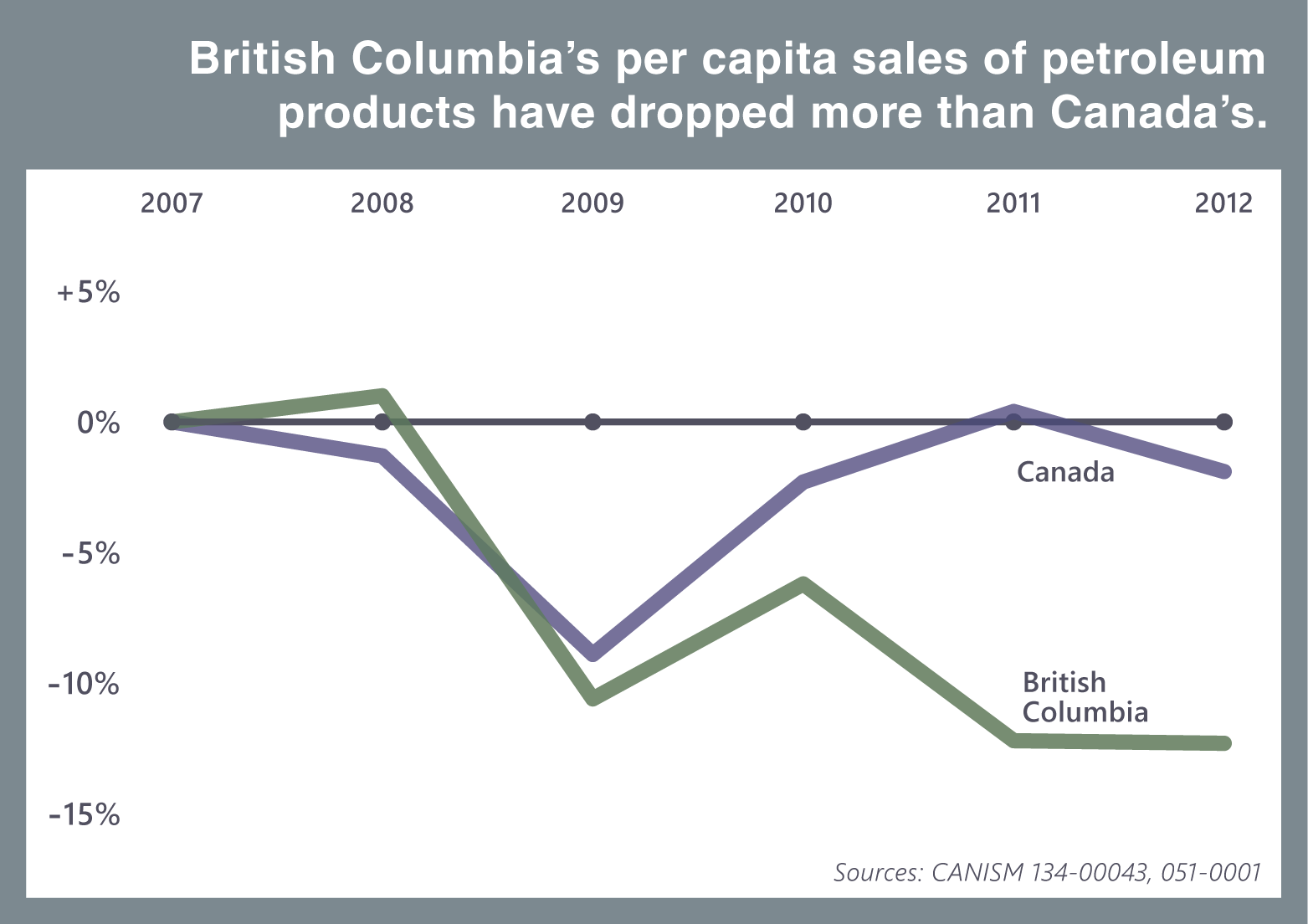
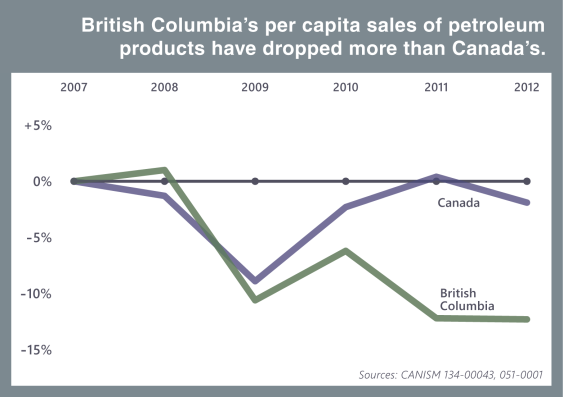
The second question is about the British Columbia carbon tax: How much of the reduction in petroleum consumption in British Columbia (see graph below) is caused by Canadians filling up south of the border?

The answer: not much.

Original Sightline Institute graphic, available under our Free Use Policy.

Before I’m attacked by enraged Hamsters, let me be clear: I feel your pain, and your eyes don’t lie: cross-border trade is a huge economic player in Whatcom County, accounting for almost half of all credit-card transactions in Bellingham, according to one estimate.

Read more

A New Measure of Food Deserts

The concept of a “food desert“—a place where residents have little access to healthy, affordable food—can seem somewhat alien to the well-off. If you’ve got your own car, living close to a grocery store just doesn’t matter much: you can always drive a bit and stock up with a big load of groceries! But if you don’t have a car, fresh, healthy food is often simply out of reach. Taking a cab to the store is expensive; walking or transit can take too much time, or simply be too much of a hassle. So for many car-free folks living in food deserts, the only real options are processed foods from convenience stores, or else fast food meals—typically, the sort of inexpensive, energy-dense, nutrient-poor foods that contribute to North America’s obesity epidemic.

But even though there’s an emerging understanding that food deserts are a significant public health concern, there’s little academic consensus on how to define and identify them…which can make it hard for policymakers to even find food deserts, let alone decide what sorts of policies might help fight them.

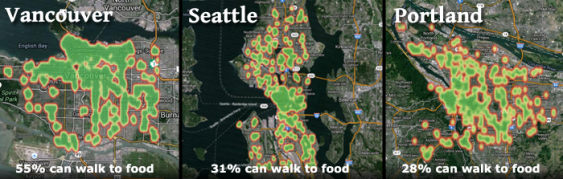
Enter Walk Score. They’ve constructed a new tool that offers basic maps of food deserts: places where residents can’t get to a full-service grocery store within a 5 minute walk. The tool could make a huge contribution to the healthy food movement, since it gives everyone—policymakers, activists, and ordinary citizens alike—a simple measure and a starting point for a discussion about food access.

Just as important, Walk Score’s tools introduce a bit of healthy competition into the food desert discussion.  Take a look, for example, at the three largest cities in the Pacific Northwest.

Cascadia big city food deserts


Read more

The Thin Green Line

The Pacific Northwest stands squarely between the most voracious energy markets in the world and huge fossil fuel deposits in the interior of North America—Powder River Basin coal, Bakken shale oil, Alberta tar sands, and remote natural gas fields. Big energy companies plan to unearth these vast reserves of carbon-intense fuels and put them up for sale in Asia.

If they are successful, these energy firms will unleash the carbon equivalent of roughly five Keystone XL Pipelines. But to get their products to market, energy companies first have to build new terminals and pipelines to move all that fuel. They need destinations for the scores of oil and coal trains that they plan to run across the Northwest, and they need right-of-ways to lay new pipelines.

In short, they need our permission.

So it is by geographic accident that the Northwest, perhaps the greenest corner of North America, will play an outsize role in determining the planet’s climate future. Will we double-down on coal and oil use, thereby jeopardizing our chance at a stable climate? Or will we act as a thin green line, insisting that we must do better—that our economy and our children demand a cleaner future?

To illustrate the threat—and the enormous opportunity—Sightline is proud to release a new video animation by Don Baker.

Read more

The G-Word

Here’s a Rorschach test. I’ll show you a word. You say the first thing that comes to mind.

The word is “government.”

Stop. Go down to comments and record your reaction.

Now, I’ll tell you what your answer means about you. If you’re like many of the friends I’ve asked, your answer is not typical. They said things like “protects,” “services,” “rule of law,” and “us.”

If you’re more normal, you said something less flattering. The most common answer among Americans is a derisive laugh. Yep. A laugh. The G-word qualifies as a one-word joke. Other common answers include snorts of disdain and words like “corrupt” and “waste.” One friend said “sociopaths”; another, amusingly, said “statues.”

Read more

×
Privacy Overview
Sightline Institute

More information about our privacy notice

Strictly Necessary Cookies

Strictly Necessary Cookie should be enabled at all times so that we can save your preferences for cookie settings.

3rd Party Cookies

This website uses Google Analytics to collect anonymous information such as the number of visitors to the site, and the most popular pages.

Keeping this cookie enabled helps us to improve our website.

Additional Cookies

This website uses social media to collect anonymous information such as which platform are our users coming from.

Keeping this cookie enabled helps us better reach our audiences.