Donate Newsletters

Sightline on Shell’s Presence in Oregon

For those following the controversy of Shell’s Arctic drilling program, here’s a look at the role of Northwest ports—first Seattle, now Portland—in hosting the oil drilling fleet vessels: a 45-minute interview on KBOO, a community radio station based in Portland. Host Barbara Bernstein, Sightline research fellow Nick Abraham (who is also the editor of Oil … Read more

Shell’s Rig is Headed to Portland

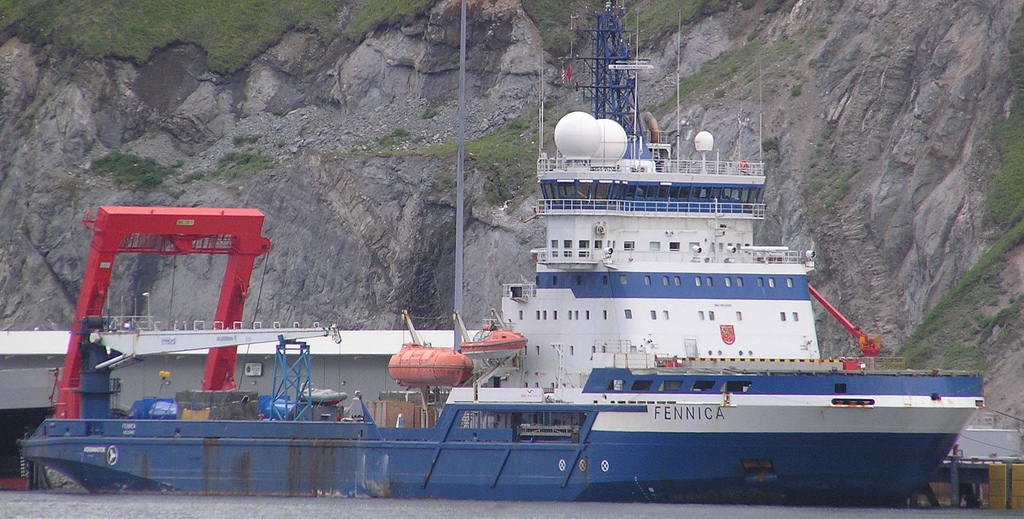
Fennica, by Tom Doyle, cc
Fennica by Tom Doyle used under CC BY-NC-ND 2.0

Royal Dutch Shell, the world’s second largest company, wants to find oil under the seabed off the coast of Alaska. After a disastrous attempt at Arctic drilling in 2012, the company has returned this summer to once again try to drill exploratory wells. But just like before, they’ve hit a major snag.

Shell’s MSV Fennica icebreaker vessel isn’t pointed north. Instead it’s headed to Portland’s shipyard for repairs to a 39 inch gash in its hull. Most observers expect it to arrive within the week. The ship was on its way to support Shell’s drilling fleet as the company commences putting in two exploratory wells 70 miles off the coast of Alaska. The Chukchi Sea’s icy waters make it far too dangerous to drill without icebreaker ships in support.

When Shell comes to town things can get messy in a hurry.

Read more

How Coal “Self-Bonding” Puts the Public At Risk

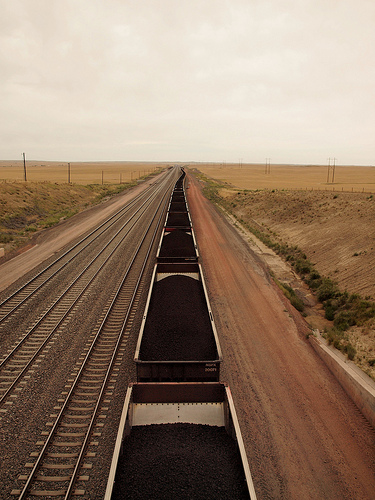
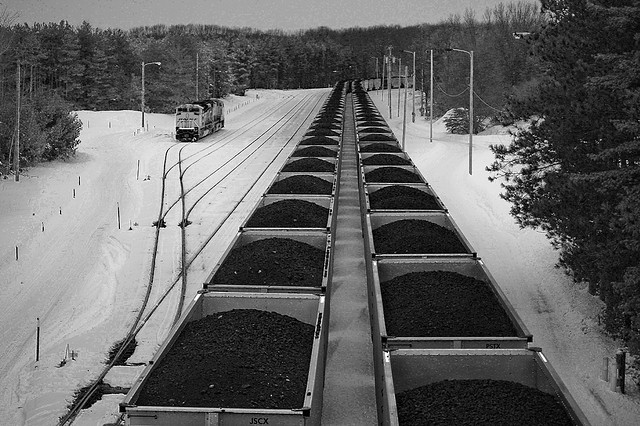
Miles-long coal train

As the Wall Street Journal reported recently, creditors of coal industry giant Alpha Natural Resources just hired a team of advisers to help them “restructure” the company’s debt—financial-speak for “next stop, bankruptcy!” And as the Journal points out, questions about the company’s massive environmental liabilities have played a major role in the company’s recent financial woes:

The company, which has posted four consecutive annual losses, disclosed in May that a Wyoming environmental agency notified the company it no longer qualified for a “self-bonding” program that had freed the company from buying insurance to cover future mine cleanup costs…[Alpha’s] rapid cash burn and potential costs tied to the loss of self-bonding status pose challenges to its balance sheet.

A couple of weeks ago, I explained what self-bonding is and why it matters so much to a coal company’s financial health.

But it’s not just coal investors who should be paying attention to self-bonding. We all should. Because If a struggling coal company like Arch or Alpha goes bankrupt, the public could have to pick up the cost of cleaning up their massive coal mines.

Here’s why.

Read more

Pacific Northwest to See One Million Barrels of Crude Oil Per Day, 100 Oil Trains Per Week

For Immediate Release: July 6, 2015 Contact: Serena Larkin, serena@sightline.org, 206-447-1880 x111 SEATTLE // The Pacific Northwest stands to see over one million barrels of crude oil per day and more than 100 loaded oil trains per week roll through the region, according to a report released this morning by Sightline Institute. The report details … Read more

1 Million Barrels a Day, 100 Trains a Week

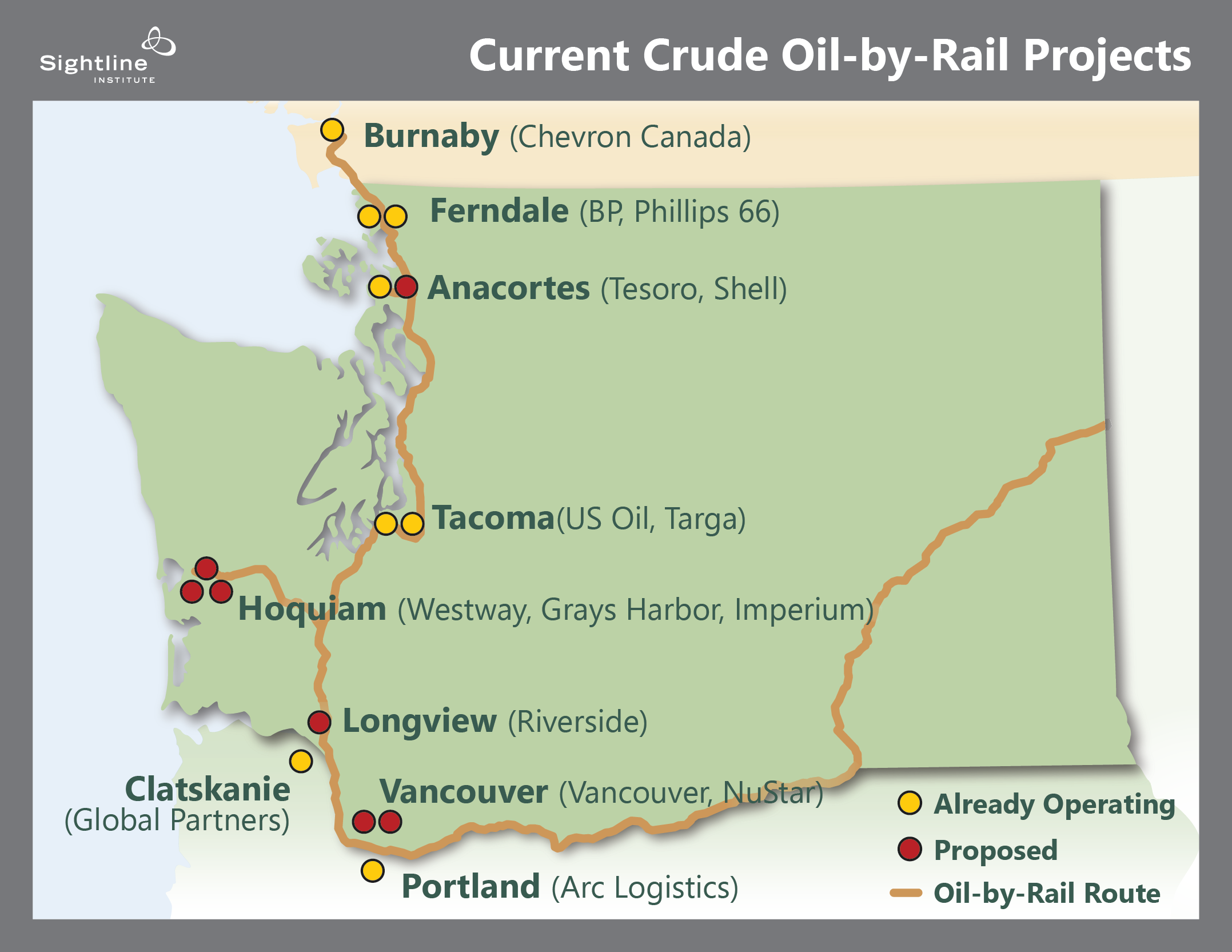
Sightline is re-releasing a popular report: The Northwest’s Pipeline on Rails. It’s the most comprehensive regional analysis of plans to ship crude oil by train. This update includes important new information showing far greater increases in oil train transport than previously thought. All told, the Northwest could soon be seeing more than one million barrels of crude oil by rail per day—far more than the Keystone XL Pipeline would move.

Moving large quantities of oil by rail would represent a major change for the Northwest’s energy economy, and the plans now in development put the region’s communities at risk.

Why does it matter?

  • In British Columbia, Oregon, and Washington, 15 refineries and port terminals are planning, building, or already operating oil-by-rail shipments.
  • If all of the projects were built and operated at full capacity, they would require more than 100 loaded mile-long trains per week

Sightline Sues Obama Administration over Crude Oil Exports and Illegal Secrecy

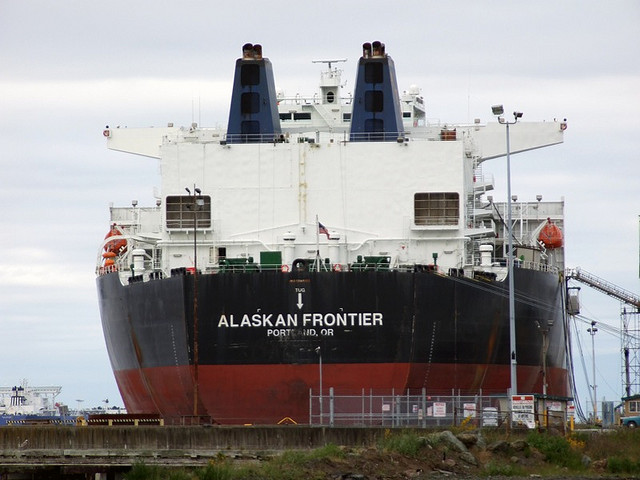
Oil tanker Alaskan Frontier anchored near Port Angeles, WA, in June, 2008

If the oil industry gets its way, the US will soon begin exporting tankers full of American crude to overseas markets. Although such shipments are for the most part illegal today, the Obama Administration is quietly changing the rules to favor oil exporters.

To shed some light on the government’s behavior, the environmental law firm Earthjustice filed a formal Freedom of Information Act request in February on Sightline’s behalf, but it was greeted only by stony silence. So today, Sightline Institute, represented again by Earthjustice, is suing the federal government. We are asking the Courts to force the Obama Administration to do what it was legally required to by March 11: release information about its secretive deals with oil exporters to the public.

The federal government’s behavior is worrisome not only because of its plain disregard for public disclosure laws, but also because it violates longstanding laws that govern the oil industry. In fact, for nearly four decades, the US government has tightly restricted exports of domestic crude oil. The oil export “ban,” as it is commonly known, has been a prominent feature of the national energy landscape since the 1975 Energy Policy and Conservation Act—but the oil industry has it squarely in its crosshairs.

Read more

Hate Gridlocked Legislatures?

It’s tempting to blame politicians. If only Obama were warmer, he might be able to win over Republicans. If only Doug Ericksen weren’t captured by fossil fuel money, he would find a way for Washington state to take action on climate change.

But gridlock is now the norm in Washington, DC, and it may be spreading to state legislatures. The problem is not that we keep electing representatives who stink at compromising. Rather, our voting system fosters gridlock. The apples (politicians) are fine when they go in; the barrel itself (winner-take-all voting) makes them rot.

I have explained that winner-take-all voting creates unrepresentative government that gives short shrift to women, racial minorities, and third-parties, while also encouraging negative campaigns and voter apathy. Proportional representation voting elects women, racial minorities, and political minorities in numbers proportional to their strength in the populace, and it generates civil campaigns and engaged voters. In this article, I show that winner-take-all voting produces gridlocked legislatures, but multi-winner ranked-choice voting creates more effective legislatures.

Problem: Legislatures are partisan, polarized, and gridlocked

In the United States, the Democratic and Republican parties are pulling away from each other ideologically. In 10 years, Democrats have moved seven points to the left, and Republicans have moved 22 points to the right. They are leaving a chasm in the middle. Only four percent of the members of the US House are moderate. Only six percent are crossover representatives: Republicans in a Democratic-leaning district or vice versa.

Read more

An Explainer: Coal Mine Cleanup and “Self-Bonds”

In case you missed the news, coal industry stock prices took yet another tumble on Friday, with all four of the largest US coal companies—Arch Coal, Alpha Natural Resources, Cloud Peak Energy, and Peabody Energy—closing at all-time lows. A Bloomberg analysis attributed the fall to new concerns about the financing of coal mine cleanups:

Two U.S. coal companies, Peabody Energy Corp. and Arch Coal Inc., sank to all-time lows amid concerns that they will have to pay more for insurance that covers environmental damage.

This, I’m sure, is the first time that many folks had ever read anything about coal mine cleanup, especially in the business press. So for newbies who just want an overview of the issue, have I got a treat for you: an FAQ covering the basics of the coal mine reclamation liabilities!!! (Please try to contain your excitement.)

Here goes…

Read more

Everything Oregon Legislators Need To Know About Stopping Climate Pollution

Quick! You have seven minutes to tell Oregon legislators everything they need to know about stopping climate pollution. . .  GO! That was my task last week when testifying at an Oregon Senate informational hearing about two bills that would stop the free lunch for climate polluters in Oregon—see the video of my testimony below.

Senate Bill 965 is a cap-and-dividend bill that would give all the revenue back to Oregon taxpayers, and House Bill 3470 is a cap-and-delegate bill that would put the Oregon Department of Environmental Quality (DEQ) in charge of limiting pollution. There was a full panel of testimony, including Julia Olsen from Our Children’s Trust making a compelling case for Oregon to act on climate now, and Phil Harding from Oregon State University giving an inspiring perspective on technological innovation. I used my time to make the following points:

Read more

The Surprising Reason You Don’t Feel Like Voting

[prettyquote align=right]”We can put the power back where it belongs: with voters.”[/prettyquote]

Do you ever think about just not voting, and then feel bad for being lazy? Or do you wonder what is wrong with your friends who don’t exercise their right to vote? Last time, I made the case that politicians aren’t bad apples, our voting system is a bad barrel. That bad barrel also taints voters, making them more apathetic, disengaged, and suspicious that the whole system is corrupted by money. In this article, I lay out more problems and solutions: voters feel like their votes don’t matter and money has too much influence, but a better voting system can engage voters and make money matter less.


Problem: Most election results are already decided before voters get the chance to vote in the general election.

Many countries have used the “election-before-the-election” as a tool for disenfranchising voters while still going through the motions of letting them vote. In the United States after the Civil War, Southern states could no longer legally prohibit people of color from voting. Instead, Southern states used “white primaries” to ensure that only white-approved candidates would be on the ballot. People of color could vote in the general election, but the real decisions had already been made. China recently used this tool against Hong Kong. China agreed to let all Hong Kong voters choose their chief executive. From a China-approved list of candidates.

In the United States, we still have systems ensuring that a select few pre-approve all the candidates before most people vote. We have party primaries. (We also have the money primary—more on money next.)

Read more

×