Donate Newsletters

Hate Negative Campaigns?

It’s tempting to think of politics in terms of personality problems: if only Obama were warmer, he might be able to break through Congressional gridlock. If only Dino Rossi weren’t such a hard-nose, he wouldn’t inspire such negative campaigns. But with wave after wave of negative campaigns, it seems the problem is not really politicians’ personalities. Maybe all politicians are not bad apples. Maybe our voting system is a bad barrel. The apples are fine when they go in; the barrel itself makes them rot.

In my last article, I explained the problems that winner-take-all voting creates: unrepresentative government that gives short shrift to women, racial minorities, and third parties, and the solution that multi-member districts and ranked-choice voting offers for generating proportional representation in which women, racial minorities, and political minorities have a voice in government proportional to their strength in the populace. In this article, I’ll show that winner-take-all voting spawns negative campaigns. But fair voting—multi-member districts with ranked-choice voting—creates more civil and engaging campaigns.

Problem: Campaigns are negative and divisive.

North Americans have a long history of outrageously negative campaigns, reaching back to 1800 when John Adams’ campaign called Thomas Jefferson a “mean-spirited low-lived fellow, the son of a half-breed Indian squaw, sired by a Virginia mulatto father” all the way to a more recent campaign in which Canada’s Conservative Party opened its home page with an animated puffin defecating on the opposition leader’s shoulder. It isn’t because North Americans are uniquely antagonistic; it is because winner-take-all elections inherently reward negativity.

Read more

No Taxation Without (Proportional) Representation!

If you put your money in a vending machine and punched in the number for trail mix, but it instead gave you a pack of gum, would you use that vending machine again? Unfortunately, voting in North America is often not so different from this vending machine. In the United States, most voters vote Democrat, yet the Republicans control Congress. Voters ask for trail mix but keep getting gum. In Canada, about 35,000 Conservative voters can elect a Conservative Member of Parliament (MP) to represent them, but it takes more than ten times as many—over half a million—Green voters to elect a single Green MP.

This is not how it’s supposed to work. Second US President John Adams believed the legislature “should be in miniature, an exact portrait of the people at large. It should think, feel, reason, and act like them. … [E]qual interest among the people should have equal interest in it.” In other words, the legislature should proportionally represent the people.

“Winner-take-all elections give the biggest block of voters 100 percent of the representation, and all the other voters get none.”

Here’s what an “exact portrait,” proportional representation, would look like: imagine people of different ideological stripes are different fruits and vegetables on a spectrum from orange to green. In Foodtown, 17 percent of voters are oranges, 20 percent peaches, 20 percent apples, 20 percent cucumbers, and 23 percent broccoli. If Foodtown elects a five-member legislature that is “an exact portrait of the people,” it would be one orange, one peach, one apple, one cucumber, and one broccoli.

Unfortunately, in Canada and the United States, winner-take-all elections give the biggest block of voters 100 percent of the representation, and all the other voters get none. In winner-take-all, also known as “first-past-the-post” or “plurality” voting, the candidate with the most votes wins, regardless of how many votes he or she gets. In an election with only two candidates, the winner will need a majority—half plus one—of the votes to win. With three candidates, the winner only needs a plurality of votes to win: one-third of the votes plus one; with four candidates, one-fourth of the votes plus one; etc.

If Foodtown was split into five single-member districts with winner-take-all voting, the biggest voting blocks would win all the seats, so Foodtown might elect five broccolis. Or, likely, Foodtown would get four peaches and one broccoli. In Oregon, 55 percent of voters are Democrats, yet Democrats hold 4 out of 5 Congressional House seats. In 2012, Americans voted for Democratic candidates by a 52-48 margin, yet gerrymandered single-member districts resulted in Republicans winning 57 percent of the House seats.

Read more

We Can’t Fix Anything Until We Fix Democracy

Grab the issue you care most about—climate change, sustainable cities, a fair economy, or something else—sit it down, look it in the eye, and tell it there will be no Christmas this year. Or next year, or the next—we cannot fix important problems until we fix democracy.

[prettyquote align=right]”Remove #corruption from elections, and #democracy will become responsive to citizens.”[/prettyquote]

Climate change should be imminently solvable. We know which policies work. We have clean technologies, and people want to fix it. But none of that matters if government doesn’t represent the people. If government is implementing policies and propping up industries because they are lucrative for a small group of plutocrats, then no amount of public demand or technology solutions will help us solve climate change. Or any other issue that we care about.

We need a government that represents the people.

Professor Larry Lessig eloquently explains that the root of the problem, the fundamental corruption of US democracy, is elected officials’ dependence on the tiny number of wealthy funders who control elections. Remove corruption from elections, and democracy will become responsive to citizens.

But there is more than one root.

Read more

Oil Train Explosions: A Timeline in Pictures

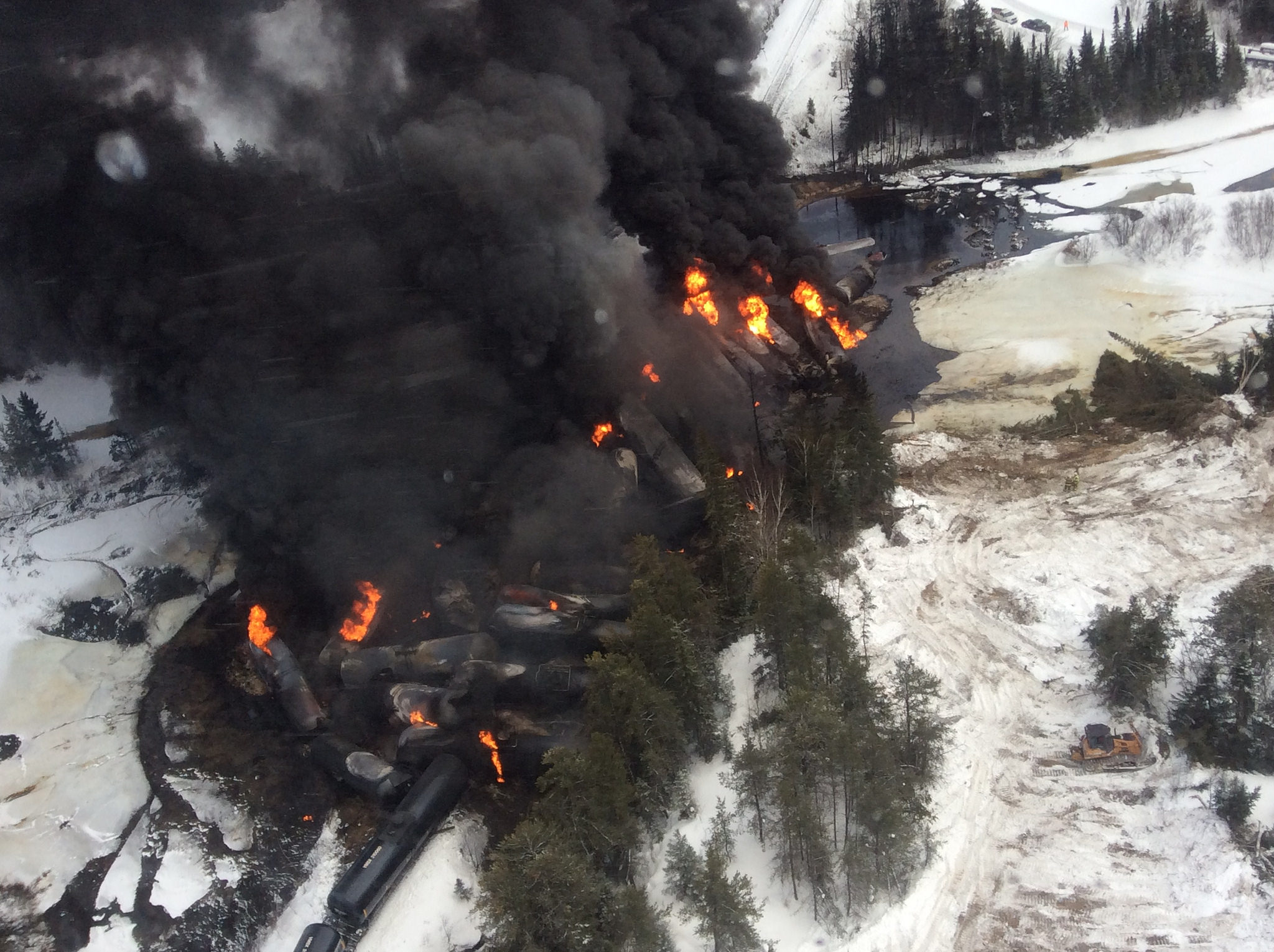
At 7:15 this morning, yet another crude oil train erupted into an inferno, this time near a small town in central North Dakota. As these wildly dangerous trains continue to explode—at least 10 in the last two years—it’s become challenging to keep track of them all. So, for the record, we’ve assembled here a pictorial timeline of North America’s bomb trains.

Last week, the Obama administration adopted new regulations that will phase out many of the most hazardous tank cars over the next five to six years. The regulations also substantially reduce public oversight of train movements and industry behavior.

We will update this post as new explosions occur.

The Thin Green Line Grows Stronger

Important update 5/8/15: The news just keeps getting better. In a stunning reversal, Portland Mayor Charlie Hales withdrew his support for a large propane-by-rail terminal in the city. The Willamette Weekly calls it a “death sentence” for the project. As the Oregonian reported, “At some point, those of us in power have to listen to those who put us there,” Hales said in an interview. It’s a huge—and hugely surprising—win for the opposition movement to Northwest fossil fuel exports.

Yesterday at the annual Climate Solutions breakfast, Seattle Mayor Ed Murray demonstrated what the Northwest means for big fossil fuel expansion plans. Expense. Delay. And ultimately, failure.

In February, the Port of Seattle surprised everyone by rushing through a secretive lease arrangement to host Shell Oil’s Arctic drilling fleet for maintenance in preparation for a summer of drilling the Chukchi Sea bed off Alaska’s North Slope. The move earned bracing admonitions from nearly every environmental group in the state. Local activists are turning out more than a thousand people at opposition rallies, submitting more than 8,000 critical comments, and generating national media attention as they take on the most profitable industry on the planet.

On stage yesterday, the mayor revealed that he had a surprise of his own in store. He announced that the city’s planning department had found that hosting the drilling fleet would violate the Port’s existing land use permits. If the Port wants to proceed with its unpopular and environmentally destructive plans, it must apply for a new permit. In a way, the mayor was actually handing the Seattle Port Commission a huge opportunity: a second chance to do the right thing.

Read more

Six Pictures that Illustrate the Staggering Growth in Oil by Rail

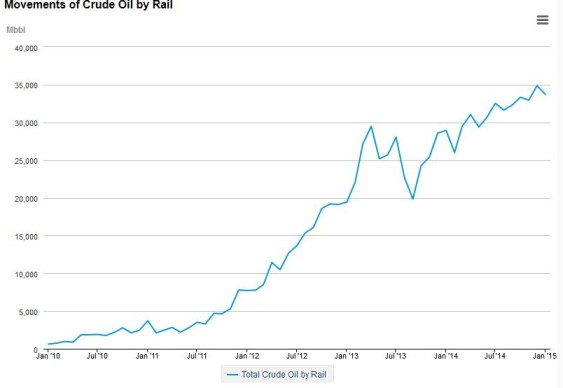
Trains have come to play an increasingly large role in North American oil transport over the last several years. Now, with a recent flurry of online publications from the US Energy Information Administration, we have data that illustrate just how profound the shift has been in the United States.

Crude oil by rail shipments have skyrocketed from just over 20 million barrels in 2010 to more than 373 million barrels transported in 2014.

Total crude by rail (thousands of barrels per month). Source - US EIA.
Total crude by rail (thousands of barrels per month), by US EIA

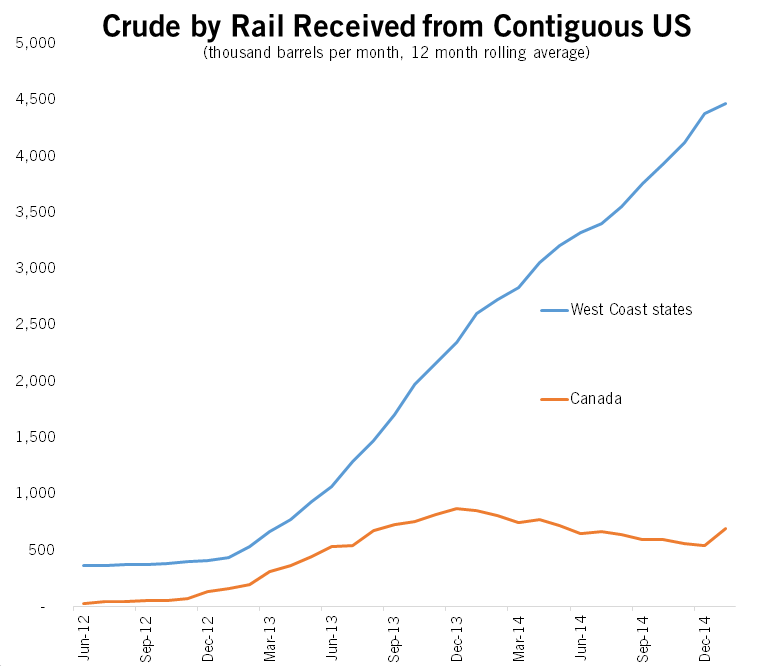
The growth in crude by rail has been, so far, mostly a US domestic phenomenon. The volume of crude transferred by rail from destinations and to origins within the contiguous United States has been on a steep ascent, while imports from and exports to Canada have grown more modestly.

Read more

Be a Champion on May 5

The Northwest is full of champions, from our winning sports teams, to the masses of sustainably minded and socially aware folks who populate our evergreen cities and towns. These heroes work to make our communities dynamic and equitable. We are grateful for the chance to team up with so many smart, committed friends who champion our shared cause to make the Northwest a global model of sustainability. It’s people like YOU, our dedicated readers, supporters, and allies, who make Sightline’s work possible.

GiveBIG’s Day of Champions is the perfect time for you to join forces with thousands of donors across the region and support Sightline’s sustainability research, communications tools, and news service. Save the date and give to Sightline here on Tuesday, May 5 in order to have your gift amplified.

Curiosity piqued? In case you’re wondering…

Read more

Oregon’s Chance to Fix the Electoral College

Thomas Jefferson believed that “[e]very constitution… naturally expires at the end of 19 years.” As “new discoveries are made, new truths disclosed… institutions must advance also, and keep pace with the times.” But Jefferson did not manage to insert a 20 year reset button into the US Constitution; instead, the nation ended up with the most difficult to amend or update Constitution in the entire world. The United States is number one!

The US Electoral College is a poster child for Jefferson’s fear that a constitution may linger beyond its natural life. When the Founding Fathers conceived of the Electoral College as “a small number” of “men most capable of analyzing” the “complicated” question of who should be president, there were fewer eligible voters in the whole country than there are now in just the city of Portland (there were only 2.5 million people in the whole country, and only a tiny fraction of those—white, wealthy, Protestant men—were allowed to vote). The Electoral College has always been a rubber stamp rather than the deliberative body the Founding Fathers imagined.

Read more

Listen In: Oregon’s Proposed Polluters-Pay Bills

No time to sit down and read our Cashing In Our Carbon series? That’s okay! I recently gave some radio interviews to help make sense of the carbon pricing bills wending their way through the Oregon legislature. So if you’re curious, maybe you can squeeze in a listen. The recent Oregon legislative hearing about carbon … Read more

Coal, Oil, and Gas Spent $2 Million on Oregon Politics in 2014

The last few months have been a wild ride in Oregon politics. Governor Kitzhaber, the state’s only Governor to serve four terms, resigned amid allegations of ethical violations. Then, over vociferous opposition from the oil industry, the state legislature almost immediately lifted a sunset provision on the state’s first clean fuels standard, one of the first bills signed by newly inaugurated Governor Kate Brown.

Many observers now believe that Oregon’s lopsided Democratic majority is positioned to ramp up renewable electricity standards and perhaps even enact a price on carbon emissions in the next legislative session. These are meaningful changes to law that would have a tremendous impact on the state’s pollution levels for decades to come by reducing fossil fuel consumption.

Needless to say, these reforms are not well liked by the coal, oil, and gas industries that benefit from business as usual. In an attempt to tip the scales in their favor, they injected nearly $2 million—$1,972,783, to be precise—into Oregon’s political system in the most recent election cycle. This money came from the usual oil suspects like Shell, Tesoro, and Chevron as well as related organizations like the Western States Petroleum Association. A hefty portion also came from major movers of fossil fuels, including railroads like BNSF and Union Pacific, and Global Partners, which owns of the oil terminal at Port Westward.

Read more

×