Donate Newsletters

How the Oil Industry Will Try to Kill Carbon Pricing

As Oregon and Washington contemplate a carbon tax or carbon cap, the oil industry is revving the engines for an astro-turf scare campaign here. The oil lobby spends a million dollars a month in California. As Oregon and Washington start thinking about holding them accountable, the oil lobby is turning its scare machine our way.

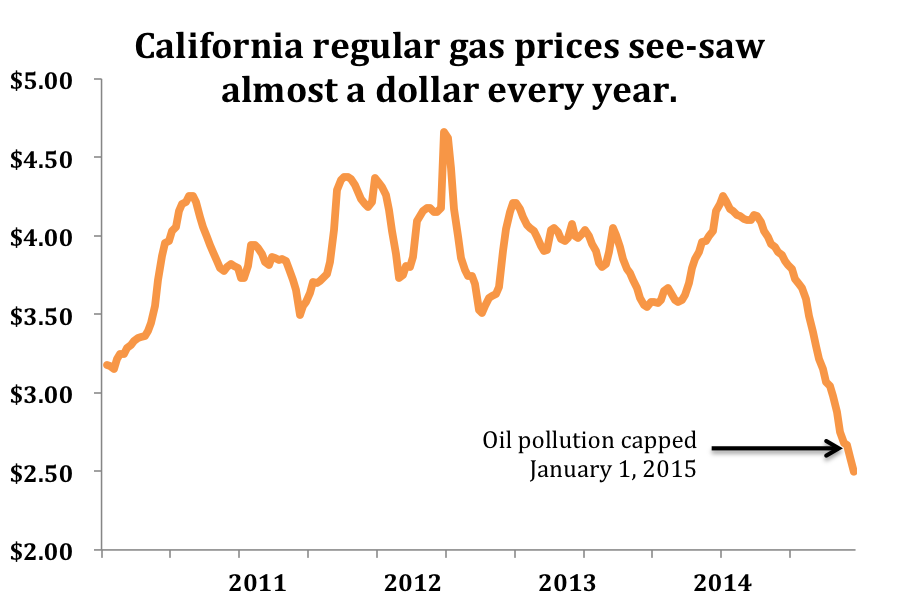
Governor Inslee has proposed a plan that would cap carbon pollution in Washington and move the state slowly but surely away from fossil fuels—away from what oil and coal companies sell—and onto clean energy. California has capped pollution from power plants and industrial facilities since 2013; when gas and diesel came under the cap this year, most economists estimated it would cost customers about a dime a gallon. But the powerful Western States Petroleum Association warned voters and legislators about a “hidden gas tax” that could cost families 76 cents a gallon of gas. Now that California has been holding polluters accountable for a few weeks, what has the price impact been? The price tag for clean air—maybe a few cents a gallon—was lost in the noise of gas prices that rise and fall ten times that amount every few months.

Original Sightline Institute graphic, available under our free use policy.

There are two things that Oregon and Washington can learn from Western States Petroleum Association’s “Wolf!”:

Read more

Understanding the North American Tar Sands

[prettyquote]”You put a big black blob in the middle of Canada, and you reach out a tentacle to every part of the Coast, there is a giant octopus that is essentially wrapping its tentacles around North America.”[/prettyquote]

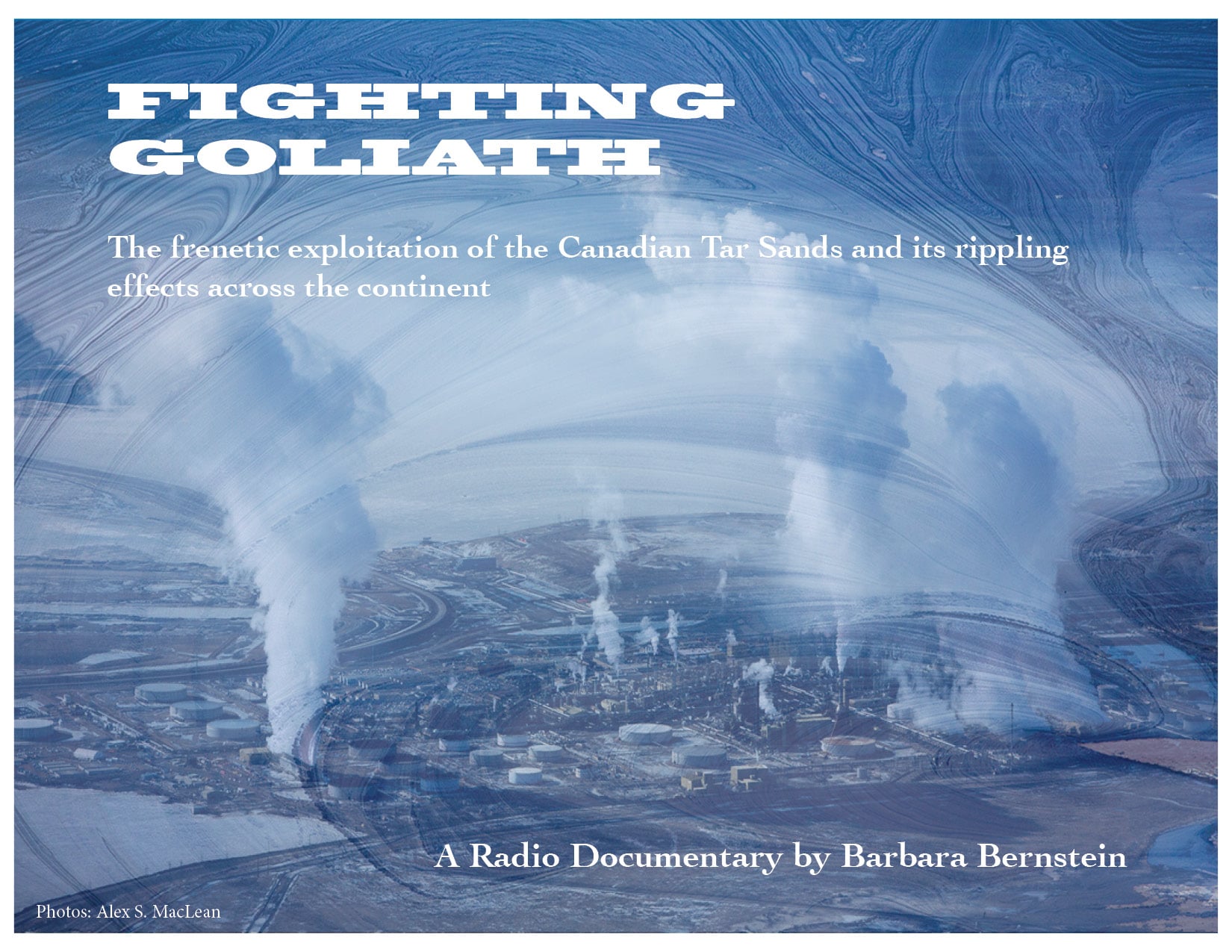
Last year, Portland’s KBOO Community Radio profiled what is “the largest industrial project on Earth”: the North American tar sands. Typically, one hears of the “Canadian tar sands,” as if the issue is one that lives only north of the US national border and need not concern American citizens. But reporter Barbara Bernstein’s documentary, “Fighting Goliath,” revealed an alarming and very real threat that deserves the same scrutiny as the coal export and oil train schemes better known in the Northwest and Plains states.

However, this is not just an account of the tar sands as a sprawling behemoth, from their massive open pit mines to their toxic tailings ponds, from their environmentally sensitive transport routes to their huge water needs and giant equipment and infrastructure demands. Bernstein also tells the story of a powerful and diverse group of citizens who came together to oppose tar sands expansion in the corporate interest and to demand accountability from government officials in responding to the public’s concerns.

It’s the most riveting hour of radio you’ll hear for a while, guaranteed. Listen in.

Read more

Event: Innovative Solutions to Money in Politics

Next Thursday, join our executive director Alan Durning to discuss how unfettered money has changed the political landscape and what Oregonians can do to make sure their voices are heard. Deb Field, executive board member of Main Street Alliance, will be joining Alan. There will be a live jazz performance by the Mel Brown B3 Organ Group after the event (note … Read more

Sightline on Kinder Morgan and Columbia River Energy Schemes

If you’re following Sightline’s work on Northwest fossil fuel exports, you may enjoy listening to this radio segment I did recently on KBOO, a community radio station in Portland. The piece is around 45 minutes long, which allows time to explore many of the dimensions that we covered in our recent report, The Facts about … Read more

A Green Light for Using Rain Barrel Water on Garden Edibles

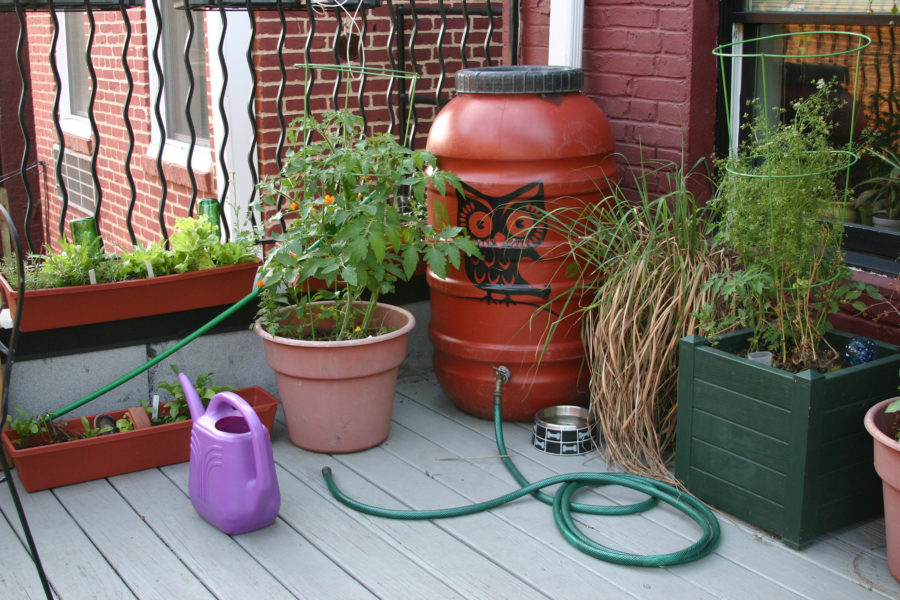
Is it safe to use rain barrel water collected from your roof to irrigate homegrown lettuces, strawberries, and tomatoes? The question is so straightforward, and yet the answer has been so murky. In the past, many sources cautioned against this use of stormwater runoff, while some, including Seattle Public Utilities, suggest it’s OK with water … Read more

Oil Trains: The Industry Speaks for Itself

A year and a half after an oil train inferno ended 47 lives in Lac-Megantic, Quebec, the crude-by-rail industry rolls on, virtually unimpeded. It’s hard not to feel horrified when, one after another, we register the place names of oil train explosions—Aliceville, Alabama; Casselton, North Dakota; Lynchburg, Virginia—as grim warnings of what could happen in so many other North American communities.

Government regulators have been slow to act, their responses painfully milquetoast. As a result, much of what I do involves research into the often-complex details of federal rulemaking procedures, rail car design standards, insurance policies, and the like—all the issues that Sightline is shining a light on.

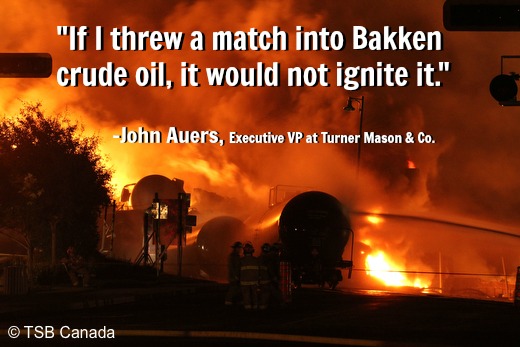
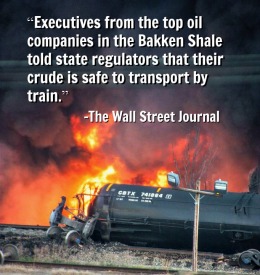
Yet on some level it’s not about any of that. It’s about a reckless and unaccountable oil industry that—in the most literal and obvious way—profits by putting our lives at risk. Every time I hear one of their accountability-shirking lines, I can’t help recalling images from those tragedies and near-tragedies. The juxtaposition is so startling that we decided to undertake a small photo project to capture it. We hope that you’ll find the following useful in your own work, and if so, that you’ll share the images with your own networks.

Read more

The Top 14 of 2014

2014 was a big year for Sightline, inside and out. We took deeper dives into family-friendly urban policy, money’s influence on our democracy, and making polluters pay for their carbon pollution. We also continued our leading research on coal and oil exports out of Cascadia; traffic trends, transit funding, and rideshare safeguards; and a number of other key topics for promoting sustainability across the Northwest. And you, dear reader, you dove right in with us! Thanks for a great year of wonking out, and cheers to 2015! Now a look back at your faves:

14. Bertha vs. the Bus: As Seattle prepared to vote on key funding for King County public transit earlier this year, a snappy infographic from Jennifer Langston proved a jaw-dropping comparison between the cost of digging a single foot of Seattle’s doomed tunnel and that of funding a better transit system.

Lynchburg, VA, Derailment by LuAnn Hunt
Lynchburg, VA, Derailment by LuAnn Hunt (All rights reserved, used with permission.)

13. New “Safer” Tank Cars Were Involved in Lynchburg, VA, Oil Train Fire: In which we saw (again) that no, Big Oil and rail companies’ claims about their industry’s safety do not in fact hold up.

12. Why Bakken Oil Explodes: Eric de Place explains why that particular strain of Dakota-originated oil rolling through our backyards and along our shorelines is exceptionally flammable.

11. Bad News for Ridley Terminal: They say bad news sells better than good news, perhaps especially when it comes to a major coal export facility in British Columbia.

10. To Revitalize Downtowns, Tax Land Speculation: Yes, something with the subtitle “5 reasons to love land-value taxes” was one of your most read articles of 2014. We’re proud to nerd out with the best of ’em.

Read more

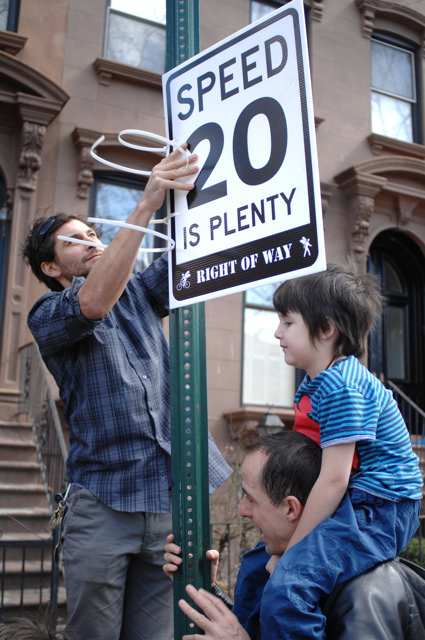
Why 20 Is Plenty on Neighborhood Streets

Next time you’re in a car driving through a residential neighborhood, try this experiment. Glance at the speedometer when you’re in the middle of a block. You’ll probably find it’s pretty easy to reach or top 25 mph, the standard residential speed limit for cities in Oregon and Washington.

I did this yesterday on my way to pick up my daughter from elementary school. And you know what I got from other parents walking on the sidewalk, often with a toddler or two in tow? Super dirty looks.

To someone on foot navigating narrow streets with parked cars and unprotected intersections, it feels like you’re driving too fast. And they’re probably not wrong. As I was cruising up to 25 mph (on streets outside the school zone), I tried to imagine that a ball rolled right in front of me with a kid chasing it. Or that someone with an armful of groceries opened a car door without looking, or that a pedestrian in dark clothes stepped into a poorly lit intersection. Would I be able to stop in time? Maybe, maybe not. It would depend on how soon I saw whatever I was about to hit.

Then drop your speed to 20 mph. With that small change, it becomes much easier to halt the momentum of 3000 pounds of metal. When I drove through the neighborhood at 20 mph, what reaction did I get from the moms and dads? Smiles. Polite waves as I stopped easily to let them cross in front of me. Like I was a safe, respectful driver (probably a parent!) who wasn’t trying to kill their children.

It turns out that the mom scowl is grounded in science. That’s why cities that are getting serious about pedestrian safety and creating family-friendly cities are lowering speed limits in residential neighborhoods to 20 mph. And thanks to recent changes in Washington and Oregon state law that made it easier for cities to do so, a handful of Northwest cities are beginning to explore or implement the change.

Read more

How much do we spend on fossil fuels?

If you could choose how much of your money to spend on fossil fuels compared to K-12 public schools, how would you divvy up your dollars?

Here’s where your money actually goes:

  • If you live in Oregon, you spend around $1,300 per year on K-12 education and around $2,800 per year on fossil fuels.
  • If you live in Washington, you spend around $1,500 per year on K-12 education and around $3,200 per year on fossil fuels.
Original Sightline Institute graphic, available under our free use policy.

Read more

What Do Oil Train Explosions Cost?

Given the nasty tendency for oil trains to explode when they derail, it’s probably worth asking what a catastrophic accident might cost. No doubt, the thousands of communities visited daily by oil trains would like to know what sort of financial risks they are exposed to. Unfortunately for these governments, the available data suggest that a reasonable worst-case-scenario explosion could do several billion dollars of damage—sums far in excess of railroad insurance coverage.

But how many billions are we talking about?

×