Donate Newsletters

5 Tips for Portland and Vancouver BC on Uber

Portland and Vancouver BC officials, welcome to Seattle’s pain. With Uber launching (or threatening to launch) its app-based personal transportation service in your city, you have a real puzzle to solve.

You only have to balance all these goals: Protecting consumers, supporting green alternatives to car ownership, enforcing sensible rules, jettisoning outdated ones, not rewarding bad behavior, confronting limitations of a strangled taxi system you created, navigating tough equity questions, and taking on a company now valued at $40 billion that doesn’t give an inch without a fight.

If it makes you feel any better, Seattle spent more than a year trying to figure that out. The compromise it reached earlier this year is imperfect, and the city arguably got swept up in a popularity contest in which the prom queen has now lost some of her luster.

But you can still benefit from that effort, as well as hindsight. Since Seattle passed its new rules for “transportation network companies” (TNCs) in July, Uber (or its officials) have been sued by district attorneys in California for misleading consumers about safety practices, went on a bizarre tear about smearing journalists, was banned in New Delhi after a driver raped a passenger, apologized for sexist promotions in France, launched in Portland against the city’s express will, and has fought stricter insurance requirements. This weekend, it appalled the world by initially defending a policy that charged $100 fares to leave downtown Sidney, Australia, where a hostage crisis was unfolding (though the company quickly walked that back).

Read more

A Carbon Pollution Policy with All the Fixin’s

A purely regulatory approach to cutting carbon is like Thanksgiving dinner without the turkey. But just charging polluters without any other policies is like eating turkey by itself with no cranberry sauce or stuffing to make it delicious, no mashed potatoes, green beans and yams to round out the meal, and no pie to sweeten the experience. In Oregon and Washington, we want the full dinner. Here’s how serving up a carbon price carefully paired with other policies makes for a delicious meal.

Policies can complement making polluters pay in the following ways:

  • Keep costs down by slashing carbon that a price can’t reach because of market barriers
  • Achieve other benefits—cleaning the air, developing new clean tech industries—in addition to trimming carbon pollution
  • By doing both of the above, complementary policies can pick the low-hanging fruit as well as the exotic fruit and put them all together in one reasonably priced basket.

Read more

How Portland’s Neighborhood Greenways Evolved

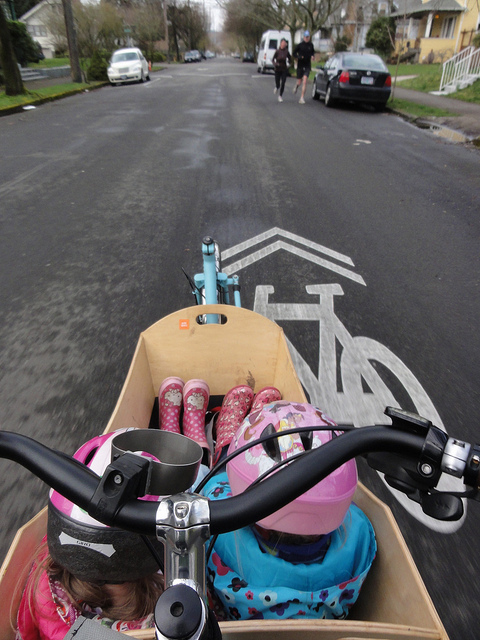
In my last post, I focused on Seattle’s nascent neighborhood greenway system, which aims to create a network of residential streets that elevates the needs of kids, cyclists, parents pushing strollers, elderly shoppers with carts, pet walkers, and other foot-powered travelers.

To get a sense of how that works, we only need look to the city that Seattle stole many of its ideas from: Portland. It’s been building some version of greenways since the 1980s. There, they evolved from traffic-calming projects to bike boulevards to what the city now calls neighborhood greenways.

In their most modern incarnation, family-friendly greenways elevate the needs of pedestrians and cyclists by making it difficult for cars to mindlessly speed through residential neighborhoods—usually through some combination of lower speed limits, speed humps, intersection art, other calming techniques, or traffic diverters that force vehicles off the greenway.

They also aim to reduce the chances that a walker or cyclist will be hit by a car. Typically, the city installs stop signs that force drivers to stop at minor intersections before crossing the greenway. A range of improvements—from signage to refuge islands to activated traffic signals—are installed to help pedestrians and bikers safely cross major intersections.

That formula wasn’t locked in overnight, though. It took years for Portland to learn how to build great greenways. Here are a few of the key takeaways:

Read more

Event: Carbon Pricing Options for Oregon

Carbon Tax vs. Cap and Trade? Can Oregon make polluters pay and grow jobs? How will low-income communities be affected? Where should the revenue go? This Monday, join our senior researcher Kristin Eberhard to talk about carbon pricing options for Oregon. A wonderful panel of speakers will lay out smart climate policy solutions towards reducing … Read more

The New Oregon Carbon Tax Report is Out

We are already paying a high price for fossil fuels: strange and severe weather, asthma and cancer cases, a Northwest economy weakened by huge bills for importing coal, oil, and gas, and the political vice grip that Big Oil has on our democracy. Last year, Portland State University (PSU) gave the Oregon legislature a teaser about how to face those problems with a carbon tax. Intrigued by the possibility of holding big polluters accountable and generating revenue for Oregonians, the legislature asked for more information, and this week PSU’s Northwest Economic Research Center (NERC) delivered. The new and expanded analysis concludes that charging carbon polluters would cut pollution and it could create jobs and raise wages. If Oregon spends the money right.

What scenarios did NERC model?

NERC modeled carbon taxes ranging from $10 to $150 per ton of greenhouse gas pollution. The tax would apply to pollution from burning fossil fuels, such as coal, petroleum, and natural gas. It would tax pollution from coal burned outside the state to generate electricity used by Oregonians. In each scenario, the tax starts at $10 per ton in 2014, and then goes up slowly and smoothly, rising just $5 or $10 each year. Knowing that the price to pollute is slowly rising over time gives dirty energy producers the time and the motivation to start investing in clean energy. NERC ran scenarios with prices that maxed out at $10, $30, $45, $60, $100, $125, and $150.

Read more

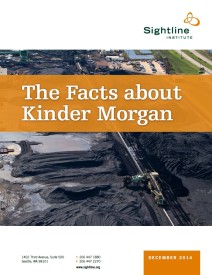
The Facts about Kinder Morgan

report pic_facts about kinder morganEnergy giant Kinder Morgan has big ambitions. The firm aspires to multiply its coal export capacity in the Gulf Coast region even as it seeks permission to build a huge new oil pipeline in the Pacific Northwest. These projects could boost Kinder Morgan’s profits, but they also raise serious questions about what the projects might cost neighboring communities.

Today, Sightline Institute is publishing a new report, “The Facts about Kinder Morgan,” that examines the facts about the company’s behavior. The report reveals that the company’s track record is one of pollution, law-breaking, and cover-ups.

In public, Kinder Morgan points out that it is already operating coal export facilities in Virginia, South Carolina, Louisiana, and Texas. Or, as the company’s spokesperson said when the firm was pushing a failed coal export plan in Oregon, “What we’re proposing is not something we don’t already do.” And that’s exactly the problem.

Read more

What Ambre Says About Its Financial Collapse

In case you missed the news, Ambre Energy—the Australian firm behind two of the three remaining coal export projects in the Pacific Northwest—is selling its North American coal business to the company’s largest creditor, a risk-hungry private equity firm called Resource Capital Funds. Ambre will realize just $18 million from the sale, even though it claimed as recently as last fall that its North American coal assets were worth between $200 and 400 million.

Over the past several days, we’ve started to see Ambre Energy’s PR strategy emerge: the firm’s North American executives are now crowing with delight that their operations are being unloaded at fire sale prices! After all, they now say, handing your business over to your creditors is a sign of financial strength, not weakness. So a story in the Longview Daily News quotes Bill Chapman, CEO of Ambre’s Millennium Bulk Terminal project, spinning the sale by saying, “The news is all good,” and implying RCF’s purchase shows that investors remain excited about the financial prospects for coal exports. And Everett King, president and CEO of Ambre Energy North America, bragged: “Their interest is validation: RCF likes the projects.”

This raises a question: Is RCF’s purchase of Ambre’s coal operation really a sign of financial strength for the company’s coal export plans?

I think the best way to answer that question is simply to quote from Ambre’s own financial disclosures—which show that the firm was running out of money, laden with debt, and had no reasonable hope of raising capital before it defaulted on its loans from RCF. [prettyquote align=right]Ambre was running out of money, laden with debt, and had no reasonable hope of raising capital before it defaulted on its loans.[/prettyquote]

More importantly, the company had been trying since 2012 to raise money from anyone other than RCF. The company even tried to raise money by selling off individual assets. Yet Ambre found no audience for its overtures: no buyers, no lenders, and no new source of capital. Finally, this past July, RCF cut Ambre off, refusing to provide them with any more money…a move that set up Ambre for the financial crisis it now faces.

In short, Ambre is selling its North American operations because the firm is deep in debt and out of options, and is essentially handing over its assets to its chief creditor in lieu of declaring bankruptcy.

Read more

Why Price Carbon—Can’t We Just Regulate It?

Most Americans—including most Republicans—want to regulate carbon pollution. Oregon and Washington have already set legally binding limits on the climate-changing gas. Next, climate change warriors in Olympia and Salem are trying to make those limits enforceable. They’re considering hard emissions caps enforced through limited permits and complemented by an array of targeted policies.

But what if Oregon and Washington’s lawmakers fail to insert sharp incisors in their beyond-carbon rules? Desperate for revenue to fulfill its McCleary obligations, Washington might pass a modest carbon tax not designed to slash pollution. Oregon might do the same, for its own revenue reasons. Such taxes would nudge the states’ economies toward a clean-energy transition, it’s true, but they would not guarantee that emissions drop to the statutory goals.

And, I shudder to ponder it, but the legislatures might simply refuse to price carbon at all, at least not yet.

In fact, a few state legislators, briefed on the fine points of carbon pricing, have rolled their eyes at the political challenges and said, “Why do we have to price it? Can’t we just regulate it?” Polls suggest some voters would actually prefer direct regulation. The logic is seductive: Polluting is irresponsible behavior. Polluters should knock it off. If they don’t, authorities should make them.

This article describes that scenario: what would it look like if we just make polluters emit less carbon?

Read more

A Mom Rediscovers Her Bike

Editor’s Note 5/3/16: Does the record-warm spring have you craving to hop back on your bike… but still a bit nervous to navigate busy city streets? In this popular article, former Sightliner Jennifer Langston shows how you can get around on neighborhood greenways, a network of family-friendly roads. Read (and ride) on!

I haven’t used a bike to get across town in six years. I know because that’s how long it’s been since I had a baby.

It wasn’t entirely the baby’s fault—options and resources for family biking in the Northwest have exploded. But having less time, a rotting garage door (now fixed!) and an inconvenient daycare in automobile-choked Amazonia were barriers to using my bike more often.

I’m somewhere on the spectrum between the “enthused and confident” and “interested but concerned” bike user that so many cities are trying to win over. During the pre-baby year I spent in Cambridge, Mass., my bike was a main mode of transportation. Since then, I’ve bought a used Burley trailer, biked recreationally, and occasionally hauled my kid a few blocks to the grocery store or playground. But I assumed Seattle’s bike infrastructure was too unintuitive and stressful to meet my needs for getting around. From my pre-baby days, I recalled bike lanes to nowhere, frequently having to pull over to check a map, not being sure I was in the right place, thinking sharrows were a mean joke, and being thankful if you had a white stripe that separated you from oblivious drivers in cars that were moving pretty fast.

So I was genuinely surprised last week when I discovered it was relatively easy to take a mapless bike ride from my house near Woodland Park to I-5 to Puget Sound, with only a vague goal of testing the two neighborhood greenways in my neck of the woods.

Children give you an easy benchmark by which to measure how much things change. And I can unequivocally say that in the last six years, Seattle’s bike infrastructure has gotten noticeably better for someone like me. In this post, I’m going to focus on neighborhood greenways—a tool that Portland has used widely (which I’ll discuss in a future post) and that Seattle is now banking on to attract left-out bikers, create a family-friendly network of calmer streets, and make the city safer for people of all ages and abilities.

Read more

All the World’s Carbon Pricing Systems in One Animated Map

[button link='{“url”:”https://www.sightline.org/2017/06/06/map-the-future-is-carbon-priced-and-the-us-is-getting-left-behind/”,”title”:”Click here for an updated version of this map”}’]

Editor’s note: We updated this map in 2017—you can see it here.

Oregon and Washington leaders are contemplating turbocharging their clean energy transition by instituting carbon pricing here in the Pacific Northwest. Will a cap or tax on carbon work? Has anyone else ever done this before? Why, yes. Since you ask: Scandinavian countries have been pricing carbon for more than two decades. The European Union Emissions Trading System (EU ETS) has been pricing carbon for almost a decade. US states and Canadian provinces have been pricing for years. Today, there are 39 (1) different programs that collectively put a price on 12 percent of all the greenhouse gas (GHG) emissions in the world. And when China’s national program starts in 2016, almost a quarter of global GHG pollution will carry a price tag to speed the changeover to clean energy. The animated map below shows carbon pricing programs around the world, with the size of the bubbles indicating the amount of pollution priced.

Click to enlarge. Original Sightline Institute graphic, available under our free use policy.

Carbon pricing programs come in many flavors: tax, cap-and-trade, or hybrids, and implemented at the level of country, region, state, or even city. (A fully sort-able table of the programs is at the bottom of this article.) The biggest program is the EU ETS, covering a little less than 2,000 million metric tons (MMT) of GHG emissions, or about 45 percent of all the emissions in the European Union. Japan’s carbon tax is the next biggest player, covering about 800 MMT, or 70 percent of Japan’s emissions. China, with several years of pilot project experience under its belt, is now committed to rolling out a cap-and-trade program in 2016 that will dwarf both the EU and Japan’s programs, probably covering about 5,000 MMT of pollution. For reference: the entire world emits about 36,000 MMT, so China’s program alone will price about 13 percent of global emissions. To get a sense of how the carbon pricing programs relate to global emissions, the map below shows the world’s biggest polluters. (You can also see countries re-sized by emissions here.) The US has a conspicuous mismatch between its large red pollution bubble and the lack of a green price bubble. President Obama, not to be outdone by the Chinese, has announced an agreement with China to cut carbon pollution. However, new Congressional leadership has vowed to move in the opposite direction by delaying and undermining federal efforts to cut pollution.

Original Sightline Institute graphic, available under our free use policy.

Here are a few questions about global carbon pricing programs that Pacific Northwest leaders might want answered:

Read more

×