Donate Newsletters

Northwest Car-Sharing Olympics

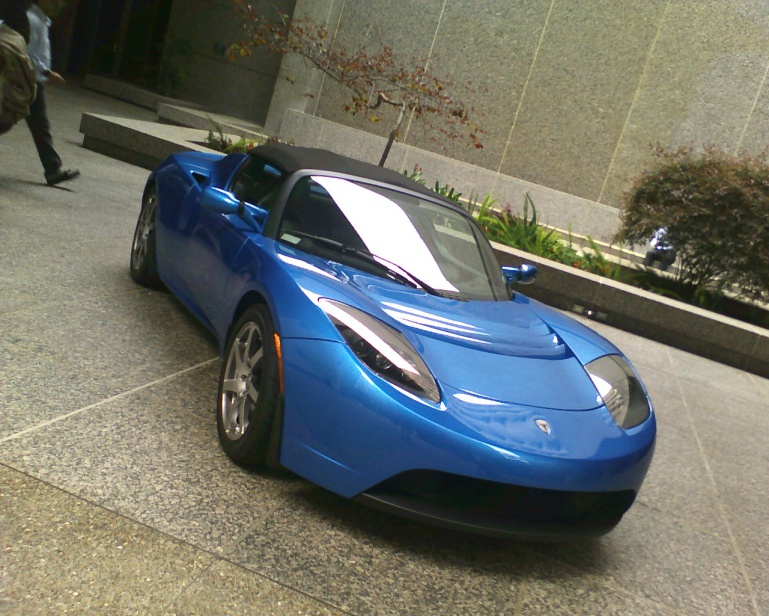
Zipcar. Car2Go. Getaround. Modo. Throughout the Northwest, car-sharing services are taking off. Residents in major Northwest cities who are looking to live a “car-lite” lifestyle—but who still need to get behind the wheel from time to time—now have a number of options for shared vehicles.

Car-sharing services offer abundant, convenient vehicle options, distributed widely around major metro regions—so that drivers have easy access to cars when they need them, without shouldering all the costs of ownership.

As car sharing catches on and states pass legislation to remove barriers, companies are vying to enter new markets. In this Northwest free-for-all, which big city is taking home the gold?

The Emerald City seems set on the bronze: it’s got one good car-sharing option, but fewer companies, vehicles, and pricing options than either of its neighbors. It’s a tight race between Vancouver and Portland for the gold…but in the end, we have to give Vancouver the nod.

Here are the details.
Read more

The Northwest’s Global Appeal

Seattle and Portland still rank among the whitest cities in the country. If life doesn’t regularly take you to Tukwila or the Rainier Valley or Bethany or Hillsboro, it’s entirely possible to miss the region’s incredible growth in foreign-born residents.

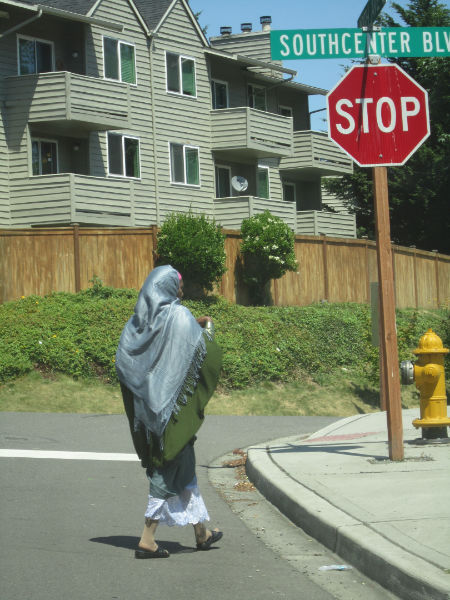
Occasionally, though, the magnitude of these changes hits you. On my first day as a writing tutor in a local English Language Learning class, a boy handed me a very short story. His fifth-grade class of recent immigrants—Somali girls wearing headscarves, Hispanic kids chattering in Spanish and Mixtec, Burmese and Iraqi students—had been assigned to write something about their life. These aren’t his exact words, but this is how I recall the story that made me realize how ill equipped I was to offer any useful advice:

My mother asked if I was hungry. I said yes. She went to get food and fell down. I shook her. She was dead.

He didn’t offer many details at first, but I later gathered that he arrived as a refugee from Eritrea with what was left of his family.  It’s not an uncommon path to Washington State, which typically ranks among top 10 states for resettling refugees as they arrive in the US. That accounts for part of the state’s astonishing rise in foreign-born residents, as do recruitment practices at high-tech companies or research departments looking for international talent.

Read more

Top Northwest Cities for Walking to Work

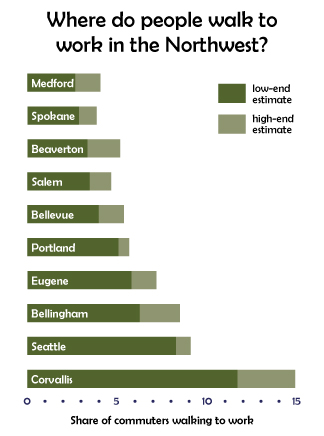
Chart of NW cities ranked by walking to work.

I’ve been monkeying around with US Census data to develop this comparison of foot-powered commuting in the Northwest:

Chart of NW cities ranked by walking to work.
Chart by Devin Porter.

Corvallis cleans up. That’s not too surprising given its relative compactness, its large university, its moderate topography, and its overall awesomeness for getting around without a car. [Full disclosure: I have a huge crush on Corvallis.]

Other college towns, like Bellingham and Eugene, also do relatively well.

The other standout is Seattle.

Read more

Transit Smackdown: Seattle vs. Portland vs. Vancouver

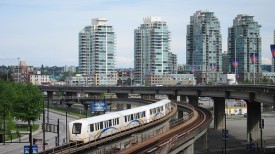
Vancouver's skytrain
AaverageJoe, flickr

A little while back, we took a look at commuting in Seattle vs. Portland—and found, perhaps unexpectedly, that Seattle had a heck of a lot more transit commuting than Portland.

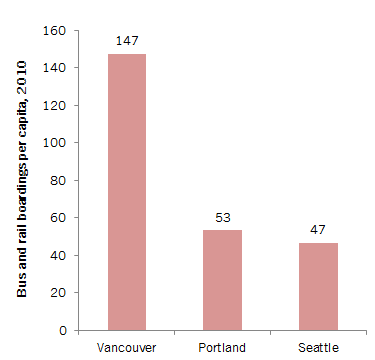
But that comparison only looked at work trips, and only trips within the city limits of Portland and Seattle. So what about the metro areas as a whole—and transit for all trips, not just trips to work?? The National Transit Database offers some clues…and as it turns out, for total transit ridership the Portland metro area may edge out greater Seattle.

But neither Portland nor Seattle can hold a candle to greater Vancouver, BC.

The simplest comparison among the three cities looks at the average number of bus and rail transit boardings per person, per year, in the entire metro area. And on that measure, Vancouver vastly outstrips its two southern neighbors.

Read more

Traffic Forecasting: A Blast from the Present

Oops, they did it again.

As we mentioned earlier in the week, way back in 1991 the Washington State Department of Transportation recommended that engineers forecast future traffic volumes by finding a recent period of steady traffic growth, and simply assuming that this growth would continue. Although that approach probably worked well enough back in 1991, it’s been failing the region badly for the last decade. Surely by now traffic engineers know better!

Or, perhaps not. Take, for example, the Oregon Department of Transportation (ODOT) “Analysis Procedures Manual,” first published in 2006 and most recently updated in 2011. It calls for almost the exact same procedure as was found in WSDOT’s 1991 manual: running linear regressions from past trends to forecast future traffic growth. For details, see Section 4.6, or just read this excerpt:

Read more

Promise of Permeable Pavement

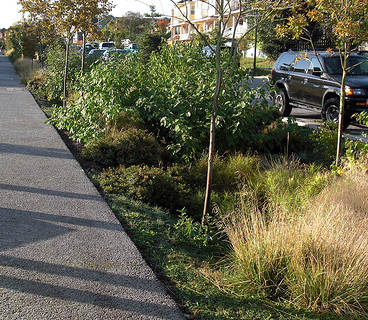
Permeable sidewalk

Editor’s note: This post is also available as a pdf.

Permeable pavement is one of the most promising green solutions that can help reduce and clean up polluted stormwater runoff. Like conventional pavement, it can be made of asphalt or concrete that’s either poured in place or sold as pavers, and it can be used in a variety of settings, including on parking lots, low-traffic roadways, driveways, and sidewalks.

Permeable technology has been used successfully in countless Northwest paving projects, though its use has been limited by a few persistent myths.

Let’s examine some of the most common concerns.

Read more

Sundown this Summer

Mark your calendars for Thursdays in July: Ecotrust is back with their Sundown Series. Four nights of fun, free outdoor concerts and street exhibitions—telling a story about living deliberately in the Northwest. The events are just outside Ecotrust’s Natural Capital Center in Portland. Sightline will be there on July 5 (musical guests Typhoon and AU), … Read more

×