Donate Newsletters

The Facts About Kinder Morgan

In January, Kinder Morgan—a giant energy conglomerate—announced plans to use an Oregon port on the Columbia River to export 30 million tons of coal annually to China and other Asian markets. Many in the Northwest worry about the health risks, pollution, and economic risks that are entailed by the plans. Already tribes and environmental organizations are raising serious concernsabout handling large volumes of coal on the Columbia.

A look at Kinder Morgan’s track record in communities where the company already exports coal reveals that these worries may be well-founded.
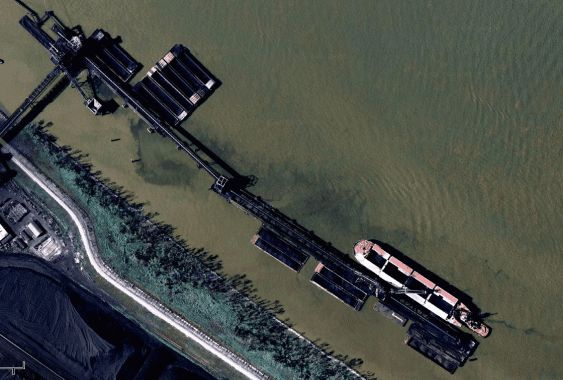
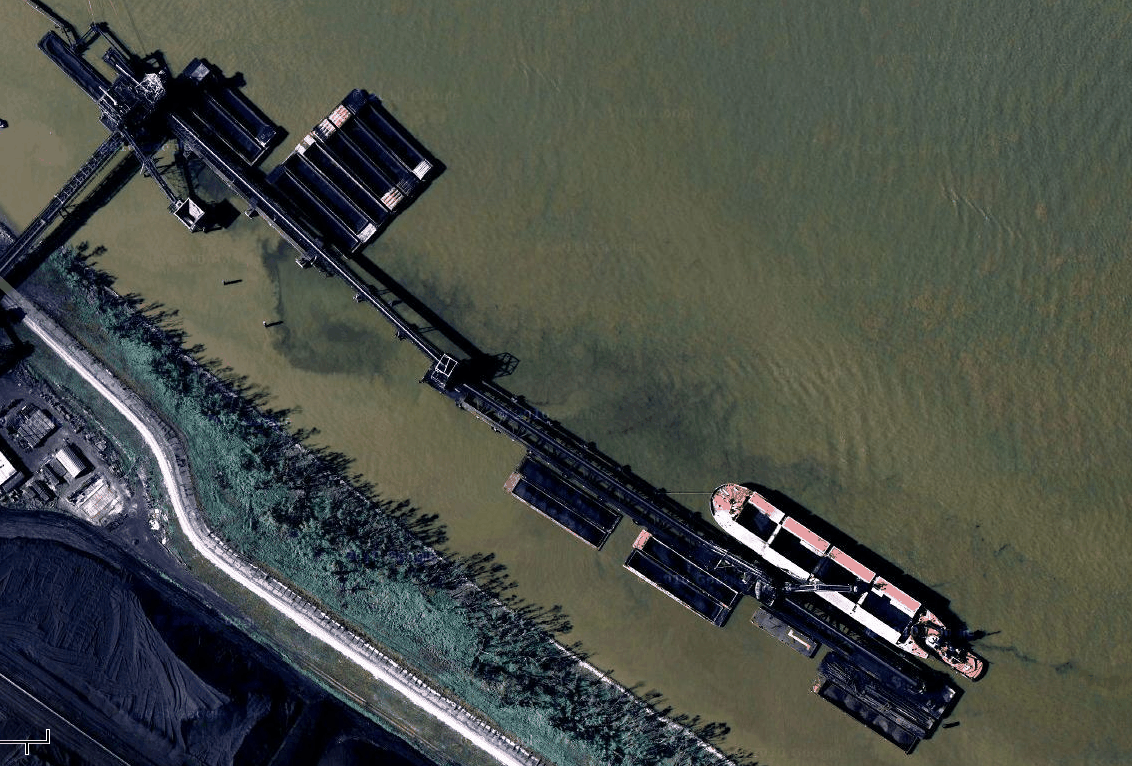
Coal dust pollutes the Mississippi River at Kinder Morgan’s coal export terminal in Myrtle Grove, Louisiana.

Many of Kinder Morgan’s coal export operations blight neighborhoods and foul rivers. The company’s track record in the Northwest and beyond is one of pollution, law-breaking, and cover-ups. Moreover, the proposed Oregon terminal would be the company’s biggest yet.

  • In Louisiana, Kinder Morgan’s coal export facilities are so dirty that satellite photos clearly show coal dust pollution spewing into the Mississippi River.
  • In South Carolina, coal dust from Kinder Morgan’s terminal contaminates oysters, pilings, and boats. Locals have even caught the company on video washing coal directly into sensitive waterways.
  • In Virginia, Kinder Morgan’s coal export terminal is an open sore on the neighborhood, coating nearby homes in dust so frequently that even the mayor is speaking out about the problem.
    Read more

Rain Garden Backlash Is All Wet

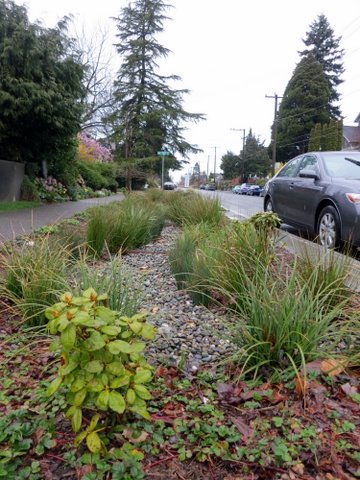
Ballard rain garden in March

Rain gardens are suffering from an identity crisis.

On one hand, there are homeowners who love rain gardens composed of feathery grasses and bushy native shrubs. They even hire landscapers to install them and post signs to let others know that their yard is helping solve the problem of polluted runoff. There are Puget Sound databases and maps packed with examples of the water-sponging plantings. Walking tours in Portland and elsewhere showcase the green landscaping approach.

On the other hand, there are some small, but vocal, clusters of residents opposed to rain gardens that have been proposed for public spaces adjacent to their homes. They invoke the “Ballard rain gardens” — a local shorthand referring to some rain gardens that the city of Seattle installed in parking strips that failed to drain properly and filled with water. (It’s worth noting that the infamous gardens have now either been rebuilt or removed to the apparent satisfaction of residents: The blog Ballard Raingardengue launched to track the offending gardens went quiet a year ago.)

So what is the true nature of Northwest rain gardens? Are they an attractive, affordable tool to shrink the amount of fouled stormwater runoff that damages local lakes and streams? Or are they an infrastructure folly that doesn’t deliver? 

Read more

Do Asian Coal Plants Pollute North America?

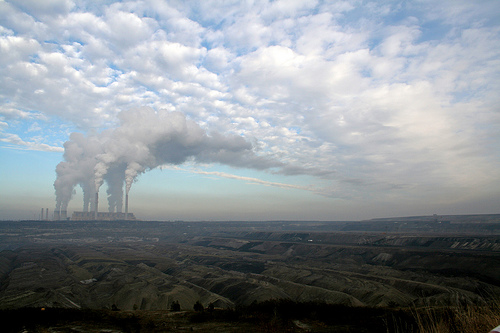
When we consider coal export plans, we would do well to consider the risk that by-products of the coal may return to haunt us. In fact, there is a growing body of scientific research examining the ways that smokestack emissions cross oceans to cause pollution problems halfway around the world.

In March, for example, the US National Oceanic and Atmospheric Administration released shocking research findings:

Several recent studies have shown that powerful spring winds can carry Asian pollution into the atmosphere above North America. …some of the imported pollution can descend to the surface, where it affects ground-level ozone, a regulated pollutant. At high concentrations, ground-level ozone can cause severe respiratory effects in some people, and it damages crops, trees, and other vegetation.

“We showed that Asian pollution directly contributes to surface ozone pollution episodes in parts of the western United States,” said Meiyun Lin, Ph.D., lead author of the new study.

In other words, some of the air pollution problems in North America result from the pollution emitted by Asian coal plants and industrial facilities.

NOAA’s findings were not entirely new, however.

Read more

Thoughts On Seeing My First Coal Train

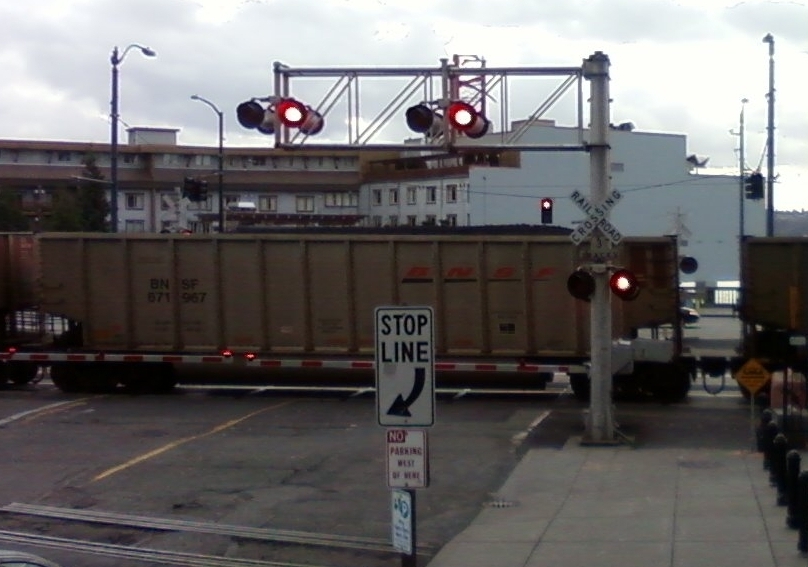
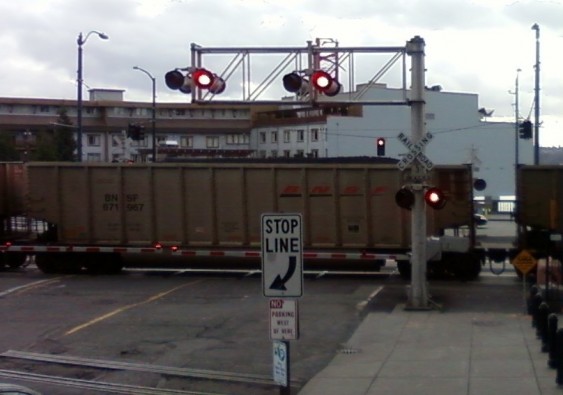
Finally. Despite more than a year of research and writing on coal exports it wasn’t until yesterday that I saw my first loaded coal train. Here it is:

I snapped this photo while standing on Seattle’s Wall Street looking west toward the waterfront. Behind the coal train, you can see the Edgewater Hotel.

My first thought was should I stop breathing? Fortunately, coal dust was not visibly blowing off the tops of the coal cars. Unfortunately, however, the lopsided shape of the coal piles suggested that wind and rain had already taken their withdrawals somewhere along the tracks.

My second thought was: wow, global logistics are amazing. Although I think large-scale coal exports are a bad idea, there’s something undeniably gee-whiz about the path that coal was taking.

The coal almost certainly originated at the Spring Creek Mine, owned and operated by Cloud Peak Energy in southeastern Montana, not far from Sheridan, Wyoming. A few of the 230 workers there mined the coal using a “drag line open-pit” technique, similar to strip mining, that deploys a giant crane-like machine with a bucket for excavations. For a Powder River Basin deposit, the coal in my train was relatively high-energy and therefore relatively valuable. A typical pound of Spring Creek coal will yield an estimated 9,350 BTUs of heat when burned, about 9 percent more than average deposits in the Basin.

At the mine, the coal was loaded into open top hopper-style railcars on a BNSF train. If my train was a typical one, it was at least 100 cars long each of which carried perhaps 110 tons of coal. At the mine, the coal wasn’t worth much. Almost certainly priced at less than $15 per ton, the entire train’s worth of coal was worth less than $200,000 when it was loaded, though it would ultimately sell for much more than that in Asia.

Read more

The Northwest’s Latino Residents

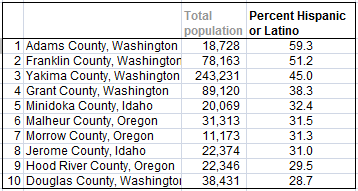
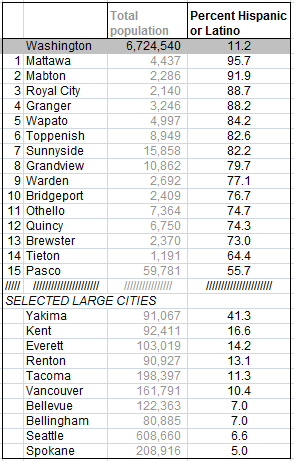
The Northwest is home to more than 1.4 million people who self-identify as Hispanic or Latino. In this installment of my ongoing analysis of the region’s demographics we’ll take a closer look at the geography associated with Northwest Latinos. (Past examinations have included Chinese American and black residents.)

Overall, the three Northwest states have remarkably similar shares of Latino residents. Oregon’s population is 11.7 percent Hispanic, compared with 11.2 percent in both Idaho and Washington. In British Columbia, by contrast, less than 1 percent of residents claim Latino heritage.

Uniquely among Northwest jurisdictions, Washington has more than a dozen municipalities with overwhelmingly Hispanic populations.

All of Washington’s majority-Latino cities and towns lie to the east of the Cascade Mountains. Cities on the western Columbia Plateau (Mattawa, Royal City, Warden, Othello, and Quincy) and cities in the lower Yakima Valley (Mabton, Granger, Wapato, Toppenish, Sunnyside, and Grandview) dominate the rankings. With the exception of Pasco, all of Washington’s majority-Latino places are small towns.

Read more

See you in Portland?

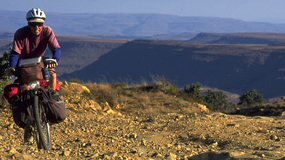
Live in Portland? Got plans next Friday? Start your weekend off right with Sightline. We’ll be hosting an event at the Bike Gallery in SW from 7:00-9:00pm. We’ll have food and drink, fun people, and all-around good times. Bonus: Willie Weir, writer and cyclist, will talk about how he became a bicycle advocate one sunny … Read more

Freeing Food Carts

Editor’s note: Eric posted Seattle and Vancouver follow ups to this piece.

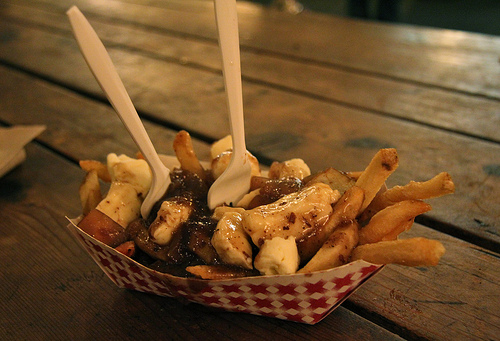
Whatever you’re craving, you can probably find it on sale at a parking lot in Portland. Barbecue jackfruit fried pie? Try Whiffies on Hawthorne. Foie gras over potato chips? Eurotrash on Belmont. Kimchi quesadilla? Koi Fusion on Mississippi. It’s no wonder Portland has been heralded as a world-class purveyor of street food.

But North American attention to the Rose City’s food cart scene has cities to the north green with envy.

For decades, Seattle and Vancouver, BC, had draconian laws limiting food cart cuisine. In the last few years, however, both have tossed old rules in the dumpster, hoping to unleash legions of carts.

Street food is smart for sustainability: it makes urban living more desirable to many, improves neighborhood walkability, provides affordable dining options, and opens doors for diverse entrepreneurs.

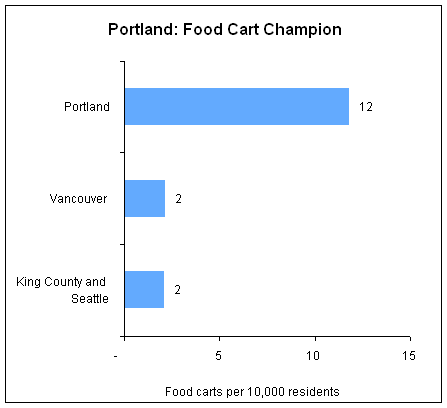
So far, though, neither Seattle nor Vancouver, BC, has cleared the way for street food to the same extent as Portland.

Portland: Ground Zero

Read more

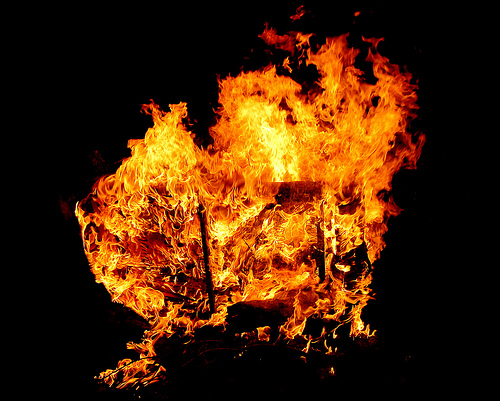
Have Toxic Couches Finally Met Their Match?

Eureka! The California legislature will this spring consider a bill to modernize the 12-second rule, the state’s obscure furniture flammability standard that fails to protect us from fires even while it poisons homes across North America. Over the past seven months, we’ve described this scientifically discredited standard; provided nine (adorable) reasons to modernize the standard; refuted Big Chem’s star witness; and uncovered the engine of toxic political influence that shuns fire safety in favor of profits.

This time, we bring hopeful tidings.

Late last month, Rep. Holly Mitchell (D-Los Angeles) introduced AB 2197, a bill that will bring California’s flammability standard into line with 35 years of independent fire safety science and 20 years of research by the US government.

AB 2197, backed by a coalition of firefighters, scientists, businesses, consumers, and public health advocates, is simple, effective, and constructive. It’s worth a read.

Read more

Recipe for a Rice Crispy Road

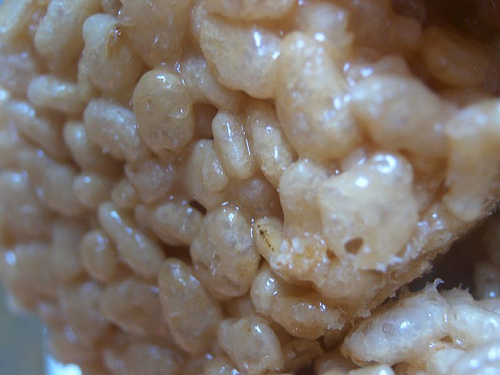
Rice Crispy close up

Water is the enemy of pavement. It gets into cracks, freezes, expands, and makes bigger cracks. It makes the ground beneath roads soggy and soft. Drive some heavy trucks over those roads and they can give way, forming potholes and ruts. Even when it’s not destroying the road, water pools on the surface, turning cars into dangerous hydroplanes and splashing buckets of filthy water onto windshields and pedestrians.

Water is the enemy of pavement—unless that pavement is permeable.

Permeable pavement is pocked with pores that allow the water to trickle through it like a rock-based rice crispy treat. In freezing temperatures the water has room to expand inside the pores without cracking the material. Potholes are less of a problem because the pavement is laid on top of a bed of gravel, which allows water to drain through to the absorbent soil below while maintaining a firm foundation under the road surface. There’s no standing water puddling on top of the road causing sliding and splashing.

And permeable pavement helps solve the top two problems created by polluted runoff: dirty stormwater that poisons streams and lakes, and the tsunamis of water that gush through creeks and flood buildings. Permeable pavement cleans the water as it trickles through it into the soil, and it helps the dirt soak up the water, recharging pockets of buried groundwater.

But just how does a simple roadway shrink our stormwater woes and make streets safer to drive, bike, and walk on? Here’s how.

Read more

The Demographics of Transit

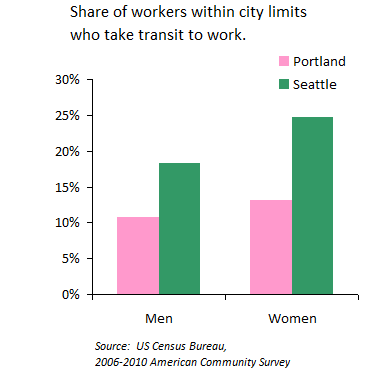
As I mentioned in my last post, Seattle and Portland have very similar commuting patterns. The biggest difference between the two cities is that Seattle has higher rates of transit commuting, and lower shares of drive-alone commuters, than Portland.

But there are plenty of interesting tidbits about the demographics of transit buried in the commuting data.

Transit and Gender

In both Seattle and Portland, women are more likely than men to commute by transit.

Just to be a numbers geek for a moment: in both Portland and Seattle, women represent just under half of all workers, but slightly more than half of all transit commuters.

Read more

×