Donate Newsletters

Commuting in Seattle and Portland

Editor’s note: For more transit geekery, check out the follow up post detailing the demographics of Northwest transit riders.

Portland, OR has a national reputation as a transit powerhouse. Despite some recent funding woes—which are depressingly common for US transit systems—the City of Roses’ combination of bus, light rail, street car, and most recently aerial tram transit has earned national kudos. US News and World Report, for example, recently ranked Portland’s transit system as the fifth-best in the country, trailing cities like New York and Boston.

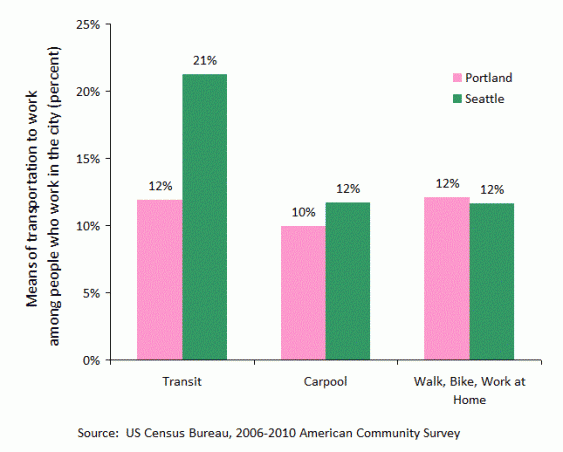
Yet as we’ve mentioned before, data from the US Census shows that Seattle has far more transit commuting than Portland.  It’s really not all that close: in Seattle, about 21 percent of workers got to their jobs on transit from 2006 through 2010. But in Portland, the figure is just 12 percent.


Read more

Dirty-Energy Money

Big Coal and Big Oil know that, in their business, political friends are worth their weight in gold. An academic study of one case of corporate lobbying estimated the return on investment at 22,000 percent: a dollar spent earned $220. Jack Abramoff, the convicted, influence-peddling super-lobbyist, pegged the return on investment of one project at 100,000 percent: $4 million dollars in lobbying cash purchased a $4 billion tax break for Tyco International.

Inspired by paybacks like those, the dirty-energy industry lavishes money on campaigns and lobbying. Not surprisingly, among its favorite sons are Rep. Joe Barton (R-Texas), who famously apologized to BP for Congress’s criticism during the Gulf oil disaster, and Sen. James Inhofe (R-Oklahoma), who insists the science of global warming is a hoax and has likened the US Environmental Protection Agency to the Gestapo. Rep. Barton has raked in $1,914,183 and Sen. Inhofe $1,287,950 from Big Coal and Oil—amounts that bring to mind social critic Upton Sinclair’s observation: “It is difficult to get a man to understand something when his salary depends upon his not understanding it.”

But what about Cascadia, with our hydropower and wind turbines, energy efficiency and smart growth? Does the lucre of Big Coal and Oil taint our delegation to Congress too? We pulled the numbers from the Dirty Energy Money Campaign, which compares recent Congressional votes on a dozen indicative energy policy issues with campaign contributions from fossil energy companies. The answer is unpleasant: even in the Northwest, Big Coal and Oil are dumping train loads of cash on our democracy—almost $5 million since 1999—and the main recipients are hewing to the dirty-energy line. These figures actually understate dirty-energy political money dramatically. They reflect campaign contributions made by energy companies and their key  employees. They ignore contributions made by major investors in these companies and the huge sums of political money that filter to candidates or their election through the bank accounts of lobbyists, PACs, and Super-PACs. Think of these figures as the tip of the iceberg: the visible part but not the most dangerous part.

Read more

Surprisingly Ambitious Permeable Projects

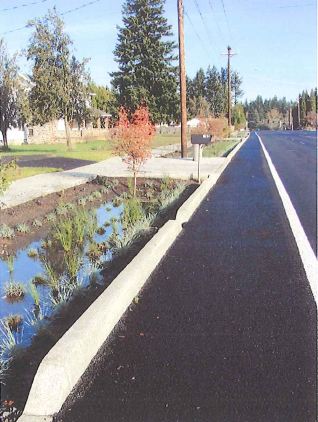
Kane Road pervious asphalt

Municipal engineers don’t exactly have reputations for being devil-may-care, live-on-the-edge risk takers. Speaking generally, they work hard, take their jobs seriously, and really really want their projects to work. Collapsed bridges and over-flowing sewers don’t look so hot on the resume.

But stormwater engineers in Gresham, a neighbor to Portland, and Issaquah, located in the foothills of the Cascades outside Seattle, have built some interesting — even a touch experimental — roads and parking lots using permeable pavement.

The main reason for using permeable pavement, which comes in two basic flavors: porous asphalt and pervious concrete, is to help shrink and clean polluted stormwater runoff. Instead of sheeting off pavement with a slug of toxic chemicals, rainwater trickles through pores in the pavement, soaking into the gravel and native soils below. In addition to treating stormwater, the pavement is safer for drivers because it reduces hydroplaning and the glare from wet pavement. Plus, it can save money by eliminating the need for traditional, costly stormwater pipes and retention ponds or vaults.

Permeable pavement is increasingly being turned to as a “green” technology for managing dirty stormwater, but the truth is, it’s still an approach that’s under development.

That’s why it’s interesting to see these two smaller cities tackling projects that stretch into uncharted territory for the Northwest. In Gresham, the city installed porous asphalt on a sloped road with less-than-perfect soils — two factors that tick up the degree of difficulty. Issaquah built a 1.5 acre porous asphalt parking lot at a formerly unpaved site that was so poorly drained, it was known for its muddy potholes.

“Everyone’s cautious on the public side,” said Steve Fancher, director of Gresham’s Department of Public Works. “You don’t want those failures.”

Read more

Clothesline Bans Void in 19 States

Clothesline. Photo by Lucas Moratelli via Flickr, CC.

Editor’s note August 2022: Wow! This article continues to be a favorite with readers. Unfortunately we no longer research this issue and cannot offer legal guidance for those trying to, say, square HOA rules with state or local ones, though we encourage that you look into “solar collectors” policy and contact local electeds with your … Read more

The Northwest’s Black Residents

I’m a number cruncher, so one way I’m observing Black History Month is by examining census figures for the Northwest’s African-American and African-Canadian populations. (Another way is here.) Although the Northwest does not have a large black population relative to many places in the United States, the region is home to nearly 340,00 residents who self-identify as black, representing 2.1 percent of the population. Among Cascadia’s African-descended people the vast majority, 71 percent, make their homes in western Washington.

It’s often forgotten that Washington’s black communities can trace roots to the years when the area was still contested by Britain and the United States, nearly a decade before the Washington Territory was created. Today, a portion of the relatively large black population in Washington can be explained by the state’s numerous military bases and the strong tradition of military service among African Americans.

The Northwest’s black population is so centered on Puget Sound that Sound-area locales claim all but one of the top 30 spots in the region for shares of people of African descent. In fact, a rank-ordered list for the Northwest turns out to be simply a list of places in Washington, 29 around the Puget Sound and one in eastern Washington. Here it is:

Read more

Toxic Money

Clausewitz said that war is politics by other means. Big Chem knows that politics can be business by other means. You’ve got to hand it to them: they’ve used politics with astounding effectiveness to secure their bottom line. The result is literally toxic for the rest of us.

The chemical industry spent nearly $5 million a year over the past five years on lobbying and campaign contributions in California. That’s a lot of money for one industry and one state. On the other hand, it’s a pittance, considering the payback: by defending an obscure and ineffective fire-safety regulation, the industry extends its North American stronghold in a market worth billions of dollar of sales each year. That’s one of the best returns-on-investment imaginable.

(If you’re familiar with this saga, skip this paragraph. If you’re just tuning in, here’s a quick catch-up: California’s flammability standard is a scientifically discredited rule that requires all foam furniture sold in the state to withstand 12 seconds exposed to a candle flame. Because of the scale of California’s market, the rule effectively governs North America’s furniture industry. The cheap way to pass the 12-second test is to blend flame retardant chemicals into foam. The retardants include all manner of health-harming compounds, which leak out of furniture and into our homes, our bodies, and our natural environments. Ostensibly, these chemicals are put into furniture to protect us from fire, but 35 years of fire safety science shows they don’t do their job. Still, policymakers have defended the rule, most recently by a vote of eight to one in a California senate committee. Last time, we deconstructed the illogical and unscientific testimony of the chemical industry’s star witness. So what’s the real reason policymakers refuse to change the rule? We fear the answer is simple: money.)

Read more

Gail Achterman: Presente!

The first time I met Gail Achterman was in the late 1990s. I was apprehensive, expecting a whip-smart, hard-edged lawyer. Her reputation was that of a policy fixer, depended on by Oregon governors to bargain out compromises on complicated natural resource conflicts like spotted owls and old growth forests.

Instead, I found a friend. Sure, she was formidably intelligent, and she was impatient with nonsense and posturing. But if she was tough, she was never hard. No, she was principled and—because confident in her principles—flexible, sensitive, and inquisitive. More: what drew me to her was that she was moved by a deep, restless, almost palpable quest—a quest for solutions for Oregon and the Northwest.

There were others in the meeting, I feel sure, but Gail and I ran away with the conversation. I remember we talked about Wendell Berry, a formative influence of mine. We talked about the meaning of place in modern life. We talked about Cascadia’s rivers and whether the love of them might motivate conservation and sustainable land-use in watersheds across the region.

Read more

Two Wheels and High Heels

In the Seattle suburb where I grew up, the main transportation choice most residents face is what kind of car to buy. I moved to Seattle after college and, inspired by the “car-lite” lifestyles of several friends, decided to give cycling a try.

I fell in love with it. Urban cycling freed me from slow buses, parking meters, and mind-numbing elliptical machines. I arrived at work with more energy. I lost weight. I discovered charming neighborhood restaurants. I could smell fresh laundry and dinners in the oven while I pedaled home through residential streets. Getting from A to B on my bike became the best part of my day.

Recently, I won a fellowship and got to spend six months living life on two wheels in the world’s most bike-friendly cities. I brought home ten lessons, and thousands of photographs, for Cascadia:

1. Its the infrastructure, stupid!

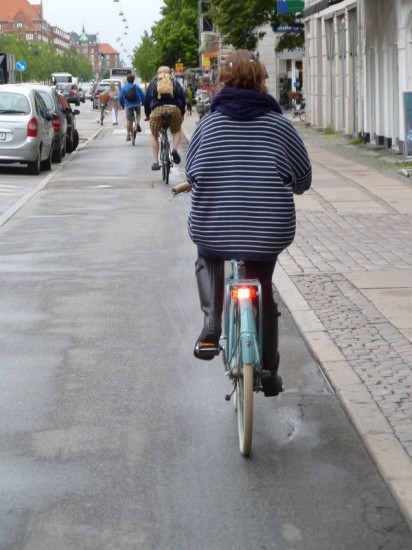
Amazing infrastructure makes cycling normal and safe in bike meccas, but not yet in the Northwest. For example, parked cars to the left of the bike lane not only provide a barrier between motorized traffic and cyclists, they also minimize a cyclist’s chance of getting “doored.” Most cars in Denmark (pictured) only have one occupant—the driver—and drivers get out on the left. Same goes for the Northwest.

Denmark. Photo by Christine Grant, used with permission.

Read more

×