


Takeaways
- In 2024, the Yukon Citizens’ Assembly recommended ranked voting as a replacement for first-past-the-post in elections for the Yukon Legislative Assembly.
- In neighboring Alaska, ranked voting has had a depolarizing effect on legislators and has given voters a more nuanced way of casting their ballots.
- Yukon voters have an option to weigh in vote during the general territorial election. Polls close at 8:00 p.m. on November 3.
Find audio versions of Sightline articles on any of your favorite podcast platforms, including Spotify, YouTube, and Apple.
Author’s update, November 4, 2025: It’s official: Yukoners are ready for ranked voting. At last count, fully 56 percent of plebiscite voters said “yes” to electoral reform. Unfortunately, the Yukon Party, which appears posed to win a majority of seats in the territory’s legislative assembly, has indicated that it does not intend to act on implementing ranked voting. But with voters showing up in even greater numbers for reform than for the Yukon Party’s own candidates, it may be hard to ignore this particular call for change.
—
If you had a chance to overhaul your government, where would you begin? Last year, 38 Yukoners from every corner of the territory stepped up to answer that question in a citizens’ assembly on electoral reform. Their recommendation? Upgrade the Yukon Legislative Assembly’s first-past-the-post elections to ranked voting, much like Alaskans did in 2020.1
Voting is already underway for a statewide plebiscite on the assembly’s reform of choice. Though the vote is advisory, two of the Yukon’s three major parties have committed to respecting the will of the voters if they win control of the assembly this year.
So, will the reform that let Alaskans vote their values and produced a more politically diverse and functional legislature inspire a similar change in the Yukon? Residents will know more after polls close at 8:00 p.m. on November 3.
How ranked voting would work in the Yukon
In general elections, rather than filling in a single ballot bubble for a candidate for member of the legislative assembly (MLA) in their district, voters could rank party nominees in order of preference, starting with their first choice for MLA, then second, and so on.2
If no candidate were to win a majority in the first round of tallying, officials would eliminate the lowest-performing candidate, redistributing their votes to voters’ second choices.
The process would continue until a candidate won a majority, or as close to a majority as possible. Elections Yukon has published an overview here.
What could ranked voting do for Yukoners?
In Alaska, the ranked voting upgrade has prevented “spoiled” elections, given voters more viable choices, encouraged candidates to work toward common goals, and created a cross-partisan, solutions-focused legislature. Though the Yukon’s governmental structure and political makeup differ from Alaska, similar dynamics and incentives would likely carry over.
Preventing spoiled elections with real voter choice
In general elections, the Yukon’s single-member electoral districts are prone to the same plurality winner problem that prompted Alaskans to adopt ranked voting in the first place.
When there are more than two candidates in the running, as has been the case in 94 percent of general election assembly contests since 2000, voting blocs may fracture. If like-minded voters split their vote between two similar candidates, a conservative district can send a liberal MLA to office (or vice versa) with only plurality support—more votes than anyone else, but not reflective of majority preference. As such, voters may feel compelled to vote strategically, rather than for their favorite candidate, to avoid splitting the vote.
At its most extreme, vote-splitting can deliver one party a number of seats that is vastly out of line with what the voters wanted. Take for example the 2001 British Columbia general election. BC Liberals won 97 percent of seats in the provincial assembly with only 58 percent of the popular vote, all because the NDP and Green Party divvied up a similar voter base.
Could the same thing happen in the Yukon? To some degree, it already does; just not to the benefit of any one party. For the last three elections, MLAs who got less than 50 percent of the vote in their district won well over half of assembly seats: 12 members in the 2021 election, 17 members in 2016, and 16 in 2011.
In other words, it’s possible for every riding to go the way of Kluane, where MLA Wade Istchenko has won three consecutive elections even though most voters preferred other candidates. Under first-past-the-post, it’s conceivable that any one party could sweep the entire assembly with as little as 34 percent of the vote in each district.3
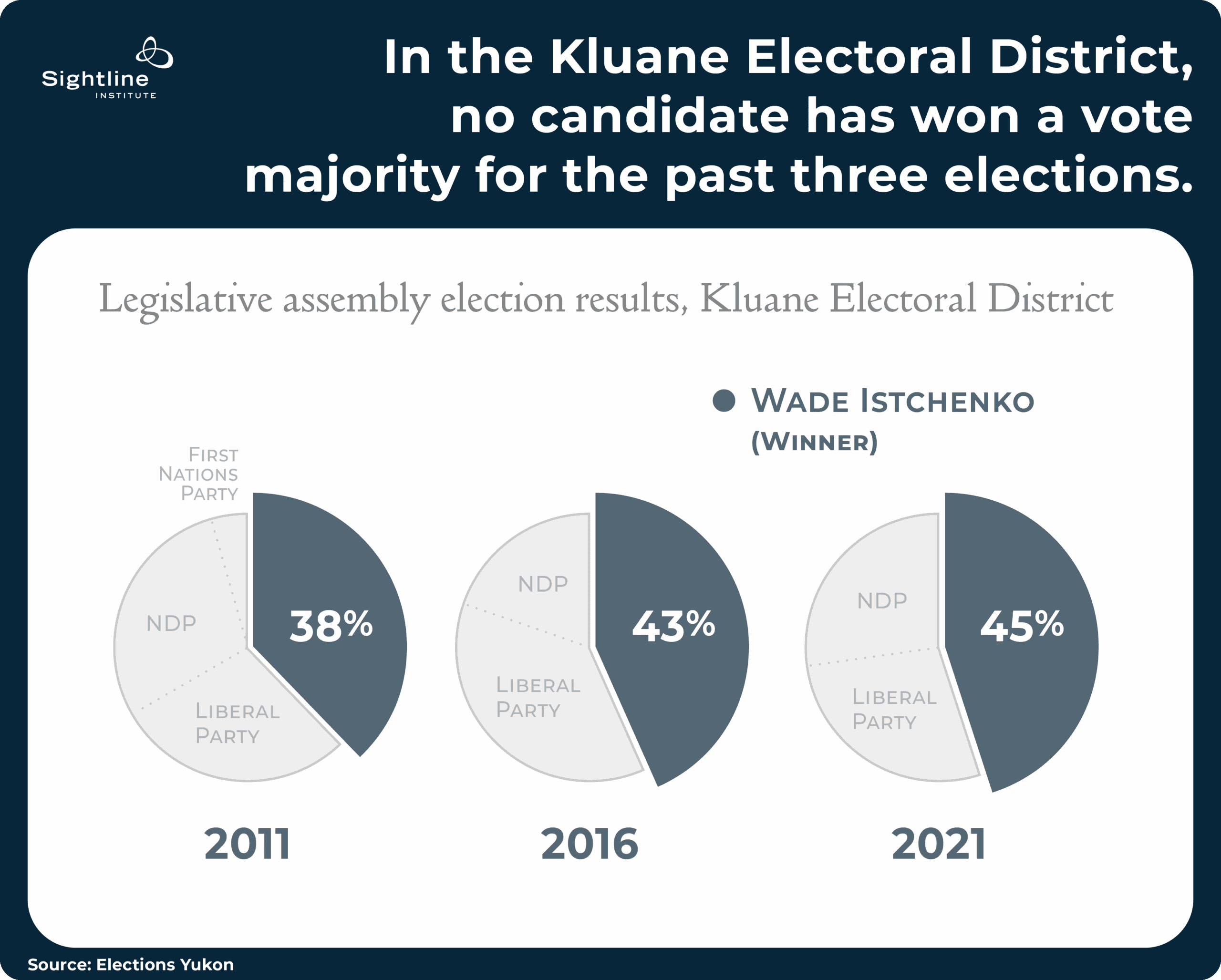
Now imagine the same contests under ranked voting: A) If Kluane voters had been able to mark their second (and third) choices, Istchenko still might have pulled enough second-choice votes to become the clear majority-preferred candidate. B) Alternatively, if non-Yukon-Party voters were united against Istchenko, they could have elected a candidate with broader appeal across the district.
In Alaska, ranked voting has empowered independent voters and candidates in a two-party-dominant system, as voters can cast their ballots without worrying about “wasting” their vote. If their first choice doesn’t win, no problem; they know their vote will transfer to their next-most-liked candidate.
Incentives for more positive campaigning and constructive governance
When politicians find cause to seek out second-choice votes to clear the 50 percent mark, it can change the way they campaign and govern. Since Alaska adopted ranked voting, candidates have had more reason to run positive campaigns focused on common ground, and legislators have worked across partisan lines in support of broadly popular policies.
Granted, governing dynamics in the Yukon are not the same as in Alaska. The Yukon currently has a three-party, one-chamber government of 21, as opposed to Alaska’s two-party/independent, two-chamber legislature of 60. Ranked voting’s incentives to campaign positively and collaborate on common issues would likely carry over to the Yukon. It would be up to the territory’s parties, candidates, and lawmakers to decide how best to engage with voters—and each other—under the new model.
If voters favor ranked voting, the 2025 general election could be the last time they use the divide-and-conquer first-past-the-post method to elect the Yukon Legislative Assembly. Last year, the Yukon Citizens’ Assembly settled on ranked voting as the superior choice for Yukon elections. It’s time to see if their peers agree.
Author’s note 10/31/25: This article was updated several hours after it initially published to amend two paragraphs in the section “Preventing spoiled elections….” The original meaning still stands, simply with additional information.

