


Takeaways
- Three of Washington’s gas utilities intend to pilot clean heating and cooling projects, thanks to a 2024 state law legalizing thermal energy networks (TENs).
- The projects would enable two college campuses to stop burning polluting gas for heat—crucial for WA’s climate goals—and the city of Vancouver, Washington, to lessen new homes’ and businesses’ strain on the grid.
- Regulators can allow gas utilities to explore a climate-friendly business model through the pilots, even though only one is a true-to-form TEN.
- Meanwhile, lawmakers can more fully explore thermal energy networks’ potential in the state by replenishing grant funding and rewarding the systems’ benefit to the grid. In turn, this support can deliver lessons to inform future projects, with an aim of driving down their costs and encouraging more of them—all to cut pollution and create more clean energy jobs in Washington.
Author’s note: On July 29, 2026, the Washington Utilities and Transportation Commission issued a final order requiring NW Natural to remove the cost of its TENs pilot from its multi-year rate plan. The Commission stated: “We expect the parties to continue to evaluate the benefits of the project, and the cost allocation among customers, before bringing this project back to the Commission for consideration.” Sightline finalized the copy of this article before the Commission issued its order.
A few years ago, Washington gas utilities looking to decarbonize lacked good options. They could pump their natural gas pipes with hydrogen, an expensive and potentially dangerous alternative. They could rely on so-called renewable natural gas, a substance in short supply and with questionable climate bona fides. Or they could offer subsidies for their gas customers to go all-electric, losing those customers—unless the company also sells electricity and does so in the same exact place where it sells gas. Good for the climate, but not exactly a business plan.
That changed when, in 2024, Washington lawmakers unanimously passed House Bill 2131, legalizing gas utilities’ development of thermal energy networks. The law allowed companies to meet their “obligation to serve” customers by furnishing thermal energy (aka, heat or cooling), rather than gas.1 The law also created a thermal energy network pilot program, supported by roughly $5 million in grant funding.2
Thermal energy networks (TENs), which Sightline has written about extensively, are highly efficient heating and cooling systems. TENs in their purest form are distributed networks of ground-source heat pumps that use water-filled pipes to pull heat from the ground (or a water source) in the winter and expel heat in the summer. Because of how efficient they are, thermal energy networks are one of the best and cleanest ways to ease mounting pressure on Cascadia’s grid. They could also offer gas company workers a path into the clean energy economy. Indeed, the United Association of Plumbers, Pipefitters and Sprinkler Fitters, which represents gas utility workers, supported Washington’s TENs bill.
Two-and-a-half years since Washington legalized thermal energy networks, three of the state’s four gas utilities have submitted pilot proposals to regulators at the Utilities and Transportation Commission (UTC), and the Washington state Department of Commerce has awarded each utility $1.6 million in grants to offset the project costs. Regulators would be smart to give utilities the chance to pursue a new, clean business line through these pilots, while scrutinizing their budgets.
At the same time, Washington can do more to encourage TENs and try to drive down their costs, the systems’ primary obstacle. Only NW Natural’s proposal is a true-to-form thermal energy network: a distributed system relying on an ambient temperature loop. The other two utilities propose modifying existing campus district energy systems to replace a central fossil gas generation plant with electricity or waste heat—a good idea, but not one that offers TENs’ full grid benefits or learning opportunities. Plus, none of the utilities has committed to pruning its gas system if the pilots succeed.
To fulfill the promise of thermal energy networks, Washington lawmakers could replenish grants for TENs pilots to the $25 million they originally allocated in 2024, with stronger conditions attached to encourage learning and identify ways to shave costs. And even without spending a dime, the state can do more to reduce projects’ sticker shock by directing electric utilities to pay TENs owners for the systems’ benefit to the grid. Finally, they can require gas utilities to analyze thermal energy networks’ potential as an alternative to pouring ratepayers’ money into the soon-to-be-obsolete, polluting gas system.
Pilots spurred by the TENs law would provide efficient heating and cooling to new homes and businesses in Vancouver, WA…
NW Natural’s pilot would provide clean, efficient heating and cooling to three new buildings near the City of Vancouver, Washington’s Columbia River waterfront. The buildings will include some 430 apartment homes and about 28,000 square feet of retail space. Of all three proposals, NW Natural’s hews closest to a true TEN, in that it would be a distributed network of underground pipes filled with ambient temperature water (more on this distinction below).
This thermal energy network would connect to and expand on City Hall’s existing geothermal system, which harnesses energy from an underground aquifer. Underground wells would draw ambient-temperature groundwater and carry it via buried pipes to the homes and businesses. (This water-based model is known as an open-loop system, as opposed to a closed-loop system, which harnesses the temperature of the earth.) Heat pumps in each building would connect to the underground pipes to provide warmth in the winter, cooling in the summer, and hot water year-round.
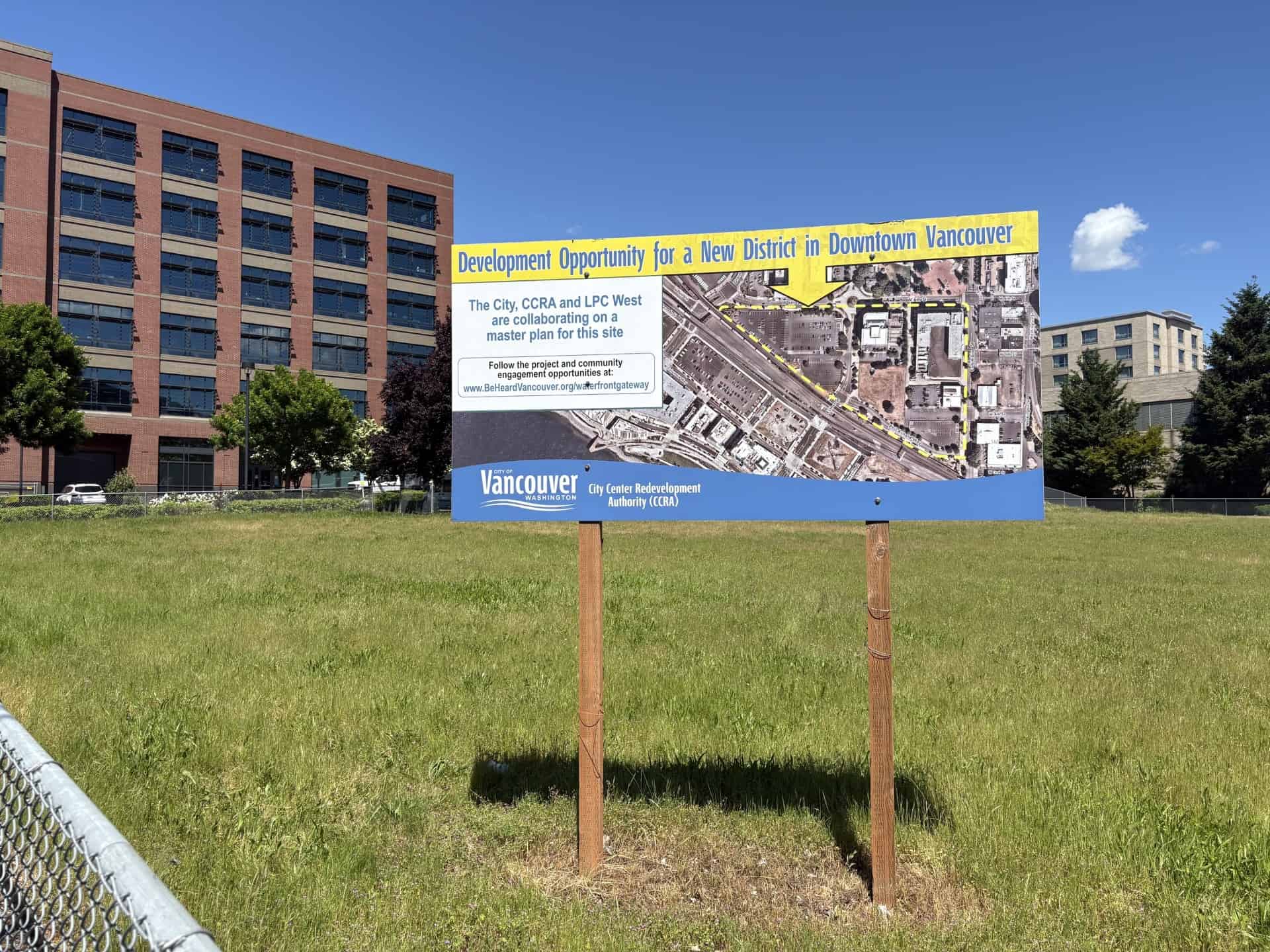
As a new development, NW Natural’s project will not displace natural gas burned for heat in buildings. Washington’s building code makes electric heat pumps the default heating choice for all new buildings in the state. However, on the coldest winter days, thermal energy networks can be nearly ten times as efficient as air-source heat pumps relying on backup resistance heat. Relying on a TEN for the new development allows the City of Vancouver to lessen the demand of new buildings on the region’s stressed grid, which in the near term also reduces emissions, since Washington’s electricity is not yet fossil-free.
Clark Public Utilities, the electric utility that serves the city of Vancouver, submitted a letter to the UTC championing the pilot because of its benefits to the grid.3
The city of Vancouver also enthusiastically endorses the project, stating in a letter of support that it would slash energy use by 36 percent compared with a conventional electric heating and cooling system.4
“Anything we can do to be a good partner and lower energy demand with new development is important for us,” Rebecca Small, the city’s Climate Action Lead and Senior Policy Analyst, told Sightline. Small also noted that the project would help the development meet Vancouver’s Green Building Policy, which will progressively raise energy and emissions standards for new buildings as the city works toward net-zero emissions by 2040.
…and make it possible for two WA colleges to slash climate-warming pollution
Cascade Natural Gas (Cascade) and Puget Sound Energy (PSE), by contrast, both propose retrofitting college campuses’ existing gas-fired district energy systems to rely on cleaner sources.
Neither of these projects meets the precise definition of a thermal energy network. Traditional district energy systems rely on a central plant to generate hot water, steam, or cold water that is then piped to multiple buildings. TENs, by contrast, circulate ambient-temperature water through a looped pipe. Instead of receiving heat from a central plant, buildings connected to a TEN use heat pumps to draw heat from or reject heat into the shared network. This distributed approach allows buildings to offset each other’s energy use (for example, a grocery store could provide heat to its neighbors in the winter), boosting the system’s efficiency. Plus, the networked design makes it possible to connect more homes and businesses over time.
Still, Cascade’s and PSE’s projects would create new opportunities for each campus to decarbonize, as well as provide more cooling.
Cascade’s pilot would connect two Bellingham Technical College buildings to a shared system of water-filled pipes. Like NW Natural’s project, the pilot would rely on groundwater to harness and store heat: in this case, water from the flooded tunnels of the former Bellingham Coal Mine, which operated beneath the campus from 1918 to 1955.
“It’s a giant man-made aquifer about 1,000 feet deep,” Patrick McKinney, Cascade’s Thermal Energy Network Manager, told Sightline.
Electric heat pumps in the buildings would connect to the system to provide heating and cooling. The project backers found that adapting Bellingham Technical College’s existing district energy system, with hot and cold pipes, would cost less than developing a new ambient-loop system.
Cascade estimates that the project will reduce how much natural gas Bellingham Technical College burns by 40 percent. Chad Stiteler, the college’s Vice President of administrative services, told Cascadia Daily News the project would reduce the college’s carbon footprint while giving students hands-on experience with its development.
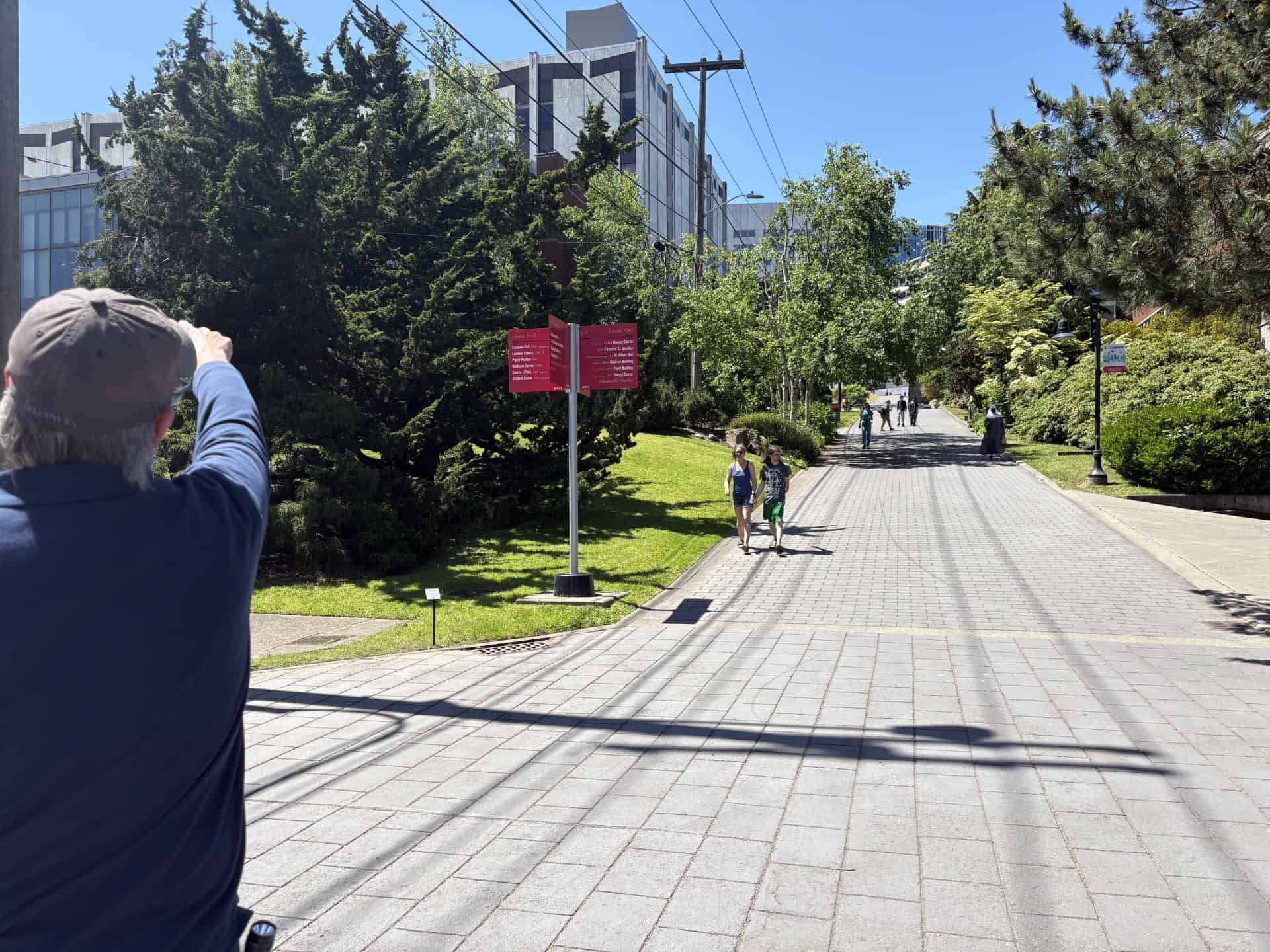
Similarly, PSE plans to partner with Seattle University to retrofit some of its gas-fired district energy system, heating a student residence and ten other campus buildings (and cooling four of them). The pilot would rely on a central air-source heat pump and allow the university to increase cooling by 30–40 percent, according to Elijah Nerger, Associate Director of Digital Services, who is overseeing the project for the school.
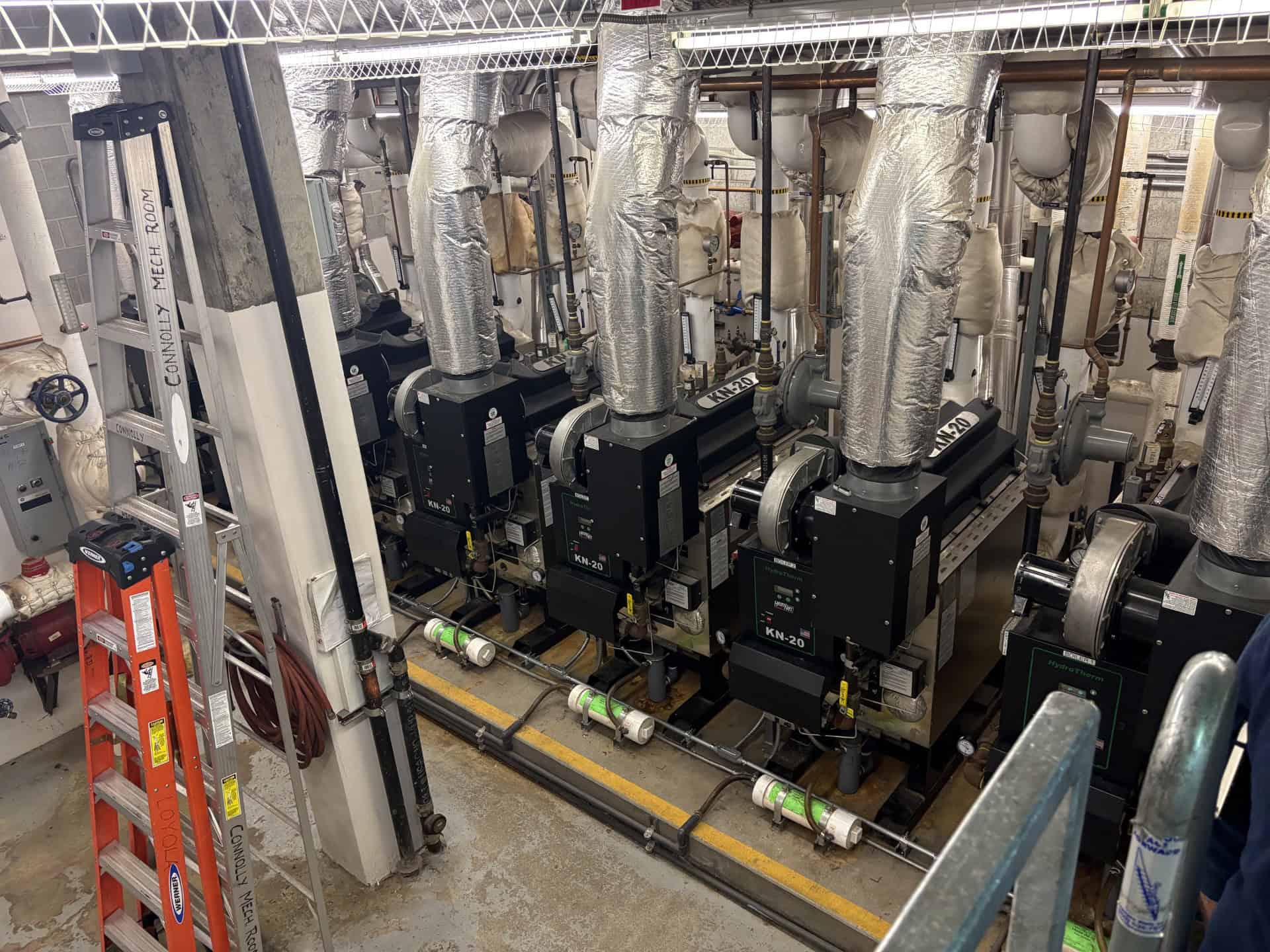
PSE expects Seattle University will burn 60 percent less natural gas because of the project. “We have a campus-wide goal to decarbonize,” Nerger told Sightline. The pilot creates a new opportunity, and one that, he said, makes it possible for the university to meet Seattle’s Building Emissions Performance Standard. The city requires nonresidential and multifamily buildings larger than 20,000 square feet to meet progressively declining emissions targets and reach net-zero emissions by 2050.
“We don’t know how to meet these targets,” Nerger told Sightline. “This thermal energy network project gets us closer, a lot better than what we would be otherwise.”
The projects’ future hinges on their cost
Both NW Natural and PSE are asking regulators to allow them to recover the cost of their TENs pilots from their broader base of gas customers in ongoing general rate cases, the proceedings in which utilities ask for permission to adjust rates. (Cascade’s rate case is also active as of July 2026, but its outcome will be decided after the deadline lawmakers have set for utilities to deploy the TENs pilots.) With the lower-than-expected grant funding from the state, the companies may abandon the projects if they cannot recover their cost in rates, utilities told Sightline.
“It’s a big regulatory question mark,” one of the utilities’ representatives told Sightline.
Together, the companies estimate the pilots’ upfront capital costs (before considering grants or tax credits) to be roughly $54 million: at least $18.5 million for PSE’s Seattle University project, $22 million for Cascade’s Bellingham Technical College project, and $13 million for NW Natural’s Vancouver project.
All three projects would require more upfront investment than maintaining or replacing gas infrastructure. But polluting as usual is not an option if Washington takes seriously its law requiring net zero emissions by 2050. Further, PSE estimates that its pilot would cost $44 million less than an electrification scenario in which Seattle University retrofitted its campus building with individual air-source heat pumps. NW Natural, by contrast, estimates the capital cost of its TEN pilot would exceed an electrification alternative by about $9 million, though the company fails to factor into this figure the TEN’s greater operational efficiency.
In comments to regulators, consumer advocates warned that the utilities relied on partial project designs rather than competitive bidding to estimate costs, leaving the final price tags uncertain. Washington’s Public Counsel noted that PSE stated “actual costs may be materially higher” and questioned whether the projects provide enough public benefit to justify the costs to ratepayers, especially with limited grant funding. A partial settlement agreement between NW Natural; UTC Staff; consumer advocate group, the Energy Project; and the Alliance of Western Energy Consumers would establish a working group to determine whether the utility should move forward with the thermal energy network.
Regulators are right to closely scrutinize the projects’ costs and ensure the utilities take advantage of all available tax credits and grants. The US federal government continues to offer an investment tax credit of up to 30 percent for geothermal projects. NW Natural hopes to receive a credit from Clark Public Utilities for the projects’ benefits to the grid; regulators could urge PSE to pursue a similar arrangement with Seattle City Light and Cascade with PSE (which provides electricity, but not gas, to Bellingham).
Even so, the project costs could be worth the broader benefits these pilots offer to Washington. Business as usual for both Cascade and PSE means continuing to furnish polluting natural gas to Bellingham Technical College and Seattle University. And all three projects could give the utilities skin in the climate game. Plus, it’s typical for project costs to drop after initial pilots, thanks to economies of scale and learning; Massachusetts utility Eversource expects Phase 2 of the United States’ first utility thermal energy network, in Framingham, to be significantly cheaper than Phase 1, though it hasn’t released precise figures.
Washington can do more to harness TENs’ potential
Even if regulators greenlight the pilots and the projects succeed, Washington may not see more thermal energy network proposals without further leadership from policymakers and regulators.
The primary barrier to thermal energy networks today is their high upfront cost. One way to catalyze more TENs in Washington would be to replenish the $25 million in grant funding that the legislature had planned to allocate to these projects back in 2024. Additional public subsidies to true-to-form TENs will allow Washington to understand how and if these systems fit into the state’s clean energy toolbox—and whether they can follow a learning curve (as with wind and solar) in which more deployment drives down costs. Lawmakers and regulators could set stricter criteria than they originally did for gas utilities to access this funding, including that the project 1) make it possible for gas utilities to decommission gas pipes or mitigate the need to replace them, 2) benefit low-income communities lacking cooling, and 3) rely on high-efficiency, distributed, ambient-loop systems.
Lawmakers could also make grants available to other entities beyond gas utilities, such as electric utilities and municipalities. In 2025, the city of Ann Arbor, Michigan, accepted $11 million in federal grants to develop a thermal energy network that will heat and cool 262 homes, an elementary school, and a community center.
Even absent further grant funding, Washington can do more to encourage TENs. In 2025, Washington allowed the UTC to authorize an electric company to discount electricity rates for the owner of a thermal energy network if it provides certain efficiency benefits. Lawmakers could build on this by directing electric utilities to compensate TENs owners for the systems’ benefits to the grid, formalizing the credit that NW Natural is seeking from Clark Public Utilities. This type of credit would compensate TENs owners for the systems’ value, driving down project costs and, ideally, eliminating the need for future public subsidies.
Meanwhile, regulators could task gas utilities with analyzing the potential for thermal energy networks as a “non-pipeline alternative” to spending ratepayer money on replacing gas pipes. Sightline estimates that Washington’s gas utilities plan to spend more than $700 million of their ratepayers’ dollars to replace gas pipes over the next several years.5 Massachusetts, the birthplace of utility TENs, again offers ideas. Since 2023, its regulators have required gas companies to show that they considered non-pipeline alternatives (which include TENs)—and found them to be either nonviable or cost-prohibitive—before they can recover costs of gas infrastructure investments.
Thermal energy networks hold tremendous promise for a clean energy transition in Washington that creates good jobs, helps people live more safely and comfortably, and reduces unnecessary electric transmission or generation infrastructure build-out. It’s up to the state’s leaders to make sure that their potential doesn’t peter out.
Thanks to Laura Feinstein and Ricardo Pelai for their research support and feedback on an earlier draft of this article.
Correction: A previous version of this article incorrectly stated that Clark Public Utilities has offered NW Natural a credit for its TEN. NW Natural is seeking a credit, but Clark Public Utilities has not yet confirmed it will issue one.
Related:
- Drill, Baby, Drill!—for Thermal Energy | How ground-source heat pumps and thermal energy networks can ease Cascadia’s grid crunch.
- Washingtonians Will Soon Enjoy Cleaner Heating and Cooling Options | HB 2131, to allow thermal energy networks, unanimously passed in the 2024 legislative session. It’s a win for consumers, the climate, pipeline workers, and electric grids.

