Portlanders are in the midst of learning a new ballot and sorting through a bounty of candidates in their first ranked choice voting election.
This election is a vital step in transitioning away from the previous outdated, ineffective, and unrepresentative city government.
By now, many Portlanders have received and opened their ballots to vote in this November’s election. For the first time, they see a grid ballot where they can choose up to six candidates in order, for both mayor and their city council district.
Many Portlanders are still learning how this new voting method works. The first time voting this way will take some adjustment, and residents might feel like they’re participating in a grand experiment. Maybe some Portlanders are overwhelmed by the abundance of choices (although one might add that it’s a bounty of highly qualified choices and that US democracy has been an experiment from the get-go). At the same time, voters might feel glad to know that they’ll have a backup choice if their first-choice candidate can’t win—particularly in the mayoral race, which has more than two top contenders who might have split votes under the former, non-ranked method.
Amid the sometimes frustrating nuts and bolts of learning a new ballot and strategizing about candidate rankings, it’s worth remembering: there’s a reason for all of this. Portland is switching into a higher gear, and just like on a bicycle, it takes some effort to make the shift.
In addition, the city’s elected officials have not reflected its population for the preponderance of the city’s history. Women and people of color are severely underrepresented historically.1 Most (80 percent) of Portland’s commissioners have lived in inner northeast Portland and west of the Willamette (in what are now Districts 2 and 4), neighborhoods that are whiter and wealthier, and that have more homeowners than the rest of the city. Just 23 percent of people polled in 2024 said there was someone on Portland City Council who represents them or their interests.2
Process matters in determining these outcomes: more than two-thirds of commissioner races, for example, were won with votes from less than 35 percent of registered voters, many times because the candidates prevailed in a low-turnout primary election.
All that history is part of why this election is such an important step in changing gears to move toward a solution—or multiple solutions—to remedy Portland’s ailments.
Future Hope
The unfamiliar ballots that Portlanders are currently encountering are a major component of the changes voters adopted (by a large margin) in 2022, and they will define both the legislative and executive branches of the new model of government.
The Charter Commission that proposed the changes carefully chose this method of running elections—multi-member districts with proportional ranked choice voting—after exploring a variety of other electoral options. Single-member districts wouldn’t guarantee any type of representation beyond geography, which doesn’t necessarily align with every issue important to city residents. And few other electoral methods can offer proportional representation for nonpartisan races (without giving a role to political parties). Plus, other US cities, not to mention other national governments, have tried out multi-winner ranked choice voting and achieved legislative bodies that better reflect their populations.
The longer ballots, though, do give voters more to parse. Portland is likely now experiencing the least satisfying phase of its transition, like the whirring and clicking that comes with shifting a bicycle into a higher gear before it settles into place. With the multitude of candidates running for all open seats, many voters feel the burden of researching candidates and sifting through positions and endorsements. It will get easier—future elections are unlikely to have this plenitude of candidates, and the ballots will be more familiar next time around. But the growing pains now are real.
Change is not only a set of new challenges, of course; it is also an opportunity. The opportunity to vote for someone you really, really like. To build a better conduit to city hall for all Portlanders. To make more effective progress on addressing homelessness and making housing more affordable.
More representative democracy does require voters to pedal a bit more vigorously, but it should result in a smoother ride, too. Namely, shifting the gears on Portland’s ballots will hopefully mean a functioning government that can address the needs of its constituents.
There’s no guarantee, of course, that anything will drastically improve, and nothing will happen overnight. It’ll take a few years of elections before we see the full electoral effects of the new model, and just as long for new policies to be enacted, implemented, and bear fruit. But there is now, at least, hope for a better path forward.
Author’s note: I first learned about ranked choice voting when I was living in Midcoast Maine in 2018. That initial glimpse into a different way of voting piqued my interest, and it’s how I became interested in researching election methods after I moved to the Pacific Northwest.
Takeaways
If Oregon adopts ranked choice voting in November, the closest analog for its election method will be that of Maine, the first state to use ranked choice voting statewide.
Maine now uses, and Oregon could adopt, ranked choice voting in partisan primaries as well as general elections.
Mainers like ranked choice voting. They voted to affirm its use not once but twice, and polls confirm continued voter enthusiasm.
Ranked choice voting ensures that the winning candidate has the broadest support, whether in the party primary or among the general electorate.
Ranked choice voting has reinforced Maine’s pattern of electing centrist, independent-thinking political leaders.
Even when it has not obviously changed an election’s winner, ranked choice voting has had subtle benefits in Maine, such as encouraging candidates to ally with each other and to reach out to each other’s supporters.
Find audio versions of Sightline articles on any of your favorite podcast platforms, including Spotify, YouTube, and Apple.
Ranked choice voting will be on the ballot in Oregon this fall. And because the proposed measure won’t alter Oregon’s partisan primaries, it is not the same as Alaska’s much-discussed electoral system, which combines ranked choice general elections with unified all-party, top-four primaries. It’s also unlike proposals before voters this fall in Colorado, Idaho, Montana, and Nevada, which emulate Alaska’s system.1
Instead, Maine, the first state to adopt ranked choice voting statewide, offers Oregonians the closest example of what the changes might look like in practice. Like Oregon, Maine has mostly closed partisan primaries and kept them after implementing ranked choice voting.
Cascadians, therefore, may want to know: How has ranked choice voting influenced elections in Maine?
In short, Maine’s groundbreaking use of ranked choice voting showcases similar advantages to what we’ve seen elsewhere, before and since the Pine Tree State’s journey with the voting method began. Ranked choice voting is popular and well-liked, especially after people use it. Candidates sometimes campaign together or reach out to each other’s supporters. And because elected leaders must earn majority support, they have strong incentives to seek votes beyond their party base.
Mainers express enthusiasm for ranked choice voting across multiple elections
Mainers like ranked choice voting. They voted to affirm its use not once but twice, and polls confirm continued voter enthusiasm.
Maine has used ranked choice voting statewide since 2018, and its largest city, Portland, has used it since 2011. The election of Paul LePage, Maine’s controversial former governor, was a major spur for reform. LePage served two terms but never won a majority of votes; in 2010, for example, he won with less than 38 percent of the vote.
After LePage, many Mainers wanted a system that would never again elect outlier officeholders supported only by pluralities of voters. Still, winning reform was not easy.
Voters in Maine adopted ranked choice voting in 2016 through a citizens’ petition and ballot measure. Ranked choice voting was set to start in the 2018 elections; however, in 2017, following inquiries from the Maine Senate, the state supreme court advised that ranked choice voting was unconstitutional in some general elections because the Maine constitution stipulates that state offices be won with a plurality (whoever receives the most votes).2 In response, the state legislature passed a bill to delay implementation of all uses of ranked choice voting until the constitution could be changed—a move many saw as repealing ranked choice voting in opposition to the people’s will.
Volunteers collected signatures for a “people’s veto” of the legislature’s delay. With the law on hold until the veto measure was voted on, the courts directed the secretary of state to move forward in implementing ranked choice voting in the June 2018 primaries. In the same June election where they used ranked choice voting for the first time, Maine voters again voiced their support at the ballot for the voting method, passing the veto measure.
Further controversy followed Maine’s use of ranked choice voting in the 2018 general election (more on this below) and again when the Maine Republican Party sought to reduce the use of the voting method after the state legislature expanded it to apply to presidential contests. But ranked choice voting remains in action.
Because the constitutional quirk that requires plurality general election winners applies to state offices, Maine uses ranked choice voting in only the partisan primaries for governor, state senator, and state representative, and in both primaries and general elections for US senator, US representative, and now US president.
Ranked ballots offer small but mighty improvements for voters
Election reform has not dramatically shifted Maine’s politics. Maine’s election administrators have only had to look at second- and third-place rankings in a handful of races since implementing ranked choice voting; as in elections prior to the use of ranked choice voting, many elections in Maine are not highly competitive or only have two candidates. In more than three-quarters of the races with more than two candidates, the winning candidates received more than half of first-choice votes and officials did not need to examine the rankings in further rounds of counting.3 Yet the voting method continues to play an important role in the state—including setting the tone even when results weren’t closely contested.
Maine’s first test of ranked choice voting showcases a positive campaign
Even when it has not obviously changed an election’s winner, ranked choice voting has had subtle benefits in Maine, such as encouraging candidates to ally with each other and to reach out to each other’s supporters. This facet of the voting method was apparent from the get-go.
The state’s first use of ranked choice voting came in the 2018 primary, where the parties used it to determine their nominees. Maine’s secretary of state had to tabulate the ranked ballots in just two races: the Democratic primary for the Second Congressional District and the Democratic primary for governor.4
In the US House primary, Democrat Jared Golden took a strong initial lead of first-choice votes among the pool of four candidates and then received more vote transfers than his main rival, Lucas St. Clair, from the two less-popular contenders. Final results indicated support from 54.3 percent of Democratic voters, showing Golden to have a solid backing from his party.
In the gubernatorial nomination, four rounds of ranking thinned the field from seven candidates down to just Janet Mills. She led the vote totals in every round and eventually won with 54.1 percent of Democratic votes.
Ranked choice voting didn’t necessarily shift the outcome of either of these elections (although we’ll never fully know; voters might have behaved differently with different ballots): the initial plurality leader was also the final winner. The method did clearly affect other aspects of the campaign, though.
One form of influence was on campaign civility and outreach to voters. Two candidates for governor, Betsy Sweet and Mark Eves, recognized their shared values and cross-endorsed each other. After the campaign, Sweet (who finished third, thanks in part to transfers from most of Eves’s supporters) wrote about how she was never labeled a spoiler candidate or discounted by voters. She noted how all candidates “talked to as many people as we could, even voters whom we knew liked another candidate better.” Sweet and Eves later jointly highlighted how ranked choice voting increased voter engagement and encouraged candidates to focus on issues. St. Clair, Golden’s primary competitor, similarly explained that “[with ranked choice voting] I could run on the issues that mattered most to me and help create a more robust public debate around the issues I cared about.”
Gubernatorial winner Mills agreed that the voting method changed campaigning dynamics, saying that “everybody’s campaign was better than it would have been without ranked choice voting. The people voted on this several times for good reasons. They expected and intended that the level of civility would rise with this tabulation [process], and I think it did so.”
Ranked choice voting also ensures that winners have a strong base of support to continue into the general election campaign and then to govern. Mills’s closest competitor Adam Cote observed how the vote transfers solidified support for Mills: “Janet Mills won this race. She was strong everywhere across the state, as her vote totals show.”
Voters seemed to appreciate that the rankings offered more choices. One voter saw, for example, how the voting method opened up possibilities to choose Sweet first and Mills as a backup, and felt more excited about the available choices.
Administratively, the secretary of state’s office did not experience any of the feared implementation chaos spouted by opponents of the change. Secretary of State Matthew Dunlap expressed that “everything came together very nicely, but through a lot of hard work. We’re very pleased that this went so smoothly.”
Pushback arises in the first general election
Ranked choice voting is designed to consolidate support behind the candidate with the broadest support, including by counting second-choice votes. But the major-party candidate who didn’t win in Maine’s first election where second-choice votes played a pivotal role blamed the voting method.
In the 2018 general election, 16 of the 17 races with more than two candidates were not closely competitive, and the winner received a majority of first-choice votes. One contest, though, required the secretary of state to dive into the details of voters’ rankings: the race for the Second Congressional District. Golden (who had made it through the ranked choice Democratic primary earlier in the year) faced then-sitting US Representative Bruce Poliquin (Republican) and two unaffiliated candidates, Tiffany Bond and Will Hoar.
When the vote totals came in, Poliquin had 2,171 more first-choice votes than Golden (46.3 percent of the vote to Golden’s 45.6 percent). Bond received 5.7 percent of first-choice votes, and Hoar another 2.4 percent.
After election officials transferred first-choice votes for Bond and Hoar to their voters’ second or third choices, Golden won with 50.6 percent.5 Maine allows batch elimination of candidates who cannot gain enough votes to win in later rounds.
Join the 15,000+ readers who get Sightline Institute’s latest research.
Get our latest research and news summaries straight to your inbox.
Almost finished! We need to confirm your email address. To complete the subscription process, please click the link in the email we just sent you.
←
Almost finished! We need to confirm your email address. To complete the subscription process, please click the link in the email we just sent you. In the meantime, here are other newsletters you may be interested in:
This “come-from-behind” victory is an intentional feature of ranked choice voting. The method is designed to consolidate support behind a majority winner based on voters’ backup choices. In this case, Golden received about two-thirds of the votes that transferred from Bond and Hoar. Like independent candidates in other elections, Bond expressed appreciation for ranked choice voting, saying that running as a third candidate is “no harm, no foul” because ranked choice voting “frees people up to make more interesting choices, to try something different.”
Unfortunately, Poliquin didn’t recognize that those voters wanted to have a voice in the final election outcome, and he initiated a lawsuit challenging the use of the method. A federal judge denied Poliquin’s request for an injunction in December, and he later dropped the suit. The outcome in the Second Congressional District, however, solidified the Maine Republican Party’s opposition to the method, and the party has continued to attempt to roll back use of ranked choice voting.
That first year of ranked choice voting created the largest splash. In later elections, ranked choice voting upheld or confirmed support for initial winners. Maine still encountered some of the broader challenges US elections face today, and voters continued to elect centrist, independent, leaders as they had in the past.
In 2020 nine races in the primaries and 10 in the general had more than two candidates and offered ranked ballots.6 In most of those elections, the winner earned a majority of first-choice votes. In the six races (all in the primaries) where election administrators needed to count second and subsequent rankings to determine a majority winner, the candidate who won the most first-choice votes won the final round as well; ranked choice voting simply consolidated support for the initial leader. Similar statistics follow for 2022: the secretary of state transferred second-choice votes in two of the nine elections with more than two candidates, and both resulted in the plurality winner winning a majority.7
Many news outlets and commentators expected the rankings to be tabulated in the 2020 US Senate race, which was hotly contested as it could have determined party control of the US Senate. Incumbent Republican Susan Collins faced Democrat Sara Gideon and two independents, Max Linn and Lisa Savage. But Collins won with 50.4 percent of first-choice votes and won the seat in the first round.
Ranked choice voting still played a role in how the contest played out, such as how independent candidate Savage encouraged her supporters to rank Gideon second, wanting to consolidate support behind a more mainstream candidate with similar views if she couldn’t win. But ranked choice voting cannot solve all the problems with American elections; it’s no cure-all. With so much national attention on the race, media outlets largely presented the race as a contest between the Democrat and the Republican, stifling how voters might have viewed their options. Outside money poured in, paying for negative ads that barraged Mainers, unlike in many ranked choice races. The influx of cash may in some ways have hurt Democratic challenger Sara Gideon in the same way that polarizing candidates were punished in Alaska’s first ranked choice election: Democrats focused their energy on national implications, whereas Susan Collins emphasized local issues more important to the Mainers voting.
Senator Collins also has a reputation as a moderate, bipartisan lawmaker—the type of candidate that Mainers have continued to elect over the years and that ranked choice voting often bolsters. Later analysis showed that many otherwise Democratic voters split their tickets to vote for Collins, appreciating her local issue-based messages and history of working across the aisle.
A similar scenario had happened in Maine’s 2018 Senate race, where voters also received a ranked ballot but administrators didn’t need to look into second- and third-choice votes to determine a majority winner. In that election, Independent incumbent Angus King earned 53.3 percent of first-choice votes against competitors Republican Eric Brakey and Democrat Zak Ringelstein and won the seat.
Both Senators exemplify Maine’s long history of centrist, independent political leaders, a tradition that continued with the revised ballots. Indeed, ranked choice voting supports more of these types of candidates: Golden, the Democrat who won his first election only after second-choice votes were counted, is also a centrist candidate who garnered votes from ticket-splitting Republicans to win his next election—in the same district where the majority of voters chose Donald Trump for president.8
And while ranked choice voting may not have visibly changed the outcome of those elections (although again, it may have affected voters in some unobvious way), it may influence how the leaders govern. Along with Senators Mitt Romney and Lisa Murkowski, Senator Collins was one of three Republicans to vote with Democrats to confirm Judge Ketanji Brown Jackson on the Supreme Court. Collins does not have the protection of an all-party top-four primary (followed by a ranked choice voting general election) that Murkowski does in Alaska, but she is safe from a far-right Republican challenger who might otherwise win with a plurality of party votes in a Republican-only primary.
Maine’s lesson for Oregon? A modest but important upgrade
Maine’s experience with ranked choice voting demonstrates the modest benefits the voting method offers. Winners needed second- and third-place rankings to reach a majority in only 11 contests, and just one winning candidate had fewer first-choice votes than his competitors, so it hasn’t completely upended the state’s politics. Mainers continue to elect centrist, independent leaders, and ranked choice voting offers even more freedom for voters to choose preferred people over parties.
Even when first-choice rankings alone have decided the winner, the introduction of ranked ballots in Maine has created important assurances for voters. Ranked choice voting ensures that the winning candidate really was desired by more voters—in contrast to past elections like that of Paul LePage.9 Voters have seen how some candidates partner together and how parties can fully align around a preferred nominee.
After confirming their desire to use ranked choice voting in two different elections, Mainers have continued to express enthusiasm for the voting method. Polling in 2018 found strong support for expanding ranked choice voting and a large majority of voters who found it easy to use. In 2022 an overwhelming 82 percent of Second Congressional District voters reported finding it “easy” or “very easy.” Most Mainers take advantage of the rankings when offered.
Future elections will use ranked choices, including the 2024 presidential race, where votes for third-party candidates may well influence the distribution of Maine’s electoral votes, particularly since Maine is one of two states to split electoral votes.10
As ranked choice voting continues in Maine, Oregon and other states may well look to the northern corner of the country on the other coast for guidance in how this electoral method can upgrade elections.
Ranked choice voting could deliver a bevy of benefits for Oregon voters, including empowering voters to vote for their true favorites and helping winners truly have majority support—not just plurality support, like Christine Drazan had when she won the 2022 Republican primary for governor with just 23 percent of the vote.
It also helps avoid “spoiler candidates” from splitting the vote against the majority’s truly preferred top candidate, as happened in Oregon’s 1990 election for Governor. Independent Al Mobley sheared off 13 percent of the vote, likely from voters who otherwise would have supported Republican Dave Frohnmayer, leading to the election of Democrat Barbara Roberts with the support of only 46 percent of voters.
Oregonians deserve to vote for their true favorite and to have elected officials who have earned the support of a true majority of the state’s residents. Ranked choice voting helps get them there in a big way.
Find audio versions of Sightline articles on any of your favorite podcast platforms, including Spotify, YouTube, and Apple.
Author’s note: In early 2023, I wrote about Oregon House Bill 2004, which let voters decide whether to adopt ranked choice voting in statewide elections, including those for president, US House and Senate, and governor. If adopted, it would also give cities, school districts, and other local entities in Oregon guidelines to adopt ranked choice voting in their elections.
The legislature passed the bill in June 2023, putting it to voters to approve or reject this fall as Measure 117. Today, by way of offering an explainer on what a switch to ranked choice voting looks like for Oregon voters, I’m re-sharing my 2023 research on the substance of that bill, including four ways evidence shows ranked choice voting gives voters more voice and more choices in elections. I’ve made a few minor updates to reflect the measure on the ballot in Oregon this November.
How ranked choice voting works
Ranked choice voting would make some key changes to Oregon’s current pick-one voting system, particularly in contests where voters have more than two candidates to choose from (as they do in almost every state election).
Using ranked choice voting, Oregon voters would no longer be limited to selecting a single candidate (though they could choose just one if they wanted to). Instead, voters would be free to rank candidates in order of preference.1
If no candidate receives more than 50 percent of first preferences, ballots go to further rounds of counting where last-place candidates are eliminated and their voters’ later choices are considered, continuing until one candidate has over 50 percent of the vote among the remaining candidates.
Here are four reasons voters tend to like the option to rank candidates on their ballots:
1. Winners earn stronger bases of support
Pick-one elections often work fine for elections with just two candidates in the running: voters select their favorite, and the person with more votes wins. But things get tricky when voters have three or more candidates to choose from.2
Maybe only 40 percent of voters cast their ballots for the winner, while two contending candidates each receive 30 percent—so the winner has less than majority support. Or maybe there are ten candidates, and the winner comes out with support from only 15 or 20 percent of voters—quite the minority! When the top candidate has a plurality (the most votes) but not a majority (more than half of the votes), more voters voted against the winner than for them.
Of Oregon’s seven gubernatorial elections since 2000, four saw the winning candidate finish with less than 50 percent of the vote.
This situation happens all the time in Oregon. Of the seven gubernatorial elections since 2000, four saw the winning candidate finish with less than 50 percent of the vote.3 In 2022, with high-profile nonpartisan candidate Betsy Johnson drawing nine percent of the vote, Tina Kotek won the race for Governor with only 47 percent of voters supporting her.
It’s even worse in primary elections. Oregon’s Republican primaries for governor since 2000 usually saw nine or ten candidates,4 and in only one of those races did a winner receive a majority of the vote.5 2022 was a particularly extreme example of this, with 19 candidates running; Christine Drazan came out on top but garnered only 23 percent of the vote. But say those other 77 percent of voters really didn’t like Drazan, and voters would have jointly preferred another candidate even if their first choice lost. Those 18 other candidates split the anti-Drazan vote, and the Drazan supporters, a small minority overall, got to pick their favorite, overriding the majority.6
Ranked choice voting would help that majority coalesce around a single candidate, mitigating vote splitting among multiple similar options. Since Drazan wouldn’t be immediately elected in the first round of counting, later rounds might show that a stronger candidate had the support of more voters. Or they could show that other voters did support Drazan, giving her a clearer base of support heading into the general election.
By counting voters’ later choices once their first choice has been eliminated, ranked choice voting helps identify stronger candidates that are supported by more voters. That means stronger party nominees, happier voters, and officeholders that know they’ve appealed to Oregonians.
2. Minor-party candidates don’t invert results
Pick-one voting is also heavily vulnerable to spoiler candidates, a specific type of vote splitting where a minor candidate siphons enough votes away from the leading major candidate closest to their platform that the major candidate loses the election. This happened quite famously in the 2000 presidential election in Florida when Green Party candidate Ralph Nader, whose voters generally preferred Democrat Al Gore over Republican George W. Bush, received nearly 100,000 votes and Bush beat Gore by just over 500 votes.
Join the 15,000+ readers who get Sightline Institute’s latest research.
Get our latest research and news summaries straight to your inbox.
Almost finished! We need to confirm your email address. To complete the subscription process, please click the link in the email we just sent you.
←
Almost finished! We need to confirm your email address. To complete the subscription process, please click the link in the email we just sent you. In the meantime, here are other newsletters you may be interested in:
Oregonians deserve the ability to vote for candidates who share their values and represent their communities, but the state’s current election system too often discourages voters from doing that. Almost every election comes with a discussion of voting for somebody who’s “more electable,” being sure not to “waste your vote,” or even “a vote for Candidate X is a vote for Candidate Y.” Voters are wary of voting for a less popular candidate they might prefer, worrying that doing so may just help their least favorite major-party candidate win.
But just like vote splitting more generally, ranked choice voting helps deal with spoiler candidates sensibly. The minor candidates are eliminated in early rounds because they received the fewest votes, and their voters’ later choices are counted to see which remaining candidate is preferred by a majority of voters. A minor candidate with only a few points of the vote won’t throw the election to a different major candidate.
3. Voters can choose their honest favorite
Due to a (very sensible) fear of slim plurality winners and spoiler candidates, the pick-one system incentivizes many voters to cast their ballots strategically, picking a candidate they see as electable rather than the candidate they like the most—somebody they think can win, not somebody they think should win. And campaigns take full advantage of this, spending chunks of their time and money on arguments about feasibility instead of making the substantive case for their candidate. I can’t even count the number of pro-Tina Kotek ads I saw in the fall of 2022 that said “I like Betsy Johnson, but she can’t win” or “a vote for Betsy Johnson is a vote for Christine Drazan.”7
Ranked choice voting changes this dynamic entirely. Since their second choice will count if their first choice is eliminated, voters can support a less popular candidate without “taking votes away” from a more popular candidate. Maybe the first round of that Florida election looks the same, with Nader receiving two percent of the vote, but the second round of counting, when Nader voters’ second-choice votes are tallied, puts Gore over the top. Or you can honestly vote for Betsy Johnson first and still know that if she loses in the first round, your vote will count for Tina Kotek in later rounds.
4. More representative candidates can run and win
Thanks in large part to vote splitting, voters and candidates in a pick-one system know they must act strategically, angling to end up with a least-bad outcome. Voters often judge women as “less electable” than men, pushing women candidates more often into the trap of feasibility and strategic voting. And candidates often must decide even before entering a race whether their presence would lead to vote splitting and help elect a minority-preferred contender. This frequently applies to less established third-party candidates, women, and people of color. In Chicago’s 2023 mayoral election, the chair of the City Council’s Black Caucus publicly called for some candidates to drop out to avoid splitting the vote among Black candidates.
When communities can better coalesce around their preferred candidates under ranked choice voting, those candidates can worry less about electability or vote splitting. That likely means opportunities for more women, people of color, and minor candidates to run and earn votes with lower likelihood of throwing the election to a less-preferred winner. One study found that in the Bay Area, women were more likely to win elections in ranked choice cities than in cities that had not adopted ranked choice voting.
In 2006, San Francisco used ranked choice voting to elect a new Supervisor from the majority-Asian District 4, and four Asian candidates ran against two white candidates. While no candidate had more than about a quarter of the vote in the first round of counting, large numbers of second- and third-preference votes from supporters of other Asian candidates in the race helped put Ed Jew over 50 percent in the final round. Even if votes were split among those Asian candidates in round one, ranked choice voting helped those voters to join forces with their second- and third-choice votes behind a candidate of their choice, even with multiple candidates running.
What Oregonians can expect with ranked choice voting
Ranked choice voting would help to mitigate the current pick-one system’s high potential for vote splitting without placing heavy limitation on voter choice and candidate entry. Candidates win by running campaigns more focused on the issues, dodging negative rhetoric and arguments about electability. With ranked choice voting, Oregonians can expect winners who’ve received votes from a majority of voters, a greater range of choices on their ballot, and officeholders more likely to represent their preferences.
Thanks to former Research Assistant Nakeshia Diop for contributing research to this article.
Oregon’s largest gas utility, NW Natural, has started injecting hydrogen into its natural gas distribution lines without informing customers or regulators.
Hydrogen is risky for consumers and a distraction from more effective and cost-efficient decarbonization approaches, especially electrification.
But Oregon, like most jurisdictions in Cascadia, lacks any laws to protect customers from hydrogen blending projects. Cascadian policymakers would be smart to act quickly and fill the gaps.
Find audio versions of Sightline articles on any of your favorite podcast platforms, including Spotify, YouTube, and Apple.
Update: Governor Kotek signed into law SB 685 on June 16, 2025, introducing public transparency, utility accountability, and public safety protections for hydrogen blending for Oregonians. The new law sets a 2.5 percent hydrogen blending threshold to trigger public notice but still allows gas utilities to blend in hydrogen in secret at volumes lower than 2.5 percent until June 30, 2030, when public notice must be issued for any volume of hydrogen blending.
Customers in southeast Portland recently found out that hydrogen may be sneaking its way into their homes. NW Natural, Oregon’s largest gas utility, has started injecting hydrogen, blended with so-called “natural gas,” into its distribution lines without informing customers or regulators.1
Hydrogen is a bad bet for decarbonizing homes pretty much any way you look at it. It’s far more expensive than electrification, can’t achieve nearly the same climate impact, and can be dangerous, as Sightline has written about extensively. Plus, since carbon-free green hydrogen is in short supply and is electricity-intensive to produce, policymakers would be smart to save it for the hardest-to-decarbonize sectors, like heavy industry.
But gas utilities across Cascadia are pushing hydrogen for use in homes and businesses, and lawmakers and regulators have yet to catch up. Oregon, home to Cascadia’s first hydrogen-blending pilot, has no laws to protect consumers and communities from ineffective, unsafe, and inefficient use of the fuel.
And Oregon is not alone in the region; Alaska, Idaho, and Montana all lack legal oversight of hydrogen blending, although no projects of this type are yet underway in these states. (British Columbia statute permits gas utilities to replace some of its natural gas with hydrogen, subject to price and quantity caps.) Washington State is the only jurisdiction in Cascadia with some safeguards for consumers, communities, and the electric grid around utilities’ use of hydrogen. Policymakers in Oregon and Cascadia writ large can build from Washington’s policy to protect customers and ensure that gas utilities aren’t throwing good money after bad.
Cascadia’s first hydrogen blending project is underway
In December 2023, NW Natural started delivering hydrogen to homes and businesses in the Portland area without formal notice to regulators or customers.
Cascadia’s gas utilities have promoted so-called green hydrogen, made from renewable electricity-powered electrolyzers that split water into hydrogen and oxygen. (See Sightline’s primer on the different types of hydrogen.) But NW Natural isn’t even piloting green hydrogen; it is blending turquoise hydrogen into its system, which it produces at its Central Portland facility. To create turquoise hydrogen, natural gas is heated to high temperatures and converted to hydrogen and solid carbon—a process known as pyrolysis. Climate-warming pollution is emitted throughout the process: methane leaks during fracking and delivery, and fossil fuels may be burned to generate heat for pyrolysis.
Even if NW Natural were using green hydrogen, its pilot would skim less than 0.07 percent of carbon emissions from NW Natural’s gas system
Even if NW Natural were using green hydrogen, its pilot would skim less than 0.07 percent of carbon emissions from NW Natural’s gas system.3 And if NW Natural scales its hydrogen operations to displace 20 percent of its gas blend (a hundredfold increase from the pilot and the maximum possible blend amount in existing pipelines), it would still reduce its carbon emissions by at most 7 percent.
Oregon lawmakers can safeguard communities and the climate from hydrogen’s risks
In 2022 Washington became the first place in Cascadia to require that a gas company show, in advance of hydrogen blending, that it has hydrogen-specific safety standards, that hydrogen production will not adversely impact the electric grid’s reliability, and that hydrogen production is consistent with the utility’s integrated resource plan. No gas company in the state has yet put the law to the test.
The rest of the region, however, lacks regulatory safeguards for hydrogen blending projects by gas utilities. Lawmakers in Oregon, home to Cascadia’s first hydrogen blending pilot, would be especially smart to act quickly to close the gap in state law.
At a minimum, policymakers could require utilities to give regulators and customers advance notice of the intent to replace natural gas with hydrogen. Even better, though, would be for lawmakers to require utilities to include the following five components in a notice to regulators. (Washington law already includes the first three components, but lawmakers could strengthen state statute by requiring utilities to conduct life-cycle emissions analyses of hydrogen blending and compare hydrogen blending to electrification alternatives.)
1. Robust hydrogen-specific standards.
Hydrogen behaves differently in pipelines than natural gas. The molecule is smaller, lighter, and more flammable. Natural gas appliances and pipelines weren’t designed with hydrogen in mind.
Utilities should demonstrate that they have standards and specifications for producing and transporting hydrogen blends as well as for metering, leak detection, emergency response protocols, and compatibility with customer-owned equipment and piping.
2. Assessment of impact on the electric grid.
Green hydrogen has been the most prominently discussed hydrogen manufacturing method for decarbonization. But green hydrogen takes a tremendous amount of renewable electricity to produce. For many purposes such as home heating, hydrogen is a woefully inefficient alternative to direct electrification. The Northwest already faces a formidable challenge to installing enough renewable electricity and bolstering its electric grid to meet rising electricity demand. Diverting renewable resources to produce green hydrogen, if done without careful integration, could destabilize the grid and set back decarbonization progress in other sectors, such as transportation and buildings.
Join the 15,000+ readers who get Sightline Institute’s latest research.
Get our latest research and news summaries straight to your inbox.
Almost finished! We need to confirm your email address. To complete the subscription process, please click the link in the email we just sent you.
←
Almost finished! We need to confirm your email address. To complete the subscription process, please click the link in the email we just sent you. In the meantime, here are other newsletters you may be interested in:
Gas utilities should provide a full assessment of the impacts to the electric grid from the manufacture of hydrogen. This assessment would demonstrate that hydrogen production is not detracting from resource adequacy in the region.
3. Consistency with an acknowledged resource plan.
Every two years, gas utilities must file an IRP with regulators that analyzes future supply and demand across a range of plausible scenarios. These plans evaluate the costs of various approaches to meeting future resource needs and set the stage for future resource acquisitions. Utilities should show that hydrogen projects are consistent with utility resource plans that regulators have already acknowledged.4
4. Consistency with state decarbonization goals.
Hydrogen can be made in myriad ways, and not all are low carbon. With NW Natural already manufacturing turquoise hydrogen from natural gas through methane pyrolysis, Oregon lawmakers should ask utilities for a full life-cycle emissions accounting of their hydrogen proposals to show alignment with state emissions reduction targets.
5. Cost-effectiveness relative to other decarbonization approaches.
Utilities should provide an analysis of the carbon reduction benefits of injecting hydrogen blends into pipelines compared to alternatives such as electrification. Hydrogen is much less effective at decarbonizing buildings than electricity. Only small volumes of hydrogen (perhaps up to a ratio of 20 percent hydrogen to 80 percent natural gas) can safely be injected into existing gas pipelines. But a 20 percent blend of hydrogen shaves off only around 7 percent of the combustion emissions of a system running on 100 percent natural gas.
Gas utilities are diverging from state climate goals; hydrogen is part of the reason
Alternative fuels such as hydrogen distract utilities from more impactful decarbonization approaches, most importantly electrification. In the years since NW Natural started touting its alternative fuels strategy, the utility has put little effort into examining electrification as anything but a threat, even though alternative business models such as thermal energy networks could make electrification profitable for the utility.
NW Natural did not model electrification as a way to comply with Oregon’s landmark Climate Protection Program (CPP). Likewise, in its 2022 IRP, the utility did not analyze stand-alone electrification—only hybrid electric heat pumps with natural gas furnaces, which would lock in customer dependence on the gas pipeline system. And only after stakeholders balked at the omission of electrification from utilities’ decarbonization strategies within the PUC-led natural gas fact-finding workshops did NW Natural make a halfhearted effort to model electrification. Even so, the utility omitted key analyses, including a comparison of consumer costs for electrification versus decarbonization with hydrogen and other alternative fuels.5
But alternative fuels aren’t delivering results commensurate with Oregon’s decarbonization goals. By the end of 2023, NW Natural had replaced less than 1 percent of its delivered natural gas with alternative fuel sources (specifically biomethane). Its 2024 hydrogen pilot won’t move the needle on this statistic. And the utility’s greenhouse gas emissions have trended upward since 2010, as the figure below shows.
As NW Natural doubles down on alternative fuels with its hydrogen pilot, it is continuing on the same pathway that has thus far borne lackluster results, amplifying the need for additional oversight.
Regulators are already questioning the viability of alternative fuels such as hydrogen to meet the state’s decarbonization goals. Empowering the PUC to examine hydrogen holistically before utilities invest in and inject it into the pipeline will protect ratepayers and communities from ill-considered pursuits.
Hydrogen oversight is needed before gas consumers pay the price
Utilities are experimenting with hydrogen blending as a residential decarbonization strategy. But regulation and oversight of the use of the gas lags and is sorely needed to ensure that efforts to use the gas achieve broader societal goals. Washington recognized the need for some regulatory oversight of hydrogen blending and production when it passed its 2022 law. But Oregon, where NW Natural is already piloting the fuel in people’s homes, has not established any guardrails on hydrogen blending. Oregon lawmakers can catch up and install boundaries to protect consumers and communities from ineffective, unsafe, and inefficient use of this alternative fuel.
The Northwest needs a lot more electric transmission capacity to meet rising power demand without burning coal or gas. But building new transmission lines can take decades and cost billions.
Reconductoring—upgrading the wires on transmission lines—is an underdeployed solution that can save money and time while boosting capacity.
In the Northwest, up to 23,000 miles of transmission lines (about 40 percent of the region’s grid) could be suitable for reconductoring.
To get more of these no-brainer wire upgrade projects off the ground, policymakers can require utilities to evaluate them, fast-track permitting, and introduce performance incentives.
Find audio versions of Sightline articles on any of your favorite podcast platforms, including Spotify, YouTube, and Apple.
The lights could soon dim on the Northwest’s climate goals unless the electric grid gets some serious TLC.
The region, like the United States as a whole, needs more electric transmission capacity to reach the best wind and solar resources and meet rising power demand without burning coal or gas. But building new transmission lines can take decades and cost billions. Luckily there are no-brainer ways to squeeze more juice out of the existing electric grid.
Among the options, reconductoring—swapping out the wires on transmission lines for higher capacity ones—holds particular promise for its relative speed to deployment, capacity potential, and cost.1
In the Northwest, up to 23,000 miles of transmission lines (about 40 percent of the region’s electric grid) could be suitable for reconductoring.2 To get more wire upgrade projects off the ground, policymakers can improve utility planning processes, fast-track permitting, and introduce performance incentives. With most of the region’s grid strung up with wires invented more than 100 years ago, a grid glow-up is long overdue.
Reconductoring can double transmission lines’ capacity for less than half the cost of building new lines
Why should people who care about climate change pay attention to wires? Here’s a quick primer: In sum, the type of wire—conductor—on a transmission line affects how much power it can carry, how much electricity it wastes, and how much it sags. (Sagging lines can spark wildfires.) Swapping out old wires with the latest and greatest technology is far cheaper, faster, and easier than building whole new transmission lines.
For more than 100 years, transmission owners have strung up the same type of wire. Aluminum conductor steel reinforced (ACSR), as it is known, remains the default conductor for most transmission projects in the United States.
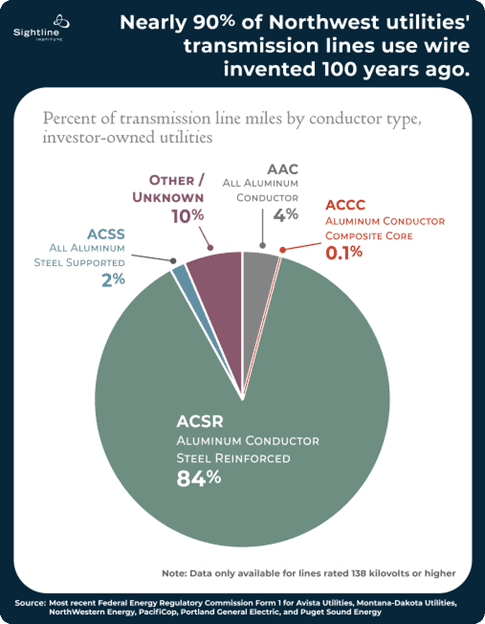
In the Northwest, nearly all investor-owned utilities’ transmission lines are outfitted with ACSR, as Figure 1 shows. (Bonneville Power Administration [BPA], which owns and operates most of the region’s high-voltage transmission system, does not provide detailed data about conductor type. However, the vast majority of its lines use ACSR, according to a BPA representative.)
Figure 1.
In the 1970s, the industry introduced a new type of conductor known as aluminum conductor steel supported (ACSS). ACSS conductors nearly double the capacity of their ACSR counterparts, but they come with a big downside: excessive sagging at high temperatures. Sag is a particular concern in wildfire-prone areas like the Northwest. Reconductoring with ACSS conductors can require raising structures or placing more towers closer together to meet minimum clearance standards, which increases project costs.
In the 2000s, newer, more advanced conductors entered the market, which traded out the traditional steel core for a smaller composite of glass, ceramic, or carbon fibers. This new lighter core allowed more aluminum (which conducts electricity) to fit on a wire of equal diameter, making it possible to operate the line at a higher temperature. Higher operating temperatures increase a line’s thermal limit—one of three possible limits to transmission lines’ capacity.
The most promising and widely deployed composite-core conductor is known as aluminum conductor composite core (ACCC®). (ACSS trapezoidal wire [ACSS/TW], a more advanced ACSS model, was also introduced in the 2000s.)
Here’s an analogy to explain this that will make sense to anyone born before the 2000s, at least: If ACSR conductors are dial-up internet, ACCC® conductors are 5G. ACCC® conductors double the capacity of ACSR models. They don’t sag at high temperatures, and they’re the most efficient conductors on the market, meaning less electricity is lost when zapped from point A to point B.
The main downside of ACCC® conductors is cost; they can be twice or three times as expensive as ACSR wires. (Table 1 below compares key attributes of ACSR, ACSS, ACSS/TW, and ACCC® conductors.)
However, the cost of reconductoring, even with advanced conductors such as ACCC®, is still less than half that of building new lines with traditional, cheaper ACSR conductors. That’s because the cost of conductors makes up a small portion of the overall cost of building a transmission line. Most of the bill comes from erecting towers and acquiring new rights-of-way, neither of which is necessary when simply replacing wires. Reconductoring with composite-core conductors is sort of like upgrading your kitchen with state-of-the-art appliances; it’s pricey but far cheaper than buying a new house.
Few Northwest utilities use advanced conductors
The opportunities for modernizing the electric grid are considerable. In the Northwest, composite-core conductors (the latest and greatest) are virtually nonexistent. Only NorthWestern Energy, one of Montana’s utilities, has reconductored a line using an ACCC® conductor. A new line that PacifiCorp completed in Oregon in 2023 is the only other one in the region that uses an ACCC® conductor, according to Sightline’s analysis, and that line is four miles long.3
BPA is advancing several reconductoring projects but is only considering using ACSS or larger ACSR conductors, not ACCC® ones, according to an agency spokesperson.
Inertia and caution can largely explain utilities’ and BPA’s slow adoption of composite-core conductors. Installing advanced conductors requires training workers and building confidence in a technology different than the one companies have relied on for more than a century. In 2019 a contract worker for Avista Utilities died working on a transmission line project. Two representatives from Northwest transmission-owning entities told Sightline the project involved a composite-core conductor and cited it as a reason their companies are wary of the technology, though neither were sure if the conductor type had contributed to the accident. “We have not gone through the testing to trust the composite conductors,” one told Sightline. However, according to a representative of CTC Global, which manufactures ACCC®, the accident occurred on a project using a different type of conductor, not ACCC®. (Sightline was unable to find public information about the type of conductor used).
Up to 40 percent of the Northwest’s electric grid could be suitable for reconductoring
Despite recent hype, not all lines are good candidates for reconductoring. To state the obvious, only lines with a (current or future) capacity constraint benefit from a capacity upgrade. To state the less obvious, that capacity constraint needs to be specifically caused by a thermal limit for reconductoring to be useful.4 Lines with voltage ratings less than or equal to 345 kilovolts (kV) and shorter than 50 miles are the most likely to be thermally limited—and thus good reconductoring candidates.
Roughly 23,000 miles of transmission lines in the Northwest meet these voltage and length criteria, representing about 40 percent of the region’s grid. Table 2 below provides an estimate of how many miles of transmission lines in each Northwest state are rated 345 kV or lower and shorter than 50 miles.
Table 2. Miles of transmission lines potentially suitable for reconductoring in Northwest states
Short line miles (345 kV and under and shorter than 50 miles)
Total line miles
Percentage, short line miles
Idaho
4,403
10,826
41%
Montana
5,822
13,991
42%
Oregon
5,523
14,639
38%
Washington
6,861
16,807
41%
Total
22,609
56,263
40%
Source: Data provided to Sightline by Idaho National Laboratory (INL). INL’s methodology and data for other regions can be found in the Advanced Conductor Scan Report.
However, many of these transmission wires likely rest on aging structures that companies would need to fully rebuild if they were to reconductor. “Some of our structures are 80 years old. We don’t want to hang new wire on an old structure that we then have to replace,” a BPA representative told Sightline. (In the case of a full rebuild, companies are more likely to install larger traditional ACSR conductors or ACSS models than the more expensive newer composite-core conductors, according to all the Northwest utility representatives Sightline spoke to.)
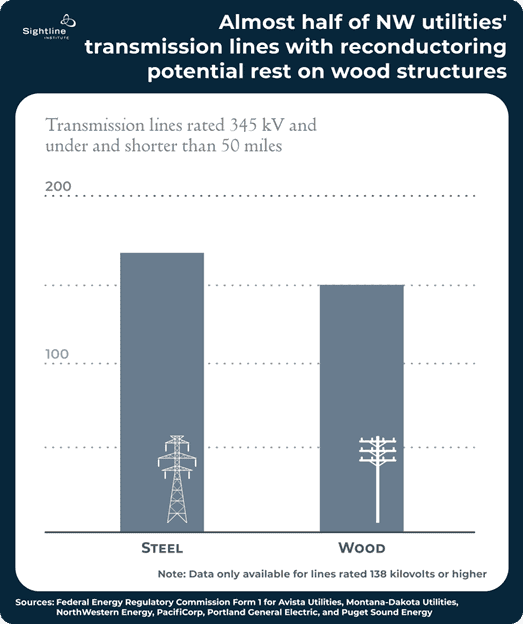
Roughly half of Northwest investor-owned utilities’ transmission lines rated 345 kV and under and shorter than 50 miles rest on wood structures, as Figure 2 shows. (BPA does not release detailed data about the structure types of its lines.) Any reconductoring project on these lines would likely require a full rebuild. Still, rebuilds are cheaper, faster, and easier than brand-new greenfield transmission lines, even if not as simple as just reconductoring.
Even so, reconductoring or rebuilding existing lines alone cannot decarbonize the Northwest. Reconductoring is like upgrading a regular bus to a double-decker one: the new bus can carry twice as many people but it’s still taking them to the same places it always has. The Northwest needs not only more grid capacity but also new grid routes to reach the best wind and solar resources. “Central Washington is where solar and wind projects want to be located,” one utility representative explained. “We don’t have much transmission there to rebuild.”
Northwest leaders can plug policy gaps to modernize wires
Reconductoring costs less than building new power lines and packs a big capacity punch, so what’s standing in the way of more of these projects? The “Three P” barriers to new transmission lines—Planning, Permitting, and Paying for—also apply to reconductoring projects. Policy interventions on each can help spur more upgrade projects:
Better planning: Ask utilities to assess reconductoring’s potential.
Speedier permitting: Exempt reconductoring projects from environmental review.
Smarter paying: Incentivize reconductoring through performance-based regulation (PBR).
Below is Sightline’s inventory of the policies that are already in place in the Northwest and the remaining gaps. (See the appendix for a table version of this information.)
Planning: Ask utilities to identify reconductoring candidates
No state in the Northwest requires utilities to assess the potential for reconductoring. But regulators in both Oregon and Washington could reasonably interpret statutes governing utility planning processes to do so.
Washington asks utilities to “identify any need to develop new, or expand or upgrade existing, bulk transmission and distribution facilities” and to “make more effective use of existing transmission capacity.” Oregon’s guidelines for utility planning state that utilities must investigate “all known resources for meeting the utility’s load…including supply-side options which focus on the generation, purchase and transmission of power.” Reconductoring is one way that utilities can meet growing loads.
Still, Northwest policymakers wanting to ensure that utilities don’t overlook reconductoring could take inspiration from California’s Senate Bill 1006. The bill would require utilities to “prepare a study of which of its transmission lines can be reconductored with advanced conductors.”5 It would not only ensure that utilities evaluate reconductoring but also guarantee that companies give adequate consideration to modern, efficient technology.
State-level planning would complement recent developments at the regional level. The Western Transmission Expansion Coalition (WestTEC), the new transmission planning effort that includes the Northwest, will evaluate reconductoring, including with advanced conductors, in the 20-year plan it is developing. Plus, the Federal Energy Regulatory Commission’s (FERC) landmark May 2024 transmission planning order mandates that transmission providers analyze advanced conductors when evaluating upgrades to existing lines. This order may lead more utilities to explore newer wire types when reconductoring.
Permitting: Fast-track reconductoring and rebuild projects
The environmental impact of swapping out wires on existing structures or putting new structures where structures already exist is next to none. As a result, some jurisdictions have exempted reconductoring and rebuild projects from permitting processes.
Join the 15,000+ readers who get Sightline Institute’s latest research.
Get our latest research and news summaries straight to your inbox.
Almost finished! We need to confirm your email address. To complete the subscription process, please click the link in the email we just sent you.
←
Almost finished! We need to confirm your email address. To complete the subscription process, please click the link in the email we just sent you. In the meantime, here are other newsletters you may be interested in:
In May 2024, the US Department of Energy (DOE) expanded an existing National Environmental Policy Act (NEPA) categorical exclusion to apply to more reconductoring and rebuild projects.6 The new rule removes an earlier limit to the length of lines that qualify for the exclusion. It also specifies that the exclusion applies to upgrade or rebuild projects that widen existing rights-of-way so long as the widening is on “previously disturbed lands.” In the Northwest this rule could especially ease the way for BPA to pursue more reconductoring or rebuild projects; since BPA is a federal agency, all its transmission projects are subject to NEPA.
In Oregon, large transmission lines (those rated 230 kV or higher, stretch longer than 10 miles, and cross multiple cities or counties) fall under the jurisdiction of the Energy Facility Siting Council (EFSC), the state’s permitting agency. Any facility under EFSC’s jurisdiction must comply with a set of Oregon-specific environmental and other standards to proceed. However, EFSC has exempted reconductoring projects on lines rated 230 kV and above from needing review based on its interpretation of state statute.7
Even so, reconductoring or rebuild projects that are exempt from EFSC review could still have to go through “a litany” of local permitting processes that can conflict, a utility representative explained. Oregon could create an expedited approval process for all reconductoring and rebuild projects to resolve confusion and fast-track these no-brainer projects.
Washington lawmakers can also ease permitting processes for electric grid upgrades. The state only spares some reconductoring and rebuild projects from review under the State Environmental Policy Act (SEPA). Projects on lines rated 115 kV or less and within existing rights-of-way are exempt. Policymakers could remove these voltage limits and broaden the exemption to apply to projects that widen existing rights-of-way on previously disturbed lands, following the US DOE’s lead.
And as in Oregon, projects exempt from Washington’s state-level review can still face local permitting challenges without a more comprehensive expedited approval path. “If it’s not maintenance, you trigger permitting,” one utility representative explained, adding that he’d like to see exemptions for all “new wires and new poles [that stay] right where they’re already at.”
Paying: Incentivize upgrades with PBR
Finally, policymakers and regulators could financially incentivize utilities to reconductor, but they would be smart to proceed cautiously. Utilities already profit when they reconductor lines, since these projects are capital expenditures (and low-risk ones at that). Plus, not all lines are good candidates for reconductoring, nor can upgrading all lines help with decarbonization goals. Offering too-generous financial incentives risks enticing a utility to “gold plate” its system.
A 2023 Montana law attempts to incentivize advanced conductors for both reconductoring and new lines.8
The law allows regulators to develop cost-effectiveness criteria, which could include “decreased electrical losses” for projects using advanced conductors and to put projects meeting those criteria into the utility’s rate base. The Montana law, though, goes a step too far by then allowing utilities to earn a higher-than-normal rate of return on these low-risk projects.
Nonetheless, the cost-effectiveness provision of Montana’s law is a worthy idea. It resembles a step toward regulation to steer specific outcomes, also known as performance-based regulation (PBR). PBR revises traditional utility incentives, which encourage companies to increase infrastructure spending and sales even when these pursuits are at odds with societal goals such as energy conservation. PBR instead measures, rewards, or penalizes utilities’ performance using values-aligned metrics such as reductions in greenhouse gas emissions or customer savings.9
Washington is the only state in the Northwest so far fully transitioning to PBR. (Oregon investigated PBR in 2018, but those efforts have stalled.) Regulators at Washington State’s Utilities and Transportation Commission (UTC) are developing performance metrics but do not plan to immediately tie them to any financial reward or penalty. So far, the UTC has declined to include any metrics related to grid upgrades.
None of these incentives would apply to BPA, however, since, as a federal agency, it is not state regulated. But the upcoming Northwest Power Plan, which the Northwest Power and Conservation Council will kick off in 2025, could encourage BPA to pursue more reconductoring projects. The 1980 Northwest Power Act requires BPA to conserve and acquire new resources in a way that is consistent with the Northwest Power Plan. The 2010 and 2016 Power Plans included reconductoring as an energy efficiency strategy. The Council would be smart to devote renewed attention to reconductoring in its newest plan, especially given advances in conductor technology and the ever-mounting difficulty building greenfield lines.
Squeezing more juice out of the existing electric grid
Increasing the Northwest’s electric grid capacity is getting more urgent by the day. Thankfully the existing grid has more to give. Replacing old wires with newer, higher-capacity ones is a walk in the park compared to building new transmission lines. Policymakers would be smart to remove any lingering impediments to these projects—and brighten the region’s chances of meeting its climate goals.
Better planningAsk utilities to assess reconductoring’s potential
No.
No.
Not explicitly. The Oregon Public Utilities Commission could interpret Order No. 07-002 as requiring utilities to evaluate reconductoring.
Not explicitly. The Washington Utilities and Transportation Commission could interpret SB 5165 as requiring utilities to evaluate reconductoring.
Speedier permitting Exempt reconductoring projects from environmental review
n/a. Idaho has no state-level permitting process.
Yes. Montana exempts all reconductoring projects from state environmental review.
Only for some lines. The Energy Facility Siting Council (EFSC) interprets ORS 469.300 as exempting reconductoring/rebuild projects on lines with voltages 230 kV and greater from needing an EFSC site certificate. However, lines may still need to go through local permitting processes.
Only for some lines. WAC 197-11-800 exempts reconductoring/rebuild projects on lines with voltages 115 kV or under, within existing rights-of-way, from review under the State Environmental Policy Act (SEPA). Lines may still need to go through local permitting processes.
Smarter payingIncentivize reconductoring through performance-based regulation (PBR)
No.
No, but allows incentives for advanced conductors. 2024 Montana law grants a 2 percent adder to projects using an advanced conductor that meet cost-effectiveness criteria.
Because of building codes and construction economics, four-story apartment buildings are a “sweet spot” for homes that most people can afford.
Four stories is typically the point at which elevators and federal tax credits start to become economical, making them important for both accessibility and affordability.
The biggest boost in residential energy savings comes between two stories and four. Additional height helps but not as dramatically.
Find audio versions of Sightline articles on any of your favorite podcast platforms, including Spotify, YouTube, and Apple.
They’re naturally inexpensive. They’re often islands of physical accessibility. They’re supremely green without even trying—in part because they’re an essential ingredient for a truly walkable neighborhood. A lot of them are even sorta cute.
They’re four-story apartment buildings, and they may be the most underrated building block of a healthy city or town, especially in the Pacific Northwest.
Four-story apartment buildings hit a “sweet spot” of low costs and high benefits, according to Nathan Teske, executive director of Hillsboro-based affordable housing developer Bienestar.
In the transect of housing types, a spectrum that runs from farmhouses to skyscrapers, this keystone of the Cascadia region’s potential future housing growth sits plop in the middle, nestled between the townhouse and the “5-over-1.” Here in the Northwest, four-story apartment buildings are almost always made of wood; under US building codes, they’re the tallest structures a team of workers can easily build without using more expensive, more complicated, and more energy-intensive concrete.
“If Oregon wants to start building more apartments, it should start thinking a lot about the number four.“
Add all this to the shortage of construction labor and to overlapping state and federal prevailing wage rules that kick in with the fifth story, and you’ve got a good case that four is an even more magical number in our corner of the continent than elsewhere.
“This is timber country, so folks [here] know how to build with it,” said Meaghan Bullard, managing principal at Portland-based Jones Architecture, which has designed market-rate and below-market housing in Astoria, Pacific City, Portland, and Seattle.
As Oregon in particular looks for ways to accelerate housing production across the state without letting prices rise further, it may be coming to grips with the fact that removing the many regulatory barriers to new apartment buildings should be a bigger part of the solution than it has been so far. And if Oregon wants to start building more apartments, it should start thinking a lot about the number four.
In my next article, I’ll explore how four-story apartment buildings have generally become illegal to build in Oregon, especially in the areas richest with jobs, infrastructure, and services where people actually want to live. For now, though, let’s take a short walk through the reasons why we should care about these four-story structures: four-story apartments are affordable to live in, inexpensive to build, and physically accessible; plus, they save energy costs and fit anywhere.
1. Four-story buildings are inexpensive to live in
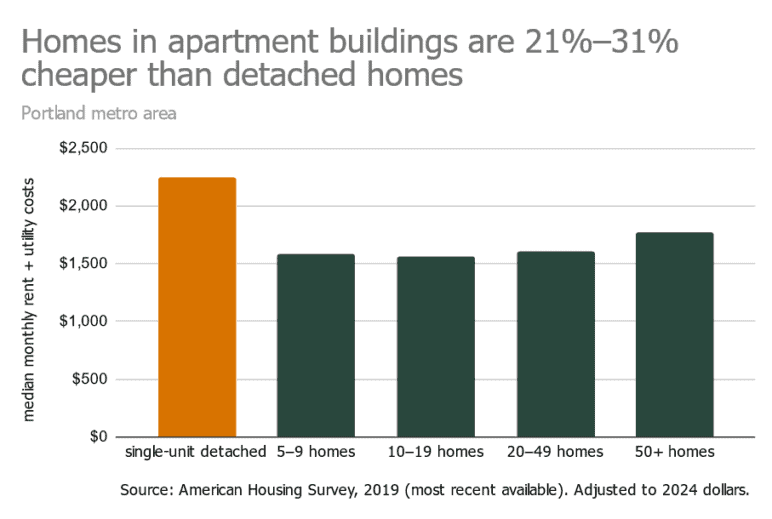
Unfortunately, the American Housing Survey doesn’t offer recent price data for the state of Oregon. However, it did recently conduct a survey for the half of the state’s population that falls within the Portland metro area, and here’s what it found:
Some of the savings compared to a detached home simply reflect the fact that most apartments are smaller than most oneplexes. But the benefit of having homes of various sizes on the market should be obvious: it lets people choose to save money by living smaller if they want to or if that’s what they can afford. Put another way: making apartments legal in more places lets people prioritize amenities or price, if that’s what they want, rather than just size.
Then there’s the smaller price difference between smaller buildings and bigger ones—look at the rightmost bar on that chart. One reason it’s a little taller than the middle three is about location; the whole point of a high-rise is to fit many homes in a premium location. Some of it reflects a building’s age; because modern zoning leaves a so-called “missing middle” between oneplexes and skyscrapers, small apartment buildings tend to be older. But again, the chart above shows why midsize apartment buildings should be allowed to exist. If they aren’t, people get stuck with the more expensive extremes.
But why four stories, not just three? In Oregon, four-story buildings are a perfect height for below-market affordable housing projects. Because federal tax credits that support these projects typically require at least 40 to 50 homes, and because the fifth story triggers state and federal prevailing wage requirements associated with public money, four stories is probably the single most common height of a below-market housing project in Oregon.
If an Oregon neighborhood bans four-story apartment buildings, any smaller affordable housing project will be competing for cash with other non-apartment projects that are four stories tall, which will make it less likely to get funded. So bans on four-story apartment buildings are, functionally, major local barriers to state-funded affordable housing. A city may not be able to afford to build its own affordable housing, but any city can afford to let someone else build four-story apartment buildings.
Thanks to Cynthia Putnam & Mark Groudine for supporting a sustainable Cascadia.
Our work is made possible by the generosity of people like you.
Of course, that’s no guarantee that homes will actually be built, and that’s O.K. Oregon’s law simply requires cities to do what they can. Anyway, there’s good reason to think that some of these homes will actually be built, because:
2. Four-story buildings are inexpensive to build
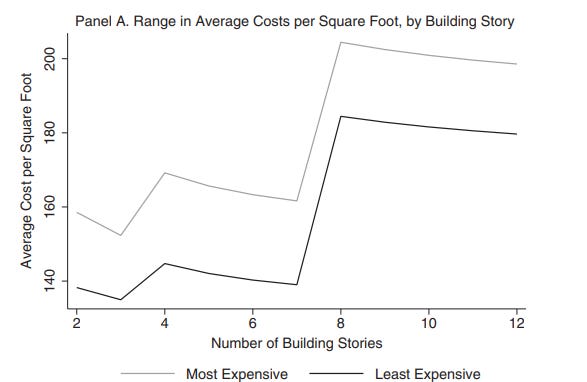
Here is a recent survey of new construction costs by height in the 50 largest cities in the United States, via Brian Potter. Note that the vertical axis starts at $135 or so, not $0:
This is the other reason why four-story apartment buildings have lower rents than high-rises: because they can.
Skyscrapers don’t exist—can’t exist, economically—until after the prices people are willing to pay for small spaces are already sky-high. Four-story buildings, by contrast, can start to sop up housing demand and bring prices under control much earlier in a rent surge.
Why are low-rise apartments cheaper to build than skyscrapers per square foot? Because under US building codes, the eighth story generally requires steel girders rather than wood. Even adding a fifth story generally requires building the first floor out of concrete. Concrete construction requires different contractors with different equipment, rarer skills, and longer timelines, which add indirect costs.
You might notice in the chart above that four-story buildings actually tend to be about 4 percent more expensive to build per square foot than three-story buildings. But that modest savings for three-story buildings is offset by another big factor: land costs, which might come to half of hard construction costs. Dividing that among four floors rather than three can save money overall. That said, one of the best things about a four-story apartment zone is that it also gives the option to build a three-story building if that’s better for some reason.
3. Four-story buildings usually have elevators
This is a likely culprit for the small bump in construction costs with the fourth story: the $100,000 to $150,000 it costs to include an elevator. But here’s the thing: elevators rule.
“A town that bans four-story apartment buildings is also banning accessibility.“
You don’t have to read the Center for Building in North America’s big recent report or this New York Times op-ed to understand why (though I recommend reading both). Cascadia’s population, like the rest of the world’s, is aging fast. Already, many thousands of Cascadians who have mobility challenges—or just, y’know, grocery bags—live in cities and towns with very few residential elevators. Most towns do have a few buildings with elevators. But as a growing share of the population is over age 75, competition for homes in buildings with elevators is only going to get worse.
More elevators are the antidote. But because of their high fixed cost, lifts very rarely go into buildings of two or three stories. A town that bans four-story apartment buildings is also banning accessibility.
4. Four-story buildings save energy
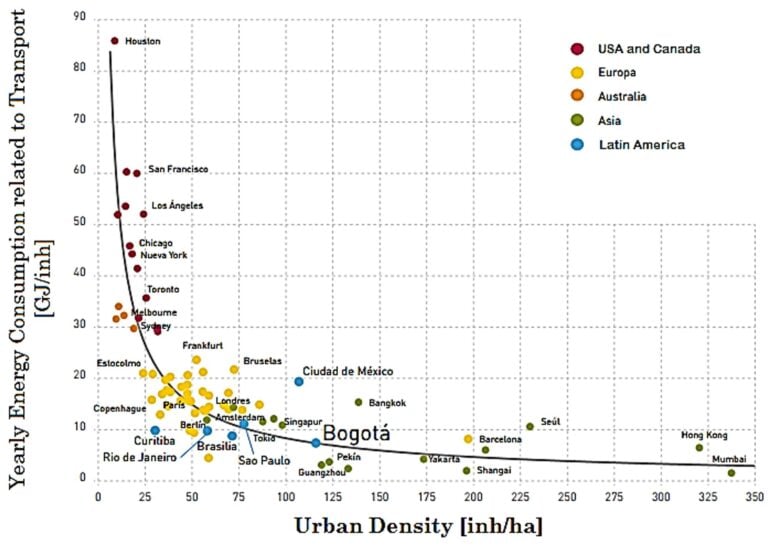
One of the most important facts in environmental behavior is that there’s not a lot of difference in transportation-related energy use per person between a neighborhood that looks like this:
Image: Google Maps.
…and one that looks like this:
Image: Google Maps.
But both of these are dramatically more energy-efficient than a neighborhood that looks like this:
Image: Google Maps.
To put it another way, getting a Houston-like city to evolve into one more like Frankfurt would make a much bigger difference to the climate than getting a Frankfurt-like city to evolve into one more like Hong Kong.
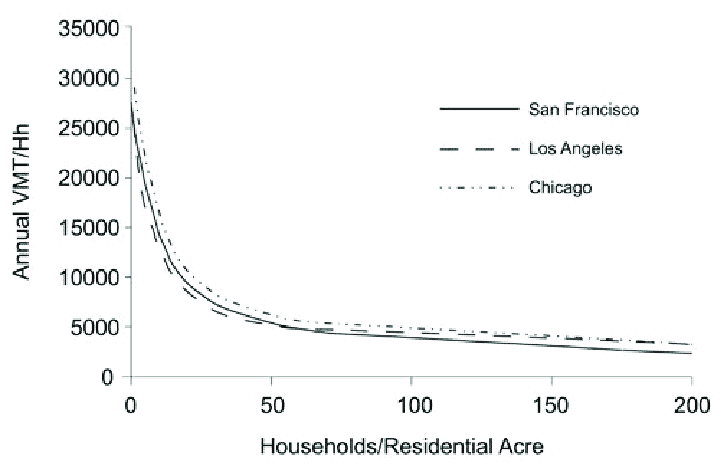
When it comes to giving people alternatives to the energy-guzzling automobile, the biggest gains fall in that leftmost part of those charts, as households per acre go from 1 to 40. You can’t find 40 households per gross acre in a neighborhood of detached homes, townhomes, or two-story walkups. But you can easily find it in a neighborhood with a mix of detached homes, townhomes, and two-story and four-story apartment buildings—in other words, in the sort of neighborhood that might take root in an area zoned for apartment buildings up to four stories.
Not everyone wants to live in that sort of neighborhood, and not everyone should be required to. But every time someone does choose to, it helps everyone else. It cuts air pollution, keeps cars off the road, and preserves electric capacity. So, again, we should make it an option for anyone who does want to live in that sort of neighborhood, by allowing four-story apartment buildings on a decent amount of land in every city and town.
5. Four-story buildings can fit anywhere
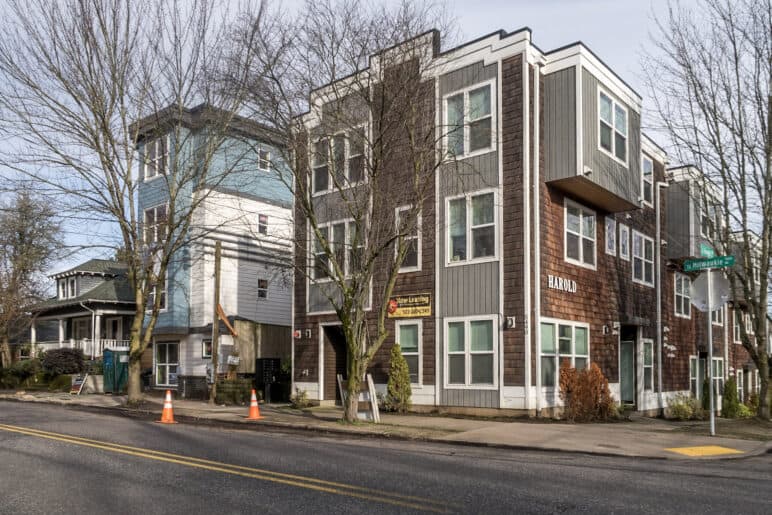
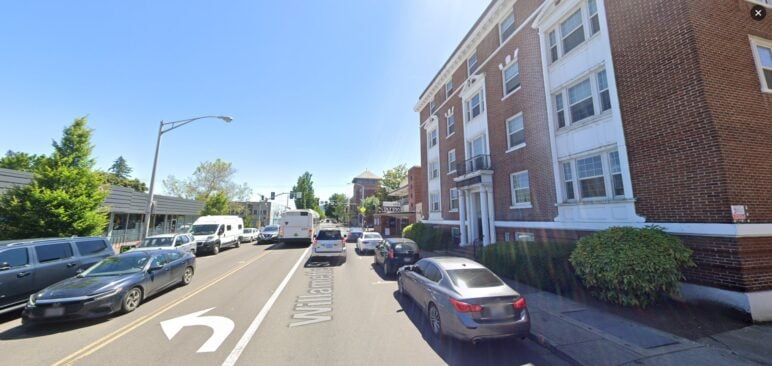
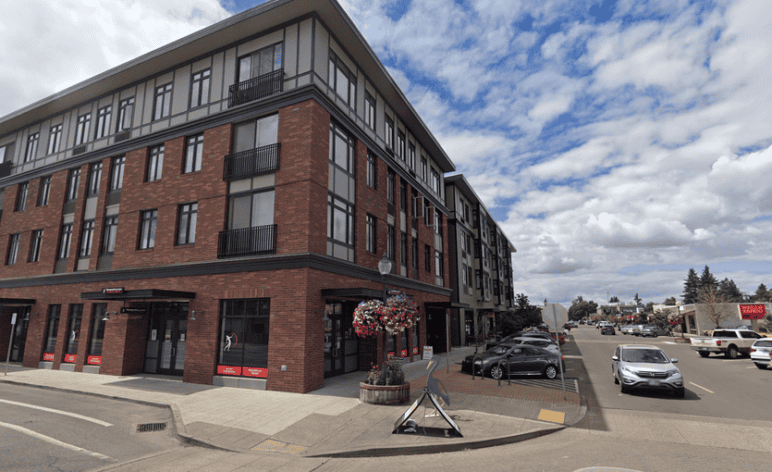
Here are some four-story buildings in Utrecht:
Photo by Ted McGrath (Creative Commons)
…and in Portland:
Photo by Mark McClure (Creative Commons)
…and Eugene:
Image: Google Street View.
…and Hillsboro:
Image: Google Street View.
…and Ashland:
Image: Google Street View.
…and Canby:
Image: Google Street View.
…and McMinnville:
Image: Google Street View.
Four-story buildings don’t loom. They’re a little shorter than the width of a typical US street, including sidewalks. Especially when they’re allowed to exist without excessive parking lots and garages, these buildings can add to a block without utterly transforming it.
Four- to five-story buildings are “a really strong typology for walkable, livable cities,” said Bullard, of Jones Architecture. “It’s a very human scale.”
Should big cities allow some buildings to be taller than four stories? Yes, of course. But in most cities and towns, there’s no need. Four stories are good. And four stories are enough.
Journalists who have reported on ranked choice voting elections around the United States have identified best practices and common pitfalls in reporting on this method of voting. In June 2024, Sightline collaborated with the Agora Journalism Center at the University of Oregon and North Star Civic Foundation to offer a training for journalists covering Portland’s first use of ranked choice voting this November. This resource guide, containing both official dates and unofficial tips, was introduced and modified during the event.
In November 2022, Portland voters approved Ballot Measure 26-228 to move to a new form of government, changes recommended by a volunteer Charter Commission.
In November 2024, Portlanders will use their new voting system for the first time:
single-winner ranked choice voting to elect the city-wide Mayor and Auditor and
multi-winner ranked choice voting to elect three city councilors in each of four new geographic districts.
The new form of government will be in place by January 1, 2025.
Point of interest
Ranked choice voting is already used in more than 50 jurisdictions nationwide, but Portland will be the largest city in the United States to use multi-winner ranked choice voting to elect its city council members. (Cambridge, MA, has been using it for some time, as have a few smaller elected bodies in cities including Minneapolis, MN.)
November 5, 2024 (election night), 8:00 pm: Multnomah County, which tabulates results for its cities, including Portland, plans to report preliminary round-by-round results for all City of Portland ranked choice voting contests at multco.us/elections.
Just like the prior system of “choose-one” elections, we will not know the final winners of close ranked choice voting races until all ballots are counted. However, some races may be called as early as election night.
November 7, 2024: The next update of round-by-round results is expected by 6:00 pm. Regular updates will be released thereafter.
In previous Multnomah County elections, typically 97% of ballots have been counted in the first couple of days after the election. This year, administrators expect early results to take longer since the counting and tabulation process is slightly more complex.
December 2, 2024 (27 days after the election): Election results are certified.
For multi-winner City Council races, the election threshold is 25% of ballotsplus one vote; for the single-winner Mayor’s and Auditor’s races, the election threshold is 50% of ballots plus one vote (see below for more on this).
Multnomah County’s data reporting format
The general format of election results will be similar to that of other jurisdictions that have managed ranked choice voting elections (including some with the same voting tabulation software as Multnomah County, RCTab). Results will be provided in three formats:
Acknowledge that final results may not be available immediately, which is true of most elections (not unique to ranked choice voting).
Multnomah County Elections will be releasing preliminary round-by-round data, but the tabulation and rounds may change as more ballots are counted. Do not report first-released data as if it is final, and remember to account for ballots that have “exhausted” their rankings and write-ins. As with other contests, the results will not be final until December 2 (certification day). While outcomes may start to become clear before then, no winners will be officially declared before that date.
Use clear and simple visuals
Keep visualizations simple. Tables and stacked bar charts can be useful visualization tools. Ranked Choice Voting Visualizations (rcvis.com) can help you create neat, comprehensible graphics.
FairVote also has a brief primer on how to display RCV election results (and a multi-winner version). North Star Civic Foundation will be offering an elections data dashboard in the coming months to compare outcomes of the 2024 election in Portland with outcomes in other cities and with Portland’s historical election outcomes.
RCV impacts: Trends to watch from existing research
More representative candidate pools and outcomes | Research shows that more women and people of color run and win when a jurisdiction switches to ranked choice voting, in part because they are not deterred by inadvertently being a spoiler candidate for another candidate with similar viewpoints. Voters can also choose their favorite candidates without fear of spoiling the election for someone else. (See St. Paul likely to welcome historic all-women City Council after Tuesday’s election | MPR News.)
Possible increase in voter turnout | A variety of factors typically impact voter turnout, such as the number of high-profile races or issues on the ballot, levels of voter enthusiasm or distaste for specific candidates, the size of voter education efforts, and whether it is a mid-term or presidential election year. Recent studies indicate that there is higher voter turnout in places using ranked choice voting, but effects vary and often take time to appear. However, there will likely be higher voter participation in some Portland City Council races compared to the city’s prior two-round system (when voters elected some candidates during a low-turnout May primary and others in November), since Portland’s electoral changes include eliminating the May primary races for city offices.
General good practices
As much as possible, use analogies, real-life everyday examples, sample ballots, and visualizations.
Offer a simple explanation of how it works whenever you bring it up.
Use voter-centric terms like “single-winner ranked choice voting” and “multi-winner ranked choice voting,” rather than more jargon-y terms like “instant runoff” and “proportional RCV”, to orient readers to the races for Mayor and Auditor and for Portland City Council, respectively. Link to city resources that demonstrate how the ballot will appear and common voting errors.
Note that the voter experience is the same for single-winner and multi-winner ranked choice voting races.
Rather than describing Portland’s new voting method as novel, untested, or complex, it can be helpful for voters to know that many places have used ranked choice voting, including multi-winner ranked choice voting, for decades. In the United States, ranked choice voting is currently used in cities such as San Francisco, CA; Boulder, CO; Cambridge, MA; Salt Lake City, UT; New York City, NY; as well as the states of Alaska and Maine. In Oregon, it’s already in practice in Corvallis and Benton County.
Lengthy, mathematical explanations of the ballot tabulation process can confuse some readers, as can acronyms and jargon. Where you do need to offer these details, be sure to define them upfront and include or link to examples.
For single-winner ranked choice voting (Portland mayoral race)
Analogy / Real-life example: “When you’re out to dinner, if the restaurant has run out of your favorite thing on the menu, you still eat. You would look at the menu and decide on the next best option or (if need be) the third. We rank things every day, and we can do the same when electing the public servants who will represent us in government.”
Sample ballot: A book club might use ranked choice voting for its next book selection.
Thanks to Molly O’Reilly for supporting a sustainable Cascadia.
Our work is made possible by the generosity of people like you.
Multnomah County Elections is also preparing a video explainer.
For multi-winner ranked choice voting (Portland City Council races)
Emphasize majority representation: In contrast to the previous winner-take-all elections, at least 75% of voters will elect at least one candidate of their choice (since three candidates must each get 25%).
Explain how many votes a candidate needs to win: In multi-winner ranked choice voting elections, the number of votes a candidate needs to win (also known as the “election threshold”) is based on the number of seats. In Portland, city councilors will be elected from three-member districts, so candidates need to earn more than 25% of the vote (since only three candidates can get more than 25%). This allocation means the three strongest candidates win.
Use caution when explaining the surplus vote transfer: Stick with the simple election threshold explanation for general audiences. For instance: “In the second round of counting, Candidate X reached the 25% needed to win and has been elected as one of the councilmembers from District 1.” Videos and graphics can supplement for a more detailed discussion. Make it clear to readers that the voter experience on the ballot is identical for single-winner and multi-winner ranked choice voting elections, regardless of the multi-winner fractional transfers behind the scenes.
If explaining the process of fractional transfers, make sure to include why the votes transfer: to ensure that voters are represented proportionally. If a very large group of voters are aligned on a set of issues and are able to elect one seat, they may be a large enough group to influence another seat in the race too. Example language: “With multi-winner elections, a popular candidate might not need your full vote to reach the threshold, so a portion of it would count towards your next favorite. That way, you aren’t penalized for voting for someone with a lot of support.”
The transfer math is basic division: the extra votes divided by the total voters for that candidate. For example: “If a candidate needs 500 total votes to win but receives 750 votes, each voter only needs to spend two-thirds of their vote to get that candidate over the finish line (two-thirds of a vote multiplied by 750 votes = 500 full votes)—and the remaining one-third of each vote can contribute to another candidate.1 With this method, your single vote can be more expressive: it will always work to elect your favorite candidate, but you can rank additional candidates, knowing that you’ll continue to have a voice if your 1st choice gets more support than they needed to win.”
Since surplus votes transfer, there will be no “margin of victory” to report. Instead, note which round each candidate won their seat: earlier rounds means that candidate received more top-choice votes.
Analogy / Real-life example: You hold a party at a pizzeria: Four tables can order 3 pizzas each to suit the group sitting there. They rank their preferences. So, most people get a slice they love or like, and the outlier who puts an anchovy pineapple pizza (yikes) at the top of her list still likely gets her second or third choice.
Sample ballot: A city might have residents use ranked choice voting to name its four new snowplows, five garbage trucks, or other plural low-stakes investments.
Example usage: Editorial board members could rank the candidates for their respective districts.
Visuals: Use charts, graphs, and other collateral, like short video explainers, embedded in articles. Examples include:
Advocacy organization FairVote has compiled data and other resources about ranked choice voting.
The Ranked Choice Voting Resource Center has a library of resources. Its experts offer resources for administering ranked choice voting resources, including hardware and software needs.
Sightline Institute has extensive research on ranked choice voting in Northwest states and Alaska, including a full series on Portland’s system. It also compiled this list of how community groups can help educate their members about ranked choice voting.
North Star Civic Foundation: Connects local leaders with data, analysis, and discussion to support timely and collaborative leadership on elections, democracy, and economic issues.
Takeaways Auditors identified some legitimate problems with how Portland has administered its housing affordability mandate. Auditors also offered some policy suggestions that might or might not be good ideas. The Oregonian made a weirdly big deal out of a 2 percent administrative cost. Find audio versions of Sightline articles on any of your favorite podcast … Read more