
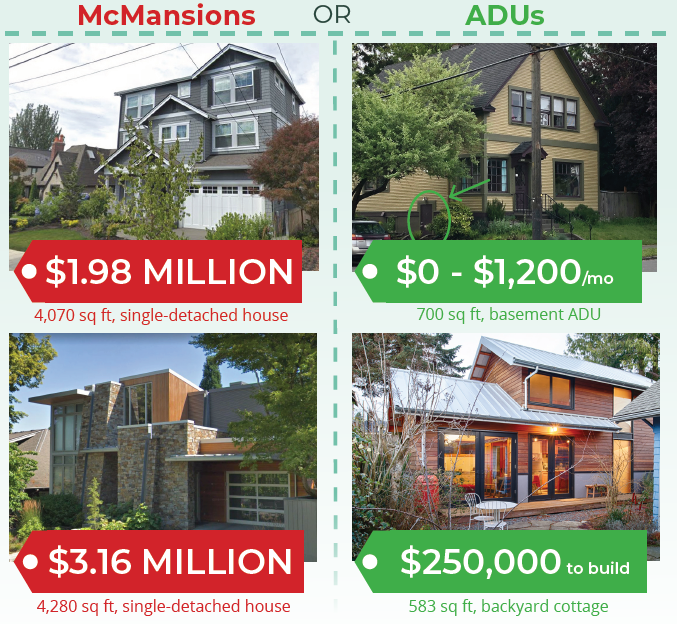




Next month, the Seattle City Council could lift regulatory barriers to small, flexible housing options in the city’s land use code. This would help neighborhoods across the city welcome more granny flats, mother-in-law apartments, and backyard cottages—rather than keeping current rules that exclude those cheaper options and instead invite more oversized, single-household “McMansions.”
Making it easier and less costly to add attached (or detached) accessory dwelling units, or (D)ADUs, can expand much needed, close-in housing options, protect affordability, and help stabilize renters and homeowners. Keeping current rules that allow only the biggest, most expensive houses in over half the city will not.
Every time a McMansion replaces a modest home, it’s a missed opportunity for affordability and abundant housing to meet diverse needs. If Seattle kicks to the curb the burdensome rules that prevent ADUs, it would give new flexibility to owners to age in community, care for family, and earn extra income from a small rental. Plus, ADUs can add more physically accessible housing choices to existing neighborhoods for aging residents and people living with disabilities.
Renters stand to gain, too: A backyard cottage or mother-in-law suite in a daylight basement can represent the kind of efficient, cheaper, and convenient home options Seattle renters need to live near jobs, schools, transit, and parks—opening up economic opportunities and cutting commutes and traffic in the region. Surveys from the region show that Cascadian (D)ADUs rent for approximately $1,300 a month. A Terner Center report from 2017 found 58 percent of ADU owners rent their units at below-market rates, including the 1 in 10 ADU owners who let their secondary units for free.
People want them, communities need them, but current city rules—including excessive parking requirements and owner-occupancy requirements—get in the way. Why put more restrictions on housing types we say we want?
Read more about the benefits of (D)ADUs in our printable two-page explainer:


How many (D)ADUs does the city expect homeowners to build/rent out? I mean, in the long term, how are (D)ADUs better then upzoning and building affordable apartments? Does Seattle really think it can retain it’s “small town big city” feel (which it’s already lost, sorry not sorry) forever? Do people think that folks aren’t going to keep flocking to the PNW as the planet heats? As tech companies continue to expand?
This would have been a smart solution 10 years ago. It might have bought the city some time to build affordable housing as we realized that the inflow wasn’t going to slow down, but now it’s far too little too late.
Not to mention that homeowners with less-than-average (D)ADUs are going to try to charge the average price when they shouldn’t, banking on tenants ignorance of their rights. A lot of them are going to make terrible landlords. Seattle has more than its fair share of them already. They aren’t going to be savvy about all their responsibilities. I doubt many of them will even know what they’re supposed to legally disclose to their tenants. Then there will be the ones who will read the state’s eviction laws, but not the city’s, which I’ve encountered before with experienced landlords.
I think it’s fair to say that there are a lot of problems that could come out of this, and solutions probably won’t come quick enough. It’s definitely smarter than thinking that this could lead to a bunch of quality housing managed by competent and experienced landlords.