
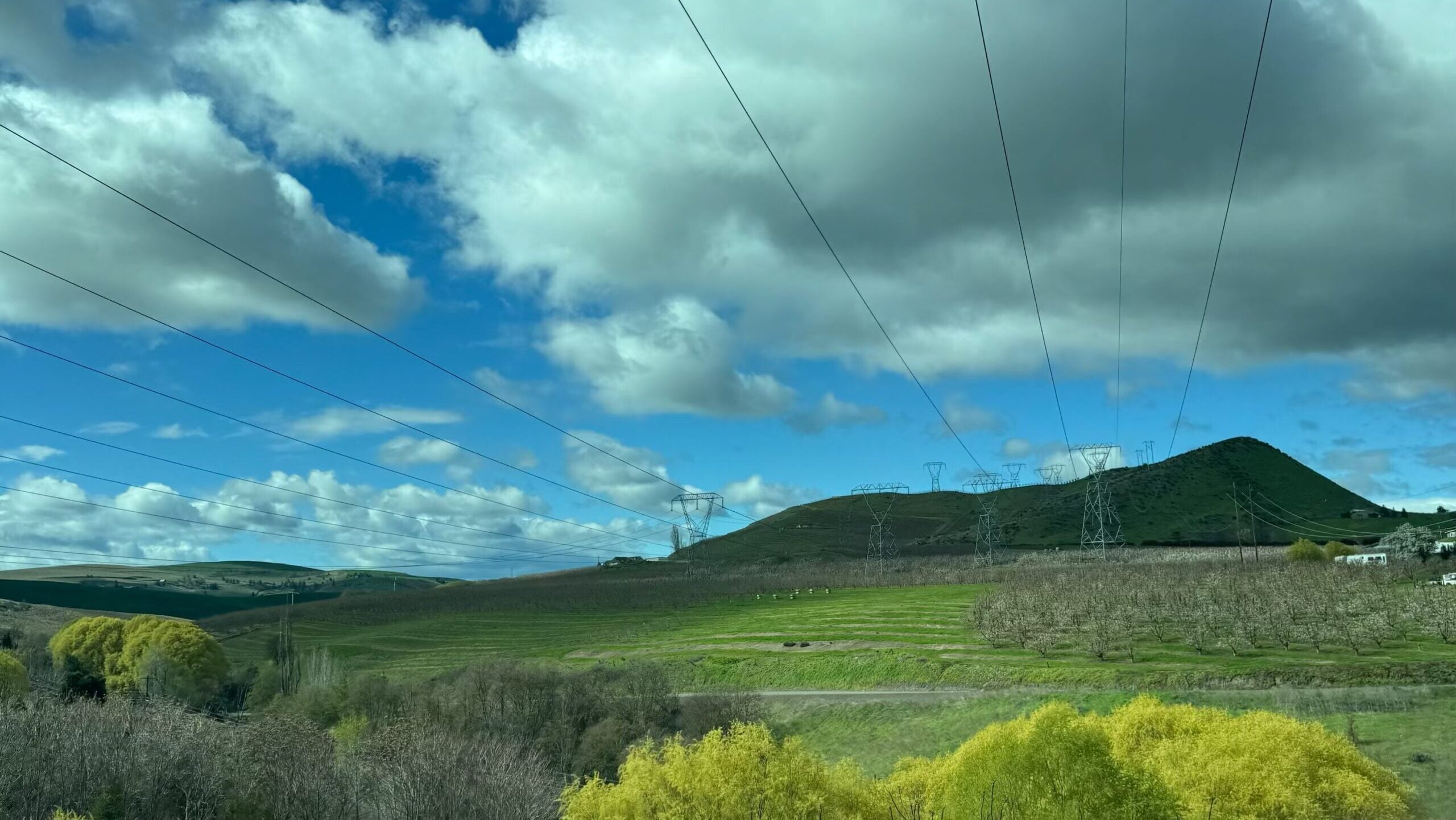

Takeaways
- Northwest residents have repeatedly voted to enact and defend some of the United States’ boldest climate goals. The realization of these goals will require, among other things, a great deal more clean energy—and in turn, the transmission lines to carry that energy to the homes and businesses that rely on it.
- Unfortunately, incumbent transmission developers, like utilities, aren’t building the power lines the region needs to meet its climate commitments.
- But Washington state just turned the page: during its short 2026 legislative session, a bipartisan group of leaders established the Washington Electric Transmission Authority, an independent public entity empowered to prioritize, access public financing for, and facilitate construction of power line projects needed to harness clean, affordable electricity.
- The move is a win for Washingtonians, and it’s a promising model for Oregon, which has considered but not yet adopted a similar policy.
Washington state policymakers made a power move for clean energy in the 2026 legislative session. On March 30, 2026, Governor Bob Ferguson signed Senate Bill 6355, creating the Washington Electric Transmission Authority, an idea that Sightline first wrote about in 2022 and that Colorado and New Mexico have already employed with success. The bill, sponsored by Senators Victoria Hunt and Claudia Kauffman, passed with bipartisan support and backing from environmental groups and labor unions.
The transmission authority will be an independent state entity empowered to plan, access public financing for, and facilitate construction of power line projects that are necessary to harness clean, affordable electricity and fulfill the state’s climate commitments. It will prioritize lines that current transmission developers, including utilities, would otherwise not build. Oregon, which has considered but not yet established its own transmission authority, would be smart to follow suit.
The new transmission authority will remove several barriers to building new grid projects
The new Washington Electric Transmission Authority’s (WETA) mandate is to improve the grid’s reliability, resilience, and affordability by expanding and upgrading Washington’s transmission system. In establishing the authority, the legislature acknowledged the crucial importance of a robust grid to achieving the state’s climate goals. An improved grid will allow the state to more efficiently tap low-cost solar power in the US Southwest, for example, or wind power from the Mountain West, as well as prepare for rising electricity demand from homes and businesses transitioning away from burning fossil fuels for energy.
How the authority is structured
By January 2027, WETA will be up-and-running. The governor will appoint a ten-person board with a range of relevant expertise to oversee the authority. The Washington Department of Commerce, an agency that houses the state’s energy office, will provide staff support in the meantime.
WETA will be in part self-financing: it will generate revenue by charging project application review fees to developers seeking to partner with it or by selling completed projects to transmission developers or operators, including utilities. It can then use this revenue to manage and acquire land for new projects. The authority will also compensate cities, counties, and Tribes whose land a project crosses. WETA and its partners must employ qualified electrical employees or apprentices from certain programs and meet prevailing wage requirements when building lines.
Lawmakers also required WETA to coordinate with the Governor’s Office of Indian Affairs, other state agencies, and federally recognized Tribes to create a Tribal consultation framework for transmission planning and development. The framework will identify gaps in and establish standards for government-to-government consultation for WETA, working to ensure Tribal sovereignty is protected throughout the process of planning, siting, permitting, and building transmission lines.
What the authority can do
To achieve its mandate, the authority will identify necessary grid projects and partner with experienced developers to get them built.
Identify needed lines that utilities have not already planned
Grid planning is woefully inadequate in the western United States, in part because of the lack of a Regional Transmission Organization (RTO). RTOs are independent, nonprofit grid operators that facilitate the sale and purchase of energy to meet demand. They are responsible for regional transmission planning in most of the United States.
Absent an RTO, NorthernGrid, a membership of 12 utilities and the Bonneville Power Administration (BPA), has conducted the federally required regional transmission planning in the Northwest. But prior plans the group has developed failed to account for anticipated renewable energy buildout, looked only ten years out, and did not include longer, more valuable lines that can connect regions and improve efficiency and resilience. In other words, they mostly cobbled together what individual utilities already planned to do.
The good news is that, since Sightline first wrote about the shortfalls of the Northwest’s grid planning efforts, the region has taken a big step forward. Utilities, BPA, environmental groups, and Tribes have been participating in the Western Transmission Expansion Coalition, which will complete the region’s first 20-year transmission study by the end of 2026, building on a 10-year study it released in February. The 10-year study identified an additional 3,300 miles of lines that the region needs to build or upgrade beyond what utilities had already planned across 12 western states.
WETA will be able to bring the result of this first-of-its kind study to life, leveraging it to identify routes in Washington where lines are most needed to meet the state’s goals—something that has not been done before.

Related: Four Ways to Get More Power Lines—and Clean Power—for Oregonians | Oregon may be one of the hardest places to build transmission lines. Here’s how to change that.
Build and finance lines through public-private partnerships
In part due to inadequate planning, and in part due to perceived risk in investing in large transmission projects, current transmission builders—namely, utilities and BPA—have been slow to expand the grid. BPA built the last major grid projects in Washington more than a decade ago.
With WETA, Washington no longer depends on these entities to construct the lines the state needs. The authority can partner with experienced transmission developers, including non-utility transmission developers (known as merchant developers) to get projects on the ground. New Mexico’s transmission authority has already put this model to work, with 1,500 miles of lines in development in partnership with merchant developers such as NextEra Energy and Pattern Energy. As a “last resort,” WETA can build its own projects, meaning it will only construct lines that utilities would not otherwise have built and will only own them as long as necessary for the public interest.
WETA can also help its partners access public financing to reduce the cost of transmission line projects, which can run up to a billion dollars. The authority can work with the Washington Economic Development Finance Authority, an independent state agency that issues revenue bonds (bonds paid back by project revenues as opposed to taxes), to provide financing to eligible partners. Today, investor-owned utilities rely on private financing to pay for the transmission lines they develop, which can drive up project costs by 25–57 percent relative to projects that rely at least in part on public financing, a California study found. And merchant developers often build lines at even higher costs than utilities, in part because they do not have guaranteed customers like a utility does, necessitating more expensive financing to account for this risk. WETA changes the status quo by opening the door to lower-cost public financing, with savings flowing to ratepayers.
Beyond grid expansion, the legislature tasked the transmission authority with assisting with grid upgrades, such as reconductoring, microgrids, distributed energy resources, and energy conservation.
Oregon can replicate Washington’s success
Washington decided it’s done waiting for someone else to put up the wires it needs to abate the worsening climate crisis. Oregon can choose so, too. Oregon faces many of the same challenges as Washington does to putting more transmission poles on the ground. The state is one of the more challenging ones in which to construct new transmission lines.
In fact, Oregon lawmakers have considered, but not yet passed, a bill that would have created an electric transmission authority. While the 2025 bill, sponsored by Representative Mark Gamba, didn’t make it out of committee, it generated considerable interest. Forty-five environmental nonprofits, individuals, and the Oregon Citizens’ Utility Board testified in support, with many citing the need for more transmission lines to meet climate, clean energy, and affordability goals.
If Oregon follows Washington in creating a state transmission authority, these adjoining authorities could then coordinate planning and permitting for projects that will cross state borders. Plus, a more interconnected grid yields a more efficient use of energy resources, mutually benefiting both states.
The faster Oregon follows in Washington’s footsteps to create its own transmission authority, the sooner the Pacific Northwest will become a clean energy powerhouse.

