

Takeaways
- Vancouver, BC’s zoning code forces apartments onto noisy, polluted arterial roads, effectively treating renters as noise and pollution buffers for low-density detached house neighborhoods.
- The city’s proposed Villages Plan promised to legalize four- to six-story off-arterial apartments, but Mayor Ken Sim defeated the policy following vocal neighborhood pushback.
- To meaningfully address the housing crisis, future municipal leaders must pair financially viable zoning rules with political courage to legalize off-arterial apartments citywide.
Vancouver BC’s zoning code is built on an injustice: if you rent your home, the city forces you onto a busy, polluted road. While single-family homes enjoy peaceful, tree-lined side streets, apartment dwellers are relegated to busy arterial routes, where exhaust and traffic noise drive up rates of asthma, cancer, and dementia. Under this so-called “Grand Bargain,” renters, in effect, are treated as human noise and pollution buffers to protect the owners of houses from city traffic.
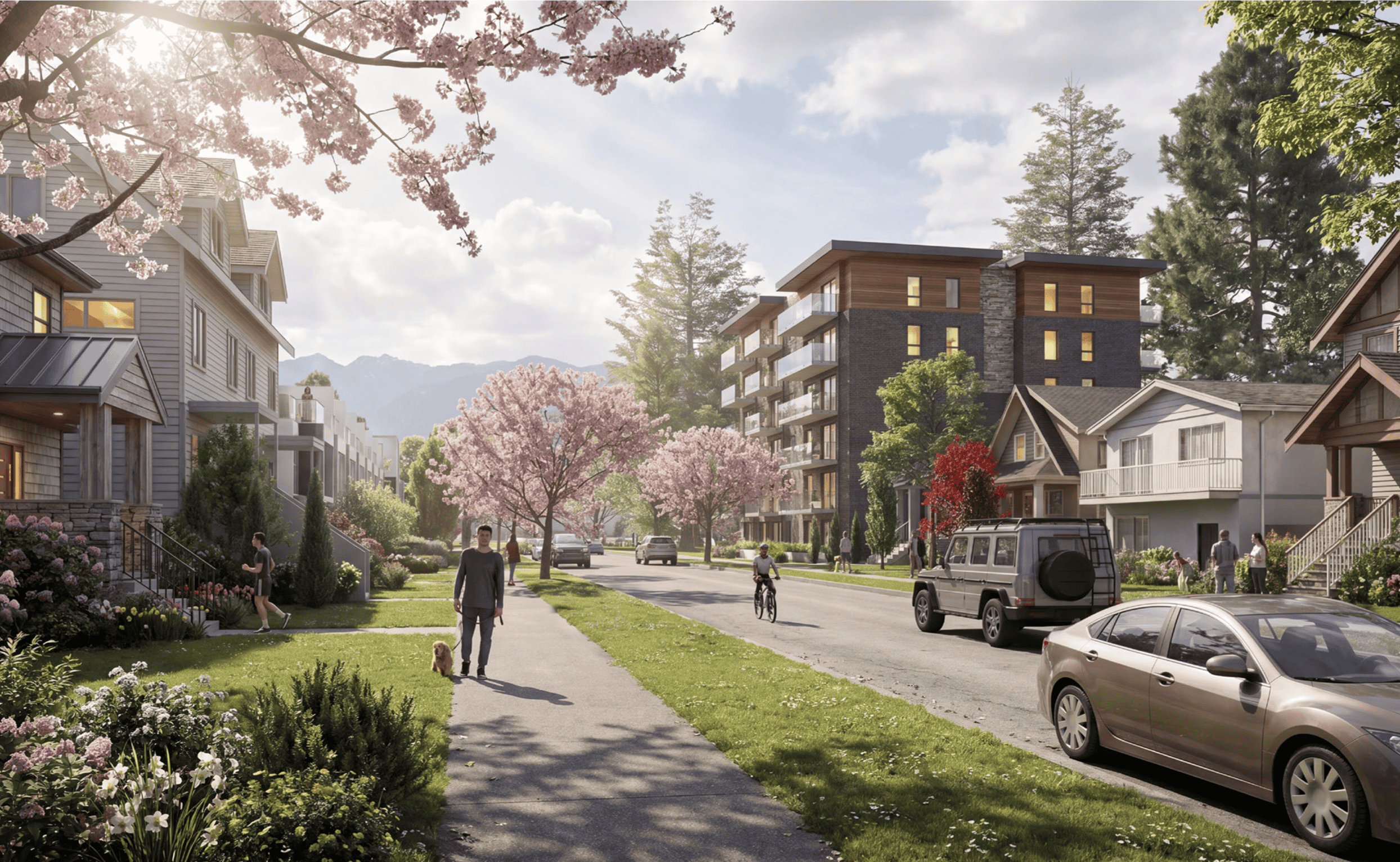
The Vancouver Villages Plan was supposed to break that pattern. Introduced in October 2023, it promised to legalize four- to six-story apartments across 17 “villages,” opening leafy, low-density side streets to apartment dwellers.
Instead, on July 28, 2026, the plan suffered a dramatic collapse. After three days of public hearings, Mayor Ken Sim and his ruling ABC party voted against their own policy. The vote left Vancouver’s long-term housing strategy in limbo and raised two critical questions: how did the mayor end up killing his own signature planning initiative, and where does Vancouver go from here?
A bold idea with fragile math
On paper, the Villages Plan looked promising. It aimed to create 17 vibrant neighborhood hubs in low-density residential areas that already contained at least some local shops.
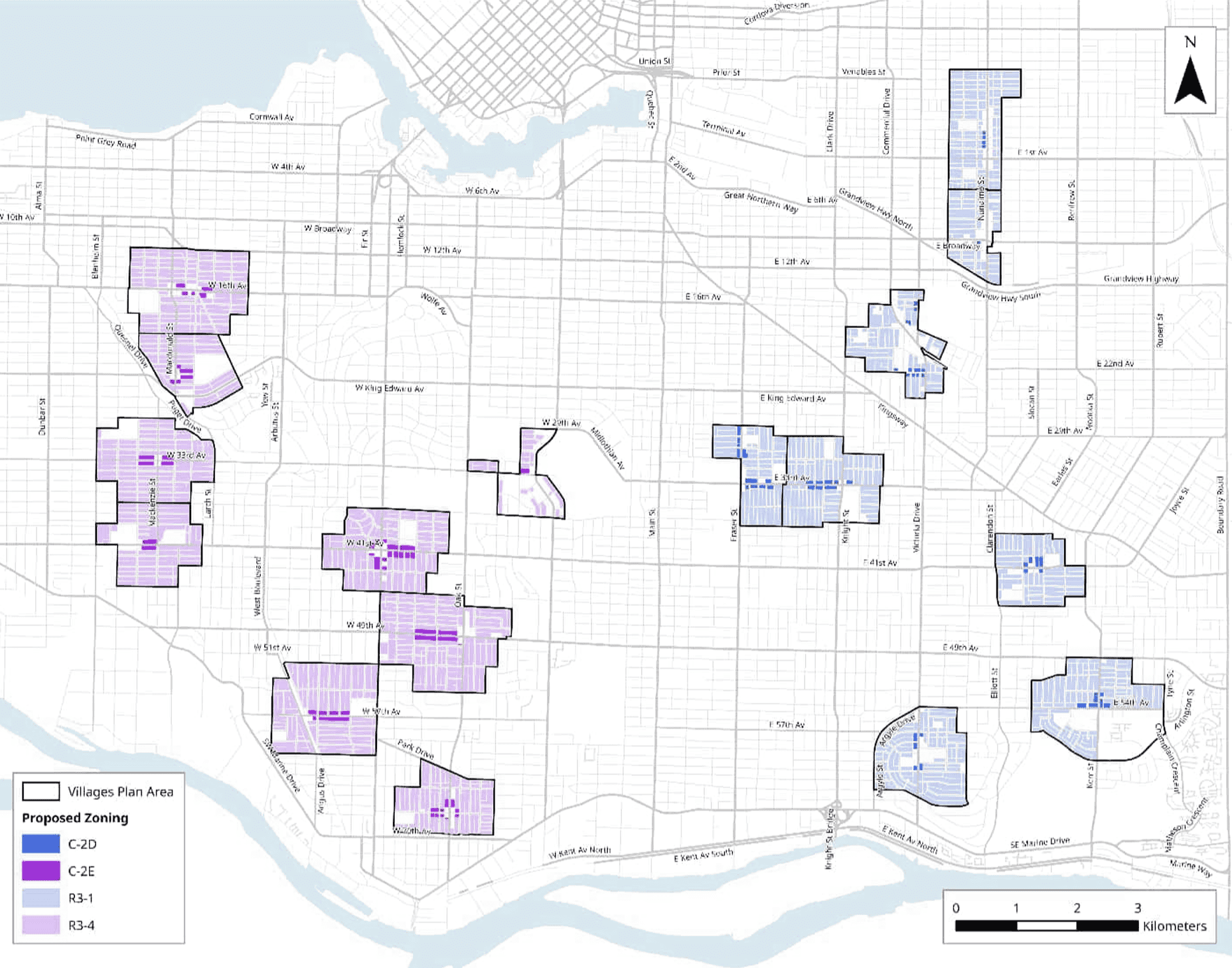
Around these hubs, city staff proposed replacing exclusive low-density zoning with new “residential low-rise” zones (R3-1 and R3-4). These zones would permit strata apartments (known in the US as condominiums) up to four stories and rental apartments up to six stories, with maximum floor area ratios (FAR) ranging from 1.6–2.7 depending on lot size. In the commercial zone hubs, mixed-use buildings could reach FARs of 2.5–3.7.
Compared to the status quo, where off-arterial streets generally allow only single-detached houses, duplexes, or modest multiplexes, the Villages Plan seemed like a major step forward. But height and FSR limits tell only part of the story: to turn zoning on a map into actual homes, the underlying economics must work. In the Villages Plan, they rarely did.
The city’s third-party economic analysis painted a grim picture:1
- Single-lot developments were non-viable: Neither strata nor rental apartments could financially work on a single standard lot.
- Lot assemblies offered little relief: Even when builders assembled multiple adjacent lots, strata apartments were economically viable only in rare circumstances, typically those involving unusually large West Side properties. On smaller West Side assemblies and across the entire East Side, maximum allowed densities fell short.
- Rentals faced steep barriers: Rental apartments required lot assembly to work anywhere, and even at the maximum FSR of 2.7, remained unviable across most of the East Side residential zones.
To make matters worse, the city layered unfunded inclusionary zoning requirements onto areas where development might have generated modest land value gains, effectively clawing back the margin required to incentivize landowners to redevelop their properties. The Villages Plan opened doors on paper, but in reality, homes would have been built only in rare, favorable conditions.
The moving goalposts of neighborhood opposition
While getting the economic math right is essential for homebuilding, the plan did not fail because of a lack of financial viability. The deeper obstacle was a familiar pattern in Vancouver land-use politics—that is, opponents shifting the goalposts.
Whenever mid- or high-rise towers are proposed in Vancouver, opponents argue that towers are out of scale, but medium density would be acceptable. A recent example was a rezoning for an 18-story rental apartment building at 14th Avenue and Yukon Street. The site is a less-than-ten-minute walk from a central SkyTrain station, in an area consisting only of single-detached homes, duplexes, and multiplexes. The proposal generated a well-organized opposition that, among other things, argued that an 18-story building did not “respect the character” of the neighborhood, but that a “low-mid rise building is an appropriate scaling up of the currently existing density.”
The Villages Plan offered exactly that: modest, four- to six-story buildings mixed into quiet residential blocks near local shops. The backlash to it reveals a simple truth in Vancouver planning—that for some, any change from the status quo is too much.
A century of defending low-density neighborhoods
Zooming out, the defeat of the Villages Plan is just the latest chapter in a century-long pattern of housing incrementalism.
In 1928, urban planner Harland Bartholomew drafted Vancouver’s first comprehensive zoning plan. Bartholomew restricted apartments to a few areas near downtown and set aside vast swaths of the city exclusively for single-detached homes.
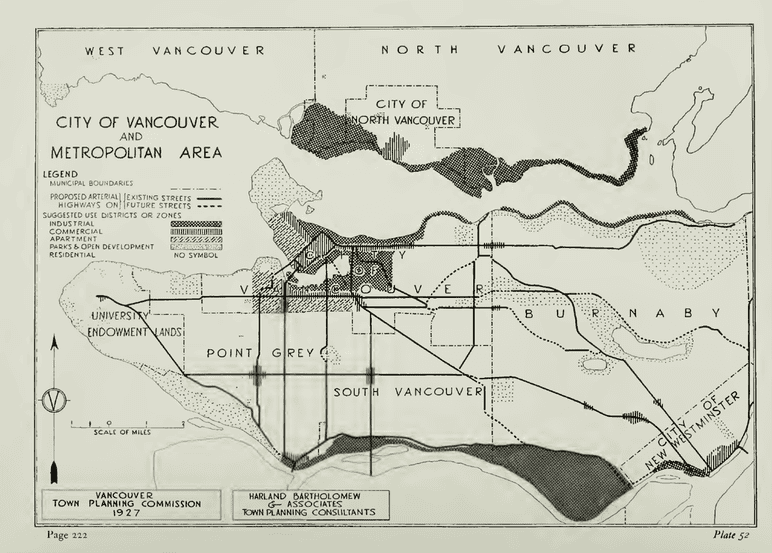
Even basement suites were forbidden; Bartholomew saw them as “a deviation from an aesthetic and social norm for single-family areas.”3 It took until 2004 for the city to fully legalize basement suites citywide.
Since then, Vancouver has opened side streets to new housing at a glacial pace: laneway houses in 2009, duplexes in 2018, and multiplexes in 2023. Yet each reform arrived weighed down by limits on design, lot size, and FAR that discouraged homebuilding in these neighborhoods at a significant scale. The 2023 multiplex policy illustrates this. In almost three years, builders have completed just 67 multiplexes across the entire city, adding a mere 250 homes. That’s not even a drop in the bucket to address the city’s housing shortage.
Meanwhile, attempts to allow off-arterial apartments have seen even less progress. The 2021 Secured Rental Policy allowed four-story rentals on side streets near main roads, but its design constraints proved so restrictive that the city has received only eight applications in five years—and none since December 2023.
The Vancouver Plan was supposed to break this cycle of ad hoc policies and create a comprehensive, citywide plan to guide growth and housing policy through 2050. Launched in 2018 and adopted by council in 2022, it explicitly recognized that building complete, healthy neighborhoods required moving apartments off busy arterials to reduce residents’ exposure to noise, air pollution, and motor vehicle traffic. The Vancouver Plan proposed four major planning concepts to deliver on this goal: multiplexes, Rapid Transit Areas, Neighbourhood Centers… and Villages.
Easier said than done
On October 17, 2023, Mayor Sim introduced an urgent motion, “Accelerating Housing Delivery Through Transformative Change.” This designated the Villages Plan as the city’s top planning priority and the next part of the Vancouver Plan to be implemented. Planners spent nearly three years consulting the public and refining drafts.
By July 2026, when the final plan went to a public hearing, intense neighborhood opposition had mobilized. The city received 2,245 written comments opposing the plan compared to 559 in support. Over 300 residents signed up to speak.
The public hearing stretched across three days, concluding after midnight on the third night. Out of nearly 200 residents who spoke, 176 spoke against the plan, and 23 spoke in favor.
Faced with vocal pushback, political resolve evaporated. Ken Sim and his ruling ABC party were joined by Rebecca Bligh (Vote Vancouver), Pete Fry (Vancouver Greens), and Sean Orr (COPE) in voting against the Villages Plan. Only Lucy Maloney (OneCity) voted in favor.
By voting against his own initiative, Mayor Sim threw away years of staff work and left the Vancouver Plan looking like dead letter law—still on the books, but without any force.
A small breakthrough for single-stair designs
There was a slight silver lining. Council severed, and passed, a technical amendment from the rest of the plan: zoning amendments to enable what are known as “single-stair” apartment buildings. It’s a form used in many cities and towns worldwide and long legal in Seattle and New York City.
Until recently, Vancouver’s building code required two internal staircases for multifamily buildings, forcing inefficient layouts. In December 2025, the city update its building code to provide for single-stair construction, enabling floor plans with more daylight and cross-ventilation, plus family-friendly sizes and bedroom counts. This was a largely theoretical update, however; without zoning that allows for such buildings, they still cannot actually be built anywhere.
The Villages Plan included provisions to update Vancouver’s R3 zoning to permit single-stair designs as-of-right. While council rejected expanding R3 zones to the 17 village areas, it passed the amendment for existing R3 areas.
Because R3 zoning currently covers only small pockets of the city (primarily along the Broadway transit corridor), this victory remains modest. While it falls far short of allowing single-stair homebuilding at scale, hopefully it will provide a proof of concept for this housing type in Vancouver.
What’s next? Real housing solutions will take political courage
The failure of the Villages Plan leaves Vancouver’s planning in limbo. In particular, one wonders if the Vancouver Plan has any more relevance to the city’s planning direction.
But it also clarifies the stakes. Confining renters to noisy, polluted arterial roads remains an environmental, health, and social failure. Legalizing apartments on quiet side streets is still the single most important step Vancouver can take to build healthy, equitable, and walkable communities.
To make that vision a reality, fixing the economic math is necessary but not sufficient.
The primary lesson of the Villages Plan is that planning cannot substitute for political will. That is where the Vancouver Plan fell short. It was largely a plan to make a plan, with no guarantee that council would actually implement any part of it. It has been the focus of the city’s planning efforts for years, and now residents see how little that counts for.
They also see that vocal opponents will fight medium-density apartments just as fiercely as they fight high-rise towers. If city leaders abandon policy every time an organized group fills a council chamber, Vancouver will never build enough homes to address its housing crisis.
As the October 2026 civic election approaches, Vancouver’s next leaders should keep these failures in mind. While a couple hundred speakers might be enough to fill up a few public hearing sessions, many more Vancouverites would benefit from even moderately ambitious low-rise apartment zoning that supports new housing options on quiet side streets. And polling shows a clear preference for spreading growth more evenly in four- to six-story buildings over concentrating housing in high-rises near transit or preserving low-density character.
Delivering on complete communities and meaningful housing reform will require that leaders:
- Prioritize community wellbeing over vocal resistance: As shown by the discrepancy between polling and the speakers’ list, public hearings are, by definition, self-selecting. Credible leadership means setting out an objective and then accomplishing it. Moving the needle on Vancouver’s housing crisis requires leaders willing to stand by their policies.
- Legalize low-rises citywide as-of-right: Prioritizing the Vancouver Plan’s villages was, perhaps, a pre-emptive attempt at compromise, since other parts are even more ambitious. It accomplished little. Instead of drawing tight, contentious boundary lines around 17 specific “villages,” council could aim for true citywide reform that broadly legalized apartments on all residential side streets.
- Act with urgency: Eight years after the Vancouver Plan was started, the city still has almost nothing to show for it. That is not how leadership that believes its residents are in a housing crisis acts.
The Villages Plan failed not because off-arterial apartments are a bad idea, but because municipal leaders lacked the resolve to see it through. By pairing viable economics with genuine political courage, Vancouver can finally give more residents who want it a place on a quiet street to call home.
Related:
- In Pictures: The Possibilities of Vancouver’s New Villages Plan | The Four/Five design prioritizes green space, daylight, affordability, and accessibility—all for greater connection and community.
- Getting Beyond the Detached House in Vancouver, BC | How a flexible “Plex” design could add lower-cost homes, green space, and walkable, vibrant neighborhoods—fast—across housing-strapped cities.

