


Takeaways
Since Alaskans adopted top-four primaries and ranked choice voting…
- State legislative general elections have seen tighter margins of victory on average.
- The percentage of legislative contests featuring three or more candidates has more than doubled.
- Alaska voters have replaced incumbent legislators more often.
More close contests, more viable candidates, and more challengers beating incumbent legislators—three signs Alaskans are getting the competitive elections they were looking for when they adopted unified primaries and ranked choice voting in 2020.
At a time when elections in the United States are notoriously uncompetitive, election experts have watched keenly to see whether the state’s top-four elections model delivers on its promise of a better democracy. More inclusive primaries and ranked general election ballots would ideally give voters more power to hold politicians’ feet to the fire.
While it’s too soon to proclaim success after just two general elections, early trends are encouraging. Indicators that the model is working as intended include that (1) fewer elections are for “safe seats” where the winner is a foregone conclusion, (2) voters have more interesting and compelling choices, and (3) incumbents have to defend their records against stronger challengers. So far, the system has passed these tests.
Future elections will provide more evidence on whether heightened competitiveness continues to hold. In the meantime, here’s what Sightline and others have gathered so far.
Races are closer across the state
The 2024 general election for the state house district sandwiched between Palmer and Wasilla—northwest of Anchorage—could scarcely have been tighter. Republican Elexie Moore, a realtor and mother of six, won the three-way Republican contest by exactly a dozen votes (less than one quarter of one percentage point). Moore’s tight win stood in stark contrast to the pre-reform era, when whoever had tied up the GOP nomination in the partisan primary always cruised to office with more than two-thirds of the general election vote (winning by a whopping 42 percentage points on average).1
The Palmer-Wasilla area is far from an outlier. Researchers at Cornell University and the University of Illinois at Urbana-Champaign found that between Alaska’s state legislative and statewide contests, the average margin of victory in 2024 was 11 percentage points smaller than the 2020 average. The scholars cautioned that other factors may have contributed to this change. However, the Alaska model has created an environment in which candidates with similar platforms can campaign in the same district without necessarily splitting the vote.
For some voters in the deep red Palmer-Wasilla area, the switch to unified primaries and ranked choice voting meant going from a single general election GOP candidate to multiple GOP competitors. That’s probably why the 2024 race was so much tighter than those in the partisan primary era; every option on the ballot was a good potential fit.
In other words, voters had more viable choices. The same appears to be holding true across Alaska.
More voters get to choose from more candidates
Since Alaskans adopted reform, the share of legislative general election contests featuring three or more candidates has more than doubled.2 In part, that’s a built-in function of unified primaries—at least four candidates will make the general election ballot if four or more seek office. Ranked choice voting also provides candidates with new strategic opportunities: independents, third-party candidates, and major party outsiders can contribute their perspectives without playing spoiler so long as their supporters rank their ballots.3
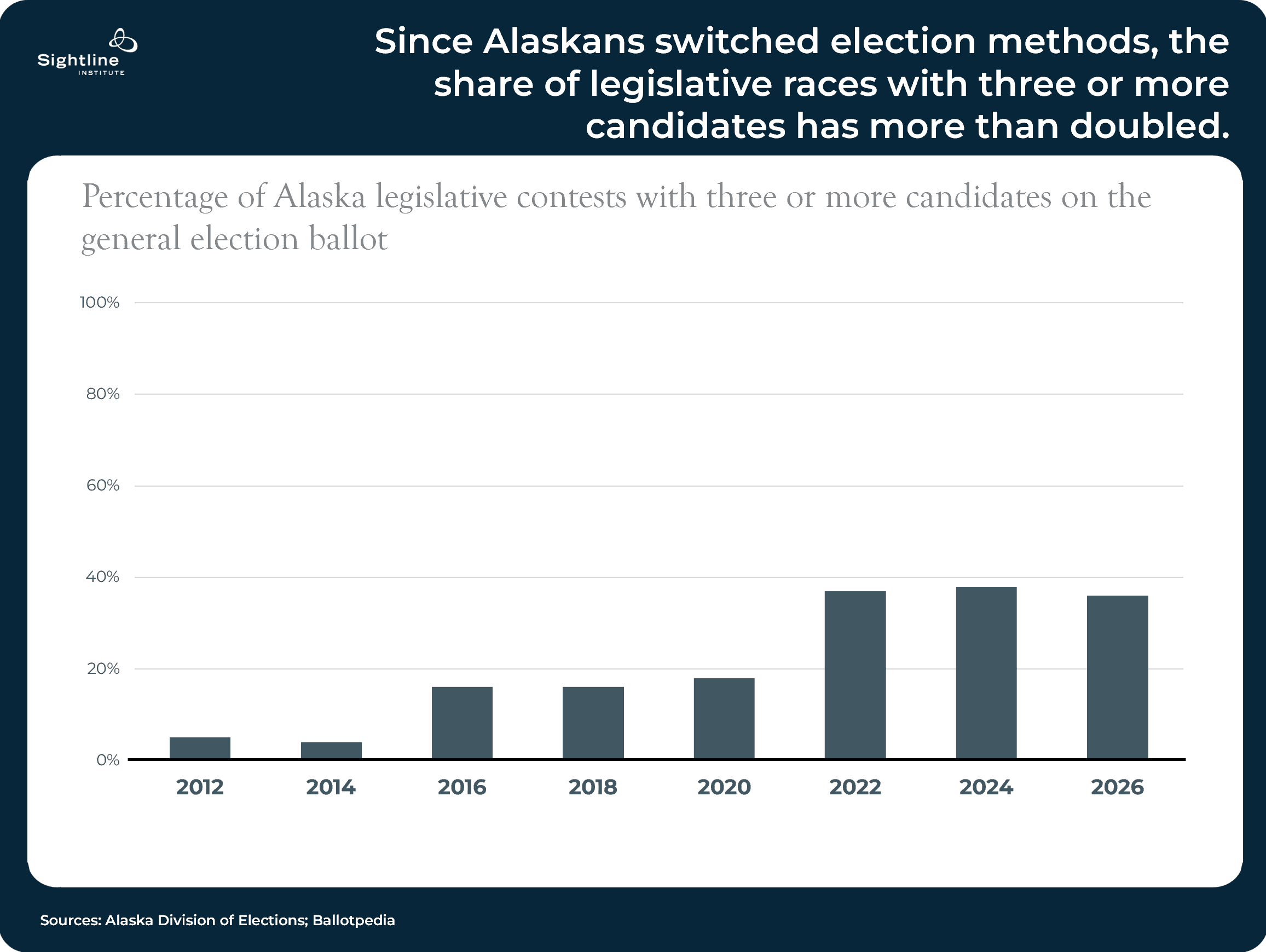
The old system created much narrower paths to victory. Democrats and Republicans nominated at most one candidate each per race, and split-vote contests plagued Alaska politics.
In contrast, Democrats and Republicans now double, triple, or even quadruple up in places where voters heavily prefer one party over the other. And likely due at least in part to new rules and new campaign dynamics, nonpartisan or unaffiliated candidates have had more success winning seats in the state legislature than they had pre-reform.
More incumbent legislators are losing their seats
The easiest way to win a legislative seat is to already have it, but the Alaska model keeps incumbents on their toes.
There’s no question as to why incumbents tend to hold onto their positions; their record is public, voters know their names, and in most cases, they have already won at least one election. In the United States, about 95 percent of incumbent state legislators who ran for re-election won in 2024.
But while incumbents hold valuable institutional knowledge, their powerful status makes it difficult for newcomers and even new generations to break into governance. Alaskans have largely continued to retain experienced lawmakers, but they are cycling out incumbents more than they did prior to reform.
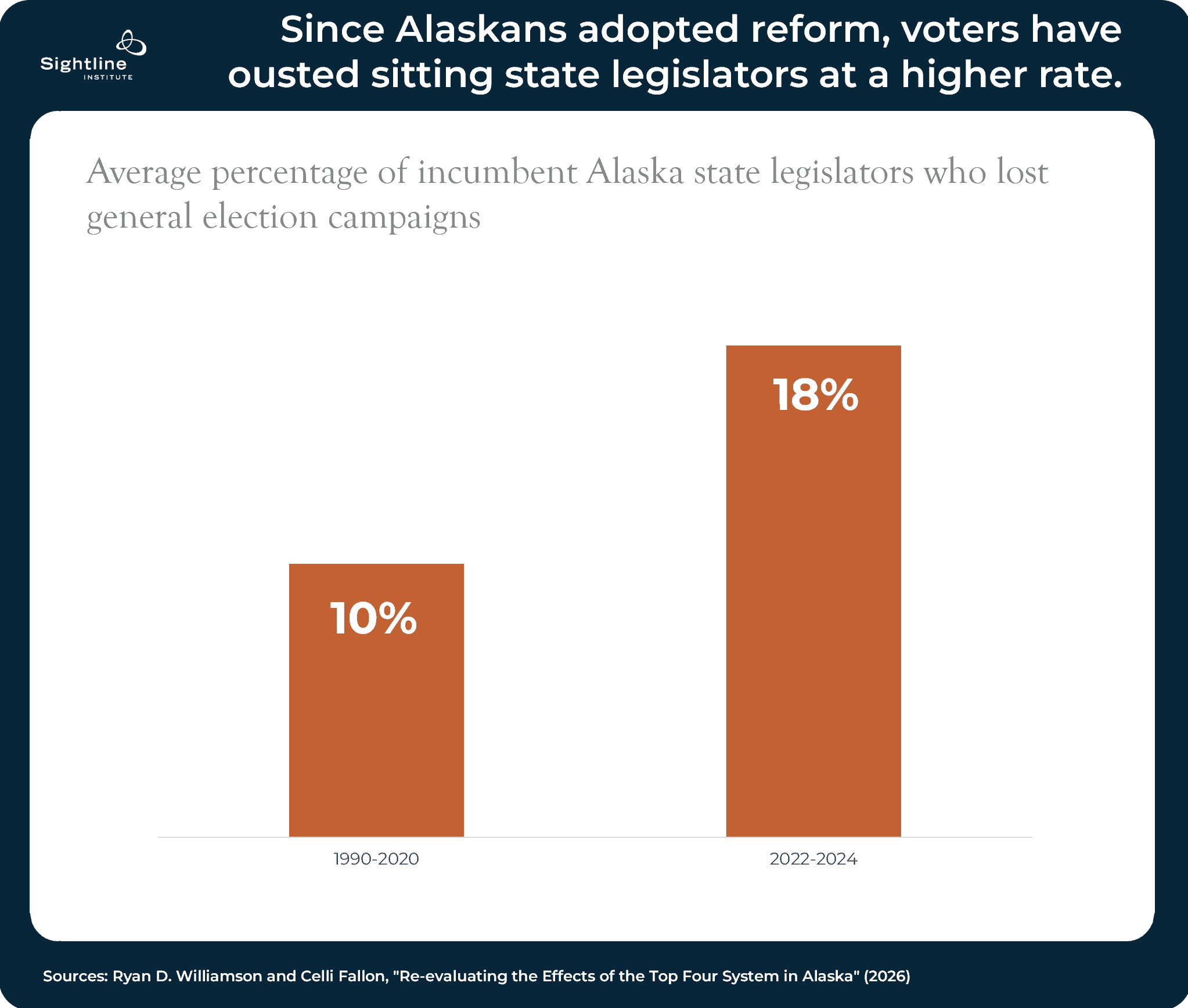
Researchers Ryan D. Williamson and Celli Fallon compared the average incumbent success rate for the two post-reform electoral cycles (2022 and 2024) with the 1990–2020 average in their 2026 study, “Re-evaluating the Effects of the Top Four System in Alaska.”4 They found that prior to reform, Alaska voters routinely cut an average of 10 percent of incumbent legislators loose every cycle. Since the advent of unified primaries and ranked choice voting, that number jumped to 18 percent.
Consider the 2022 election for State Senate District E in South Anchorage, in which Democratic voters banded together with moderate Republicans and elected former Alaska Senate President Cathy Giessel over the GOP hardliner who had unseated her in a partisan primary two years prior. Or consider deep red State Senate District N in Wasilla, where voters delivered conservative Robert Yundt an outright majority in a three-way Republican contest over a more moderate incumbent in 2024. In both cases, the whole voting public got to choose their favorite flavor of Republican, ousting an incumbent for someone from the same party who they felt was a better match. That opportunity was exceedingly rare in the pre-reform days.5
The 2026 election might be similarly competitive
Some 50 Alaska state legislative contests are on the 2026 general election ballot; 18 of them feature three or more candidates. Voters in right-leaning State Senate Districts C, E, and M have three Republicans to choose from. And of the 36 incumbents running for re-election, 32 will face at least one challenger in the general election. In other words, conditions look right for another competitive cycle.
Thus far, top-four primaries and ranked choice general elections have coincided with more close contests, more choices, and more incumbent turnover in Alaska—promising signs that voters are using an expanded toolset at the ballot box to keep candidates on their toes. If the model continues to deliver on its promises, voters suffering from uncompetitive elections elsewhere may turn to the Alaska for a remedy.

