


Takeaways
- Oregon approved new housing production rules and a statewide model zoning code, the first in the United States.
- The rules require larger cities to allow more low-rise apartment and condo buildings, especially if they’ve been underperforming peers on meeting housing need.
- The model code includes big new incentives for accessible and/or affordable homes. Cities can design their own versions.
Find audio versions of Sightline articles on any of your favorite podcast platforms, including Spotify, YouTube, and Apple.
UPDATE, Dec. 4, 2025: The proposed rules were unanimously approved. This article was edited to reflect minor amendments and describe the rules as approved.
Two-and-a-half years after a bipartisan bill promised “transformational” changes to Oregon’s housing policy, Gov. Tina Kotek’s administration has completed the blueprint of that transformation.
As approved by a state commission on Thursday, the new housing production rules make Oregon the first US state or Canadian province to create a model statewide zoning code and then apply that statewide code to cities underperforming their peers.
Most notably, the state zoning code would much more broadly legalize three- to four-story apartment buildings, especially on smaller parcels in neighborhoods already served by roads and pipes. The system will steer all of Oregon’s 58 largest cities, plus those in tourism-heavy Tillamook County, to gradually make their local zoning codes no more restrictive than the state’s. But the state standards will essentially become mandatory for cities flagged by the state for permitting fewer total homes, and/or fewer affordable homes, relative to their economic and/or geographic peer cities.
Because Oregon has now pre-defined many of the zoning standards it will impose on underperforming cities, various cities may opt to meet those standards sooner as part of their local efforts to accelerate housing production.
A ‘next step in the evolution’ of state housing laws
Known as the “Oregon Housing Needs Analysis,” these new rules to accelerate home construction were ordered up by a series of laws in 2019 and 2023, inspired by a similar system in California. And in crafting the OHNA rules, Oregon’s state land-use and housing agencies have been aiming to avoid some of the California’s model’s perceived pitfalls while creating a system that Oregon’s many small, cash-strapped cities can readily use.
Chris Elmendorf, a law professor at the University of California, Davis, who specializes in state-level zoning and housing statutes, tracked OHNA’s administrative rules as they were being written. In an interview Monday, he called them “the next step in the evolution” of laws known as “builder’s remedies.” Such laws use state power to remove local housing barriers when a city has a local housing shortage.
Oregon’s new rules follow a national trend toward pre-defining a set of state zoning standards. Oregon pre-defines them more specifically than other states have so far.
“Because the rules are known, people can make reasonable decisions about how to plan these projects,” Elmendorf said.
Another unique thing about Oregon’s approach: It evaluates cities based on actual homebuiliding performance relative to similar jurisdictions.
Oregon, Elmendorf said, is “not saying you’re subject to this remedial requirement because you didn’t write a really pretty plan. You’re subject to it because of outcomes. That’s conceptually a big step forward.”
“The OHNA program is the most significant update to Oregon’s housing rules since Oregon created its land use goals in 1974,” said Mary Kyle McCurdy, associate director of the advocacy group 1000 Friends of Oregon. “The potential of OHNA is to actually live up to the promise of Goal 10, ‘housing,’ which is housing for all in every community, at the price point folks need, at the location they need, and the type of housing they need.”
Among the things OHNA and the associated model zoning code do:
1. Shift toward regulating the size of new buildings, not the number of homes inside them
In Oregon today, the most common way to ban apartments from apartment zones is by limiting the number of homes a building can include.
Take Tualatin, in Portland’s southwest suburbs. The city has designated 18 acres near Hedges Creek for “high density apartment or condominium towers.”
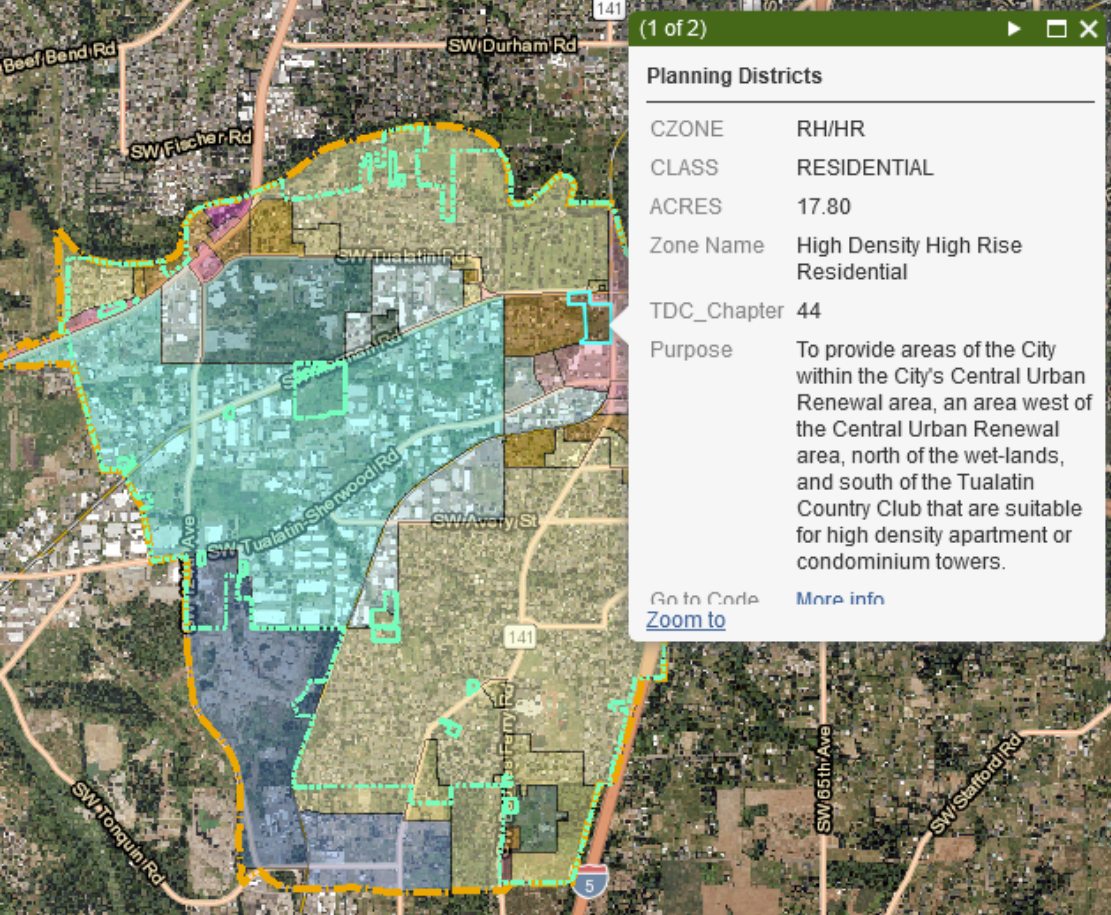
But look in Tualatin’s actual code for that zone, and you’ll see that although a building on a 10,000-square-foot lot in this area is allowed up to six or seven stories, it could only have a maximum of two homes on it. A lot twice that size can host, at most, ten homes.
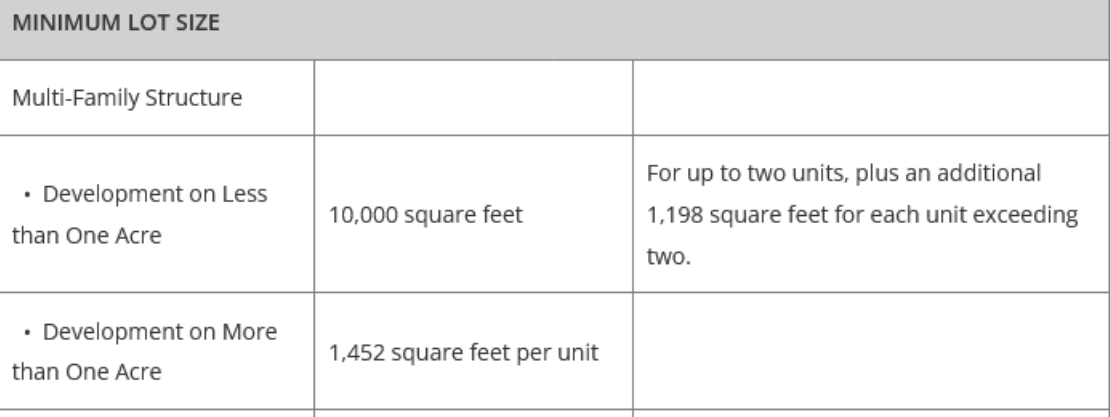
In other words, Tualatin created a “high-rise” zone in name only.
This zone doesn’t fit into Oregon’s new model zoning code. The state code doesn’t limit the number of homes on site. Instead, it uses a building’s height (40 feet, or about three to four stories, for a basic project), building footprint (up to 85 percent of a lot), and ratio of the building’s floor area to the lot’s size (which varies with lot size but is designed to consistently allow three to four stories). This allows some buildings to focus more on small homes for smaller households and other buildings on fewer homes for larger households, depending on what a community may need most.
Tualatin is an extreme case, but it’s far from alone. In Roseburg, the highest-density residential zone allows just 12 homes on a 10,000-square-foot lot. In Grants Pass, the number is 11. In Springfield, 9. In Klamath Falls, Happy Valley, and Pendleton, 8. In Medford, 7. In Newberg, 6. In McMinnville, Hermiston, and Sherwood, 5. In West Linn, Woodburn, and Ashland, 4.
Cities subject to the state standards could still cap the number of homes on a site if they wanted to, but if they did, the caps would need to be much less restrictive than any of these. They can no longer be de facto bans on the type of multifamily building allowed by the state’s model code.
By the same token, cities can opt to make their local codes less restrictive than the state’s, for example by continuing to allow six or seven stories.
2. Let apartment and condo buildings be built in more places
For another case of homes being quietly illegal in Oregon today, head up the Willamette River to Albany, the site of a recent uproar over a new greenfield subdivision.
It’s worth wondering why the homes in that subdivision weren’t instead proposed to be added to the “mixed-use village center” designated in blue, green and orange just east of downtown, between the river and the railroad tracks:
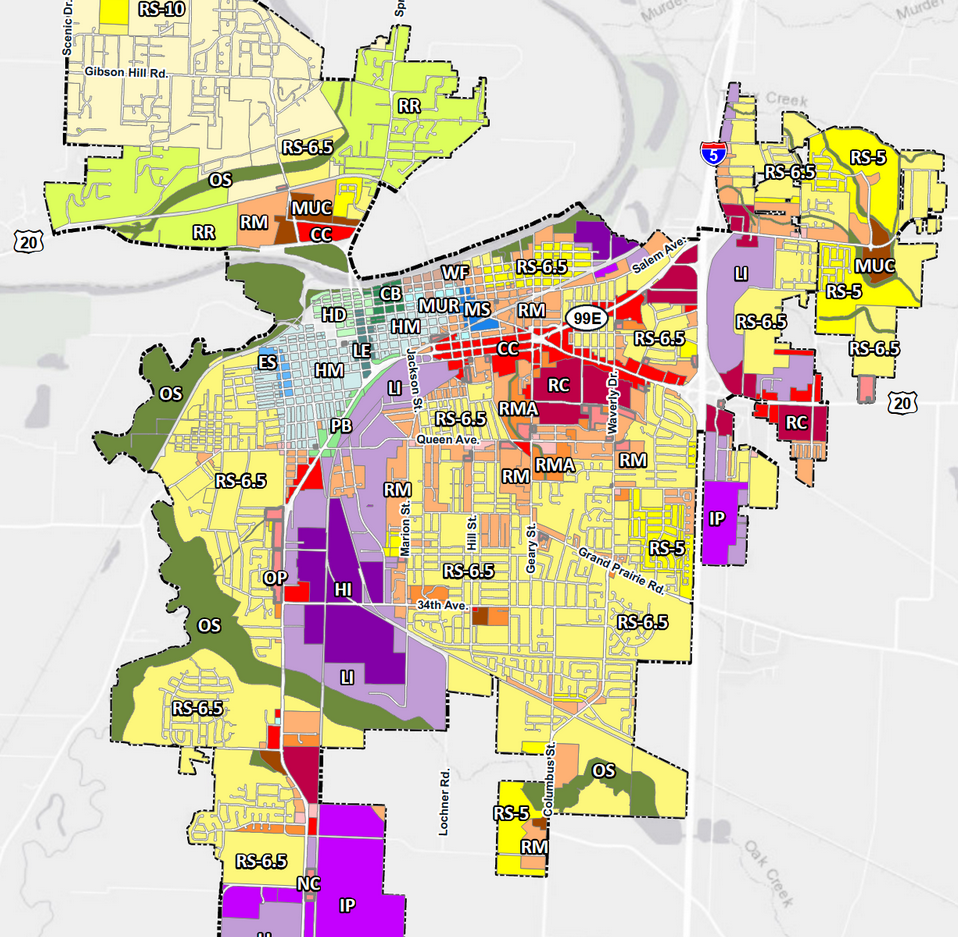
…until you look at Albany’s code for its waterfront district (intended to be “a vibrant center characterized by a variety of housing choices and a mixture of housing, office, and retail uses”), its mixed-use residential zone (“a residential district that allows a mixture of neighborhood commercial uses”), or its Main Street district (“an employment center with supporting commercial and retail services for residents and employees”). In all those zones, no more than six homes are allowed per 10,000-square-foot lot.
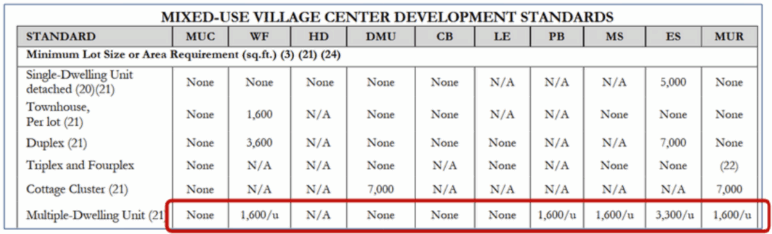
In Albany’s defense, its downtown zones (yet another category of mixed-use zone) do allow actual apartment buildings. But in this city of 57,000 people, such zones are currently confined to about 20 city blocks.
The OHNA rules set out to change this, at least in places where it’s calculated to be necessary. State economists assign each affected city a housing need target, using a formula that reflects regional population growth, proximity to future jobs, demand for vacation rentals, and (crucially) the need to catch up after decades of underproducing homes. Each city must then ensure that its land is zoned to accommodate such growth—and if an underperforming city wants to count multifamily land as “development-ready” for this purpose, then the zoning of that land must be no more restrictive than the state’s model. Even if a city is not underperforming, it can quickly fulfill this part of the state’s zoning requirements by bringing all “development-ready” multifamily land up to the model code standard.
In their formal commentary on the OHNA rules, staff for the state housing agency wrote that throughout all the affected cities, these requirements will “universally result in expansion of the amount of lands on which multi-unit housing is allowed.”
These neighborhood-scale apartment buildings were once legal to build anywhere in Oregon but were gradually banned from most urban land. Re-legalizing them doesn’t necessarily mean they will be built, but it gives more Oregonians the option to live in them if they want to.
3. Give builders incentives to include accessible homes

As of 2024, about 277,000 Oregonians have “difficulty” walking, according to the US Census Bureau. That includes about one in four Oregonians over 65—a population that is, each day, the largest it’s ever been.
Meanwhile, the state has no more than 3,000 wheelchair-ready apartments, known as “Type A,” with bigger bathrooms and lower countertops.1
Of course, many people with difficulty walking don’t rely on a mobility device. And many homes have been modified somewhat to accommodate wheelchairs, even if they weren’t originally built to be accessible. But there’s little dispute that many Oregonians would benefit from living in a more wheelchair-friendly home, and no dispute that the number has been growing.
With that in mind, Oregon’s model zoning code strongly rewards projects for including Type A features. If at least 10 percent of homes in a new apartment building (and also at least one more home than would otherwise be required) are Type A, the code allows the building to be one story taller. If that ratio is 20 percent, it’s two additional stories. (Not coincidentally, that fourth and/or fifth story would typically come with an elevator to serve the entire building.)
The model code incentivizes accessible homes in lower-density zones, too. If at least one home is Type A, a lot usually limited to two accessory dwelling units can have three; a lot limited to four homes, six. Buildings can be somewhat larger as well, and the courtyards required of “cottage clusters” can be smaller.
Again, cities aren’t outright required to apply these bonuses. But OHNA requires cities to show they’re doing what they can, and the use of a density bonus equivalent to the model is a sure-fire way to do so. And again, if cities underperform, incentives like these become mandatory.
Allen Hines, housing access director for the Oregon-based advocacy organization Community Vision and a supporter of the proposed OHNA rules, wrote in an email that all Oregonians benefit from re-legalizing more apartment and condo buildings with accessible homes in good locations.
“The ideal of neighborhoods where locals can get to everyday places like schools and grocery stores within 20 minutes promotes inclusion for people with disabilities and older adults—and everybody else,” he wrote.
4. Give a leg up to builders of affordable homes
Just as the model code rewards projects with some accessible homes, it lets apartment buildings add a floor if they offer a share of homes below a certain price for at least ten years. (Buildings offering both accessible and affordable homes can get both bonuses.)
If all homes in a project are below a certain price—with rents affordable to someone making 80 percent of their area’s median income, or sale prices affordable to someone making up to 120 percent of median income in the case of a limited, shared, or zero-equity co-op or community land trust—a building gets a whopping three additional stories, up to a maximum of seven.
“It’s going to make a huge difference in the scale of a community that you’re going to be able to build on a reasonably sized infill parcel,” said Garlynn Woodsong, chair of the Oregon Cooperative Housing Network. Creating affordable homes with a limited-equity co-op, he said, “allows you to do one-and-done subsidy” that buys down the initial price of land but keeps the structures in the hands of individual owners.
“We are in the process of inventing a new style of development,” Woodsong said, and OHNA “raises awareness of co-ops in Oregon in a way that’s never happened before.”
As with the accessibility bonuses, cities can use their own approaches, but if they underperform on affordable production then the state’s code becomes mandatory. Or they can simply check the state’s box in advance by adopting the model code or its geometric equivalent.
A long-term solution to a long-term problem

Three- to four-story multifamily buildings were legal to build anywhere during Oregon’s first 60 years of statehood. As recently as the 1970s, apartments and condos in buildings of five or more homes accounted for about half of new homes built in the state. But beginning in the 1920s and continuing for most of the next century, Oregon cities gradually banned these less expensive homes from more and more land.
Oregon wasn’t alone; more or less the same thing happened across the United States and Canada. But since Kotek became speaker of Oregon’s House of Representatives in 2013, the state has arguably led the nation in reversing the trend of using zoning to ban inexpensive homes.
The OHNA rules are a major follow-up to Oregon’s first-in-the-nation 2019 legalization of duplexes, townhouses, or cottages, so-called “missing middle” homes, on almost all residential land in these same cities. They will further loosen restrictions in lower-density zones, and they will apply a similar set of principles to legalizing low-rise apartment buildings in many more places.
OHNA will also broaden Oregon’s 2022 parking reforms within its metro areas, which have since ended parking mandates for more than half the state’s population. As OHNA applies the model code, it will reduce the number of mandatory parking spaces in larger cities outside large metro areas, like Astoria. And OHNA will work in tandem with a pair of 2025 laws that also shifted zoning powers to the state level.
Like those previous reforms, the OHNA rules won’t change local zoning immediately. For one thing, cities won’t be subject to all OHNA’s requirements until their next “housing production strategy” cycle, which is one to eight years away, depending on the city. And even then, cities will have an entire such cycle to complete the required zoning changes. If they fail to, it’ll be a few years longer still before the state can directly intervene and change the zoning itself.
Nor can any set of rules anticipate all the ways cities may try to defy, nullify, or drag their feet. Maintaining the system will probably require future laws and rules.
“The state, in monitoring local implementation, is going to have to be extra alert to taxes or fees or other things that directly affect the financial feasibility of the building,” said Elmendorf, the law professor. “There will always be some politics, and trying to get away from politics is hopeless in this case.”
But these rules, if fully implemented, make major upzoning more or less inevitable in Oregon cities. With the status quo off the table, it seems likely that some cities will choose to go well beyond the state’s minimum baseline. That’s exactly what happened after Oregon legalized fourplexes: every affected city ended up more pro-housing than the state’s minimum requirement in at least one way.
In 2022, during her successful campaign for governor, then-Rep. Kotek said that her great hope for housing policy in her state was that Oregon’s acute homelessness crisis might open a window for necessary, difficult, and long-term policy changes.
“I think right now I’ve never been more optimistic about the housing conversation,” Kotek told the crowd at the pro-housing YIMBYtown conference hosted in Portland that year by Sightline. “And also more cautious that we won’t get to long-term solutions. Right? People are going to be like, ‘I just want to have the tent off my sidewalk.’
“Well, that is a bigger conversation than about just a shelter. That is a conversation about supply; that is a conversation about housing options; that is a conversation about income and wealth inequality. I’m an optimistic sort. Right now, the timing is right to say ‘I have a solution that’s not just a short-term one but a long-term one.’”

