

Takeaways
- With 57 percent in favor as of last count, Seattle voters have renewed funding for the Democracy Voucher Program.
- Renewal means that people throughout the city can continue to give to campaigns, big-dollar donors won’t regain their sway in city politics, and candidates will have more reasons to reach out to city residents.
- Moving forward, the city will convene a stakeholder process to consider additional program improvements.
- Next city primary, Seattleites will benefit not only from democracy vouchers but also ranked choice voting.
Find audio versions of Sightline articles on any of your favorite podcast platforms, including Spotify, YouTube, and Apple.
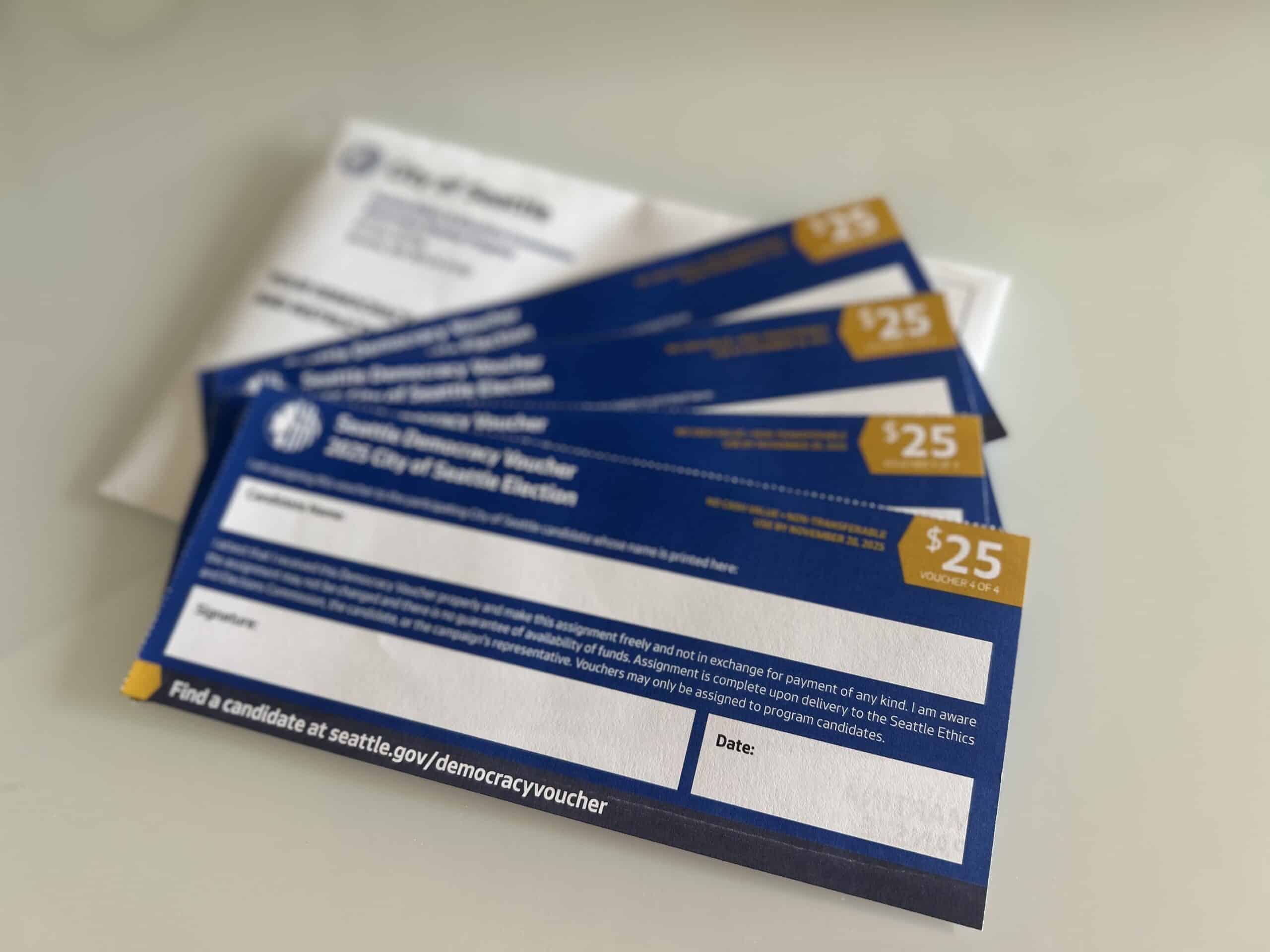
With 57 percent in favor of Proposition 1 (and 150,000 ballots in; last updated August 7, 2025), Seattle voters have reaffirmed their commitment to advancing a more democratic city government. Seattle’s iconic Democracy Voucher Program will have funding for another ten years.
This renewal means the city can continue to lead the way in the share of its population who contribute to city campaigns. Candidates will keep having more reasons to knock on doors rather than spend hours a day calling up the wealthiest people they know to fund their campaigns. And Seattle residents will get more choices in their elections and more power to express their views.
Along with helping to design the initial policy, Sightline has documented the impressive effects from the program’s first decade:
- The program has unlocked an “incredible explosion in participation” in campaign funding and empowered a much more representative group of people to become donors.
- It decreased large donations and elevated small ones, and it pushed away money coming from outside the city. For example, before the program was implemented, in the 2013 election cycle, gifts of $400 or more made up almost 60 percent of campaign dollars; in 2023, those large contributions plummeted to 9 percent of funds.
- The program even helped boost voter turnout, likely because of increased personal touches from candidates.
- While it couldn’t put a damper on dark money (no one can, thanks to US Supreme Court cases including Buckley v. Valeo, Citizen United v. FEC, and McCutcheon v. FEC), the program also didn’t cause a spike in those “independent expenditures”—PAC spending is up everywhere.
- Democracy vouchers have encouraged more diverse candidates to run and given them a pathway to win. Almost all viable candidates have participated in the program since it began, including people with viewpoints across Seattle’s political spectrum.
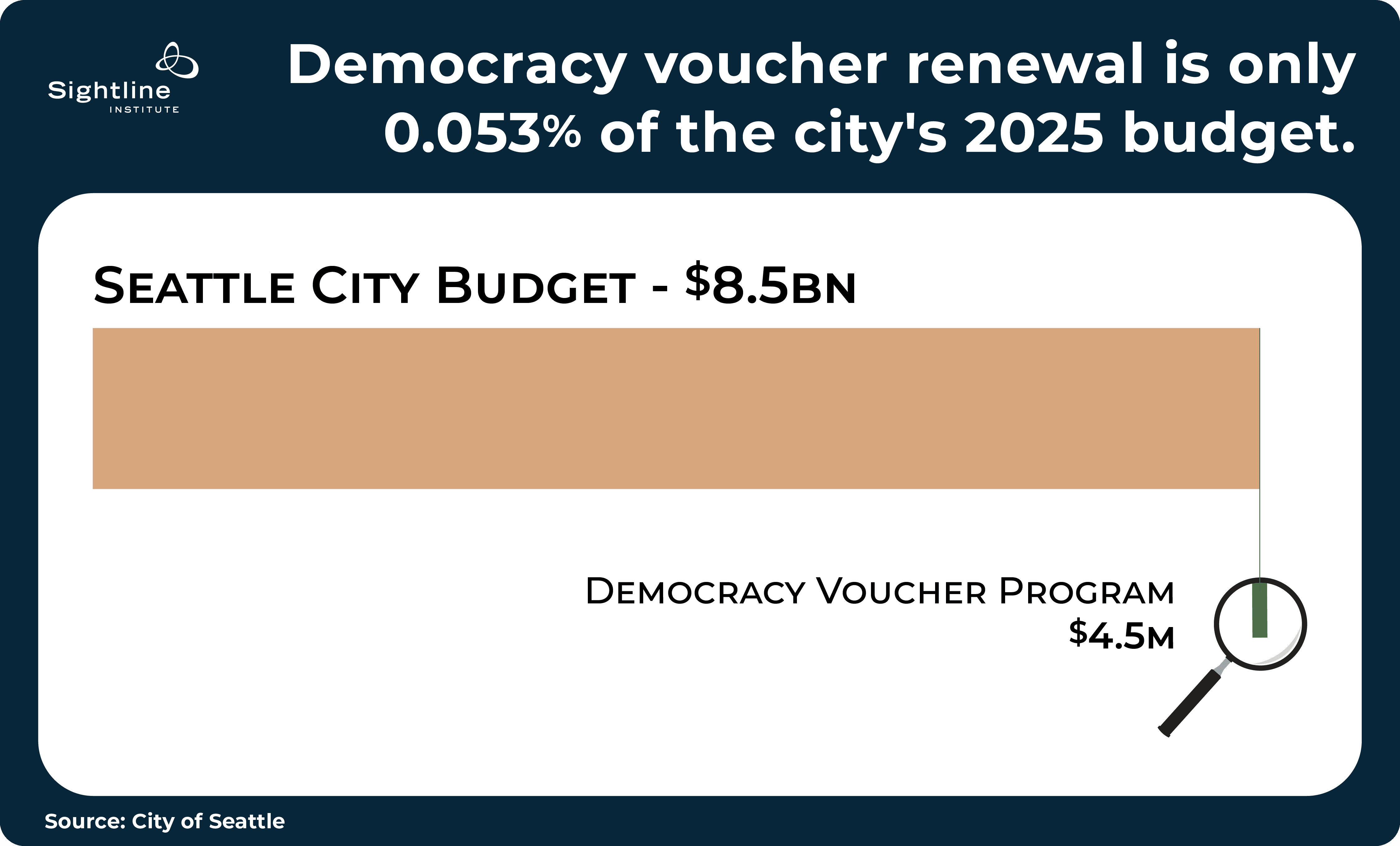
- The program has done all that with “budget dust,” a portion of the city budget you need a magnifying glass to see in a chart.
Tuesday’s vote shows Seattleites’ confidence in the program and belief in the importance of doing everything possible to make their government representative and accountable. City residents face many daily challenges—and the stronger and more democratic our governments, the better equipped they are to understand and respond to what’s happening in people’s lives.
What’s next: Program improvements and complementary reforms
One component of the measure that passed is a directive for the mayor, city council, and the Seattle Ethics and Elections Commission (the SEEC, the entity that manages the program) to convene a workgroup to explore potential improvements to the program. While the SEEC has already tweaked some elements based on ongoing feedback, the workgroup will offer a more defined process for additional recommendations, considering input from candidates, campaign staff, consultants, advocates, and the SEEC.
Commentators have already pointed to spending caps for possible modification, particularly given the large number of PAC funds that enter city races. Others have suggested shifting the timing of voucher mailings, improving outreach, and allowing candidates into apartment buildings to meet voters. Some might look beyond the program to other ideas for making political donors more accountable, perhaps following Maine’s example (currently moving through the courts) to limit donations to super PACs.
Future city elections will get another boost toward fairer representation: Seattle will start using ranked choice voting in city primaries in 2027, the next local primary election. Ranked choice voting offers similar voter-centric benefits as democracy vouchers: candidates benefit from knocking on more doors and talking to more voters because they seek out second-choice votes as well as first choices; more diverse candidates tend to run and win, because voters don’t have to just pick the popular option while others get squeezed out; and voters get a more nuanced way to express their political choices. Combining the power of democracy vouchers and the freedom of ranked choice voting could make Seattle an even stronger model of democracy.
At a time when US democracy feels unstable to many, Seattle offers a bright spot of public government participation.

