


Takeaways
- Oregon’s legislature passed a bill that modernizes the state’s “inclusionary zoning” statute by giving Portland-area cities more flexibility in how they design affordability mandates for new buildings, but only if they offset those costs.
- Unfunded inclusionary zoning mandates block new homes until after prices rise, putting an invisible tax on tenants in older buildings. SB 1521 would ban this.
- A cross-ideological coalition supported the bipartisan bill through the supermajority-Democratic legislature.
Underfunded inclusionary zoning programs, which likely slowed housing production in the City of Portland from 2017 to 2024, are on track to be illegal in the Portland area.
A bill that cleared Oregon’s legislature on March 4 requires jurisdictions in the area to regularly self-evaluate these mandatory affordability programs, if they have them, and to keep them fully funded.
The legislation gained bipartisan support, passing the House 32–21, following a 21–6 vote in the state Senate in February.
“Senate Bill 1521 is the Oregon legislature’s attempt to ensure that any inclusionary zoning program cost-effectively empowers communities to build both market-rate and affordable homes,” wrote the bill’s lead champion, Sen. Khanh Pham (D-Portland).
So-called “inclusionary zoning” programs require a share of homes in all new buildings to be available below market rates. But when Portland imposed such a price control on new apartment buildings without fully offsetting the cost of those mandates, it contributed to a sharp drop in homebuilding, something that tends to drive up prices for every tenant and first-time homebuyer.
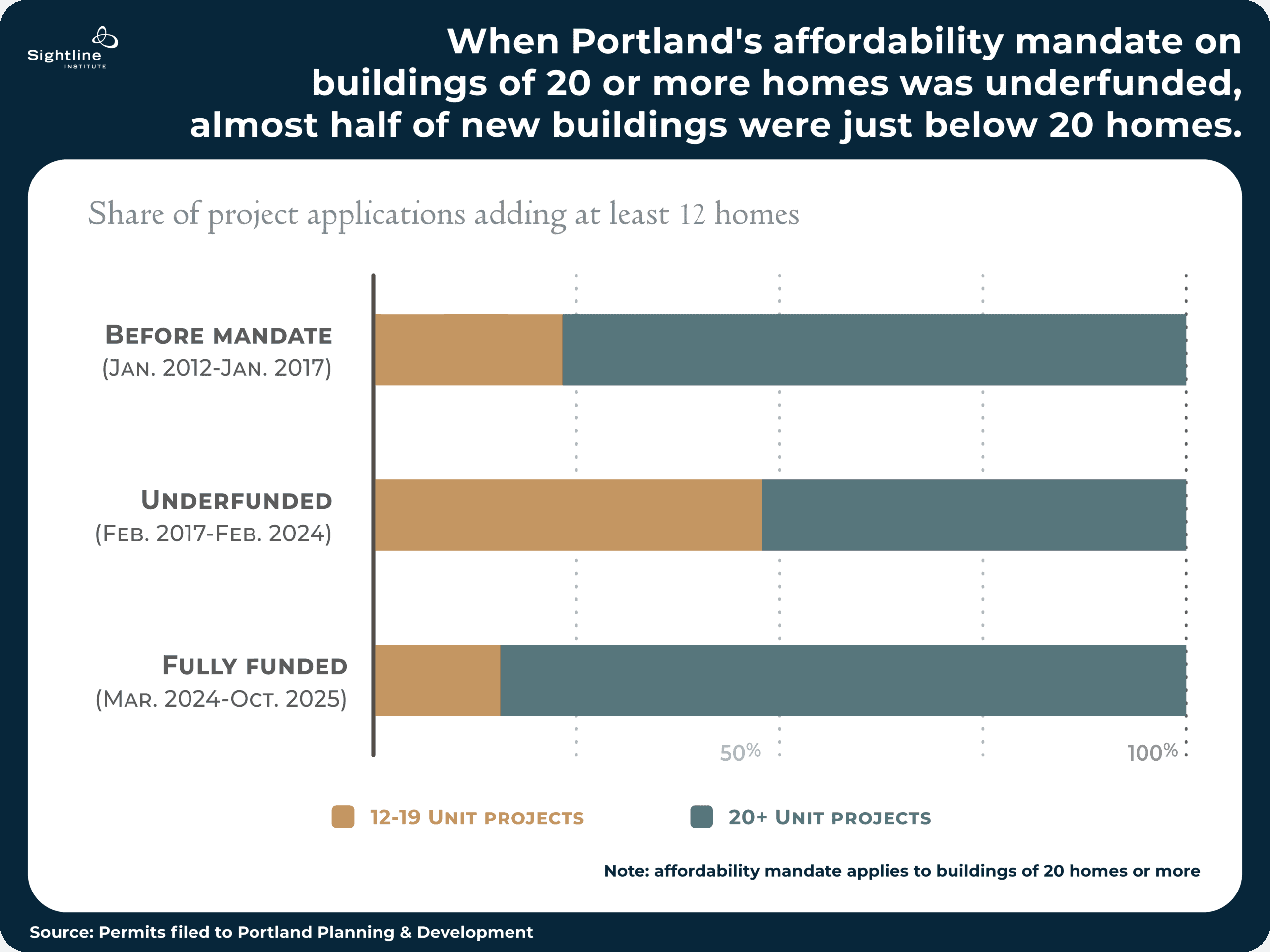
That led the state’s largest city to reverse course in 2024, using deeper property tax abatements to fully fund its program for rental buildings. Before that, the share of applications for small multifamily buildings had risen sharply, a sign that the program’s costs outweighed its benefits and that homebuilders were deliberately avoiding the program’s 20-unit threshold—or worse, avoiding building anything at all. Since the 2024 funding increase, that ratio has returned to normal, a sign that Portland’s program is no longer accidentally damping production of the projects it aims to encourage.
In Portland, the tax break for new buildings ends after the first ten years of a building’s life, sending those future taxes back into state and local budgets. The city’s 2023 economic study estimated the total cost of public incentives at about $230,000, a bit less than the average public subsidy for each similarly priced home in a 100 percent affordable apartment building.
“I’m grateful we passed a bill that learns from Portland’s experience with inclusionary zoning over the past decade,” wrote Pham, who chairs Oregon’s Senate housing committee. “I believe in inclusionary zoning as a mechanism to economically integrate neighborhoods, not as a tax on all new housing.”
New flexibility for cities with funded programs
The Oregon bill does not affect jurisdictions outside Multnomah, Washington, Clackamas, Columbia, and Yamhill counties; outside those areas, underfunded affordability mandates remain legal, though tightly constrained in their design.
Nor does it immediately affect any jurisdiction other than Portland, because so far only Portland has created a mandatory affordability program.
Even Portland is largely in compliance with the bill. It gives Portland until 2029 to bring its currently underfunded mandate on condo buildings into balance, and also provides an option for the city to qualify by waiving infrastructure fees specifically for mixed-income condo buildings.
In exchange for the funding requirement, the bill gives Portland-area jurisdictions more flexibility in program design. For example, a city can now set lower price targets for homes in new buildings, or a variety of price targets within a building. But the city must use some combination of tax breaks, fee breaks, or grants to keep the mandate’s costs and benefits, whatever they are, roughly in balance for the prototypical project.
“If you’re going to have an inclusionary zoning program, you should fund it,” said Portland City Councilor Mitch Green, a Democratic Socialists of America-affiliated member of the city’s housing and permitting committee. “Otherwise, you get perverse outcomes such as 19 units instead of 20. You get a lot of uncertainty. You get into kind of a production-cycle lag that we can’t really afford.”
“I think dollar for dollar, it’s probably one of the most cost-effective ways to subsidize housing,” Green added. “My bent is toward social housing, but I don’t know that that is mutually exclusive with that.”
Green was part of a cross-ideological array of groups that expressed support for the bill concept. To the left, supportive institutions had included Habitat for Humanity Portland Region; the community land trust Proud Ground; the Community Alliance of Tenants; and Housing Oregon, an umbrella group of affordable housing organizations. Real estate industry supporters included the apartment-developers lobby group Oregon Smart Growth; the Portland Metro Association of Realtors; and the Portland Metro Chamber.
Jamie Dunphy, president of the Portland city council, called it “the most bizarre coalition of supporters I’ve ever seen.”
A national trend toward funding mandates
Oregon’s Senate Bill 1521 resembles a provision in another bipartisan housing bill from the opposite corner of the country: Florida’s Live Local Act of 2023. That law, too, requires jurisdictions that impose local inclusionary zoning mandates to fully fund them, though unlike Oregon’s, it requires custom calculations for each individual project.
Aside from that similar approach, Oregon’s law blocking unfunded inclusionary zoning (while allowing a variety of funded versions) is the first of its kind in the United States.
However, the concept of funded inclusionary zoning seems to be growing in popularity. As my colleague Dan Bertolet reported in 2024, variations on the concept have been introduced in Baltimore; in Chicago; in New York City; in Shoreline, Kirkland, and Redmond, Washington; and in New Haven, Connecticut. Last year, funded inclusionary zoning was a key part of the formula for a Washington state bill that legalized apartments near transit.
Fully funded inclusionary zoning is also a major tool for affordable housing production in greater Paris, which has been held up as an international model for mixed-income housing production.
And funded inclusionary zoning has been working in Portland itself for years. Even before the city’s 2024 expansion of funding for the program, it had fully funded mixed-income rental projects in central Portland since 2017, protecting the viability of various mixed-income buildings that will soon be rolling into local tax rolls as planned. (They’re part of the reason Portland’s program wasn’t even more of a damper on construction from 2017 to 2024.)
“This bill strikes an important balance: a durable framework for getting more mixed-income housing on the market for Oregon families—and flexibility to keep projects feasible so our members can actually build them,” says Cassidy Bolger, Board President of Oregon Smart Growth. “It’s a win for Oregonians, it’s a win for housing producers, and it’s a win for the cities and towns we all love to call home.”
Related: Portland’s Inclusionary Zoning Program Is Finally Performing, New Data Suggests | Because for the first time, the city fully funded it.

